Formula details
Product Details
Overview
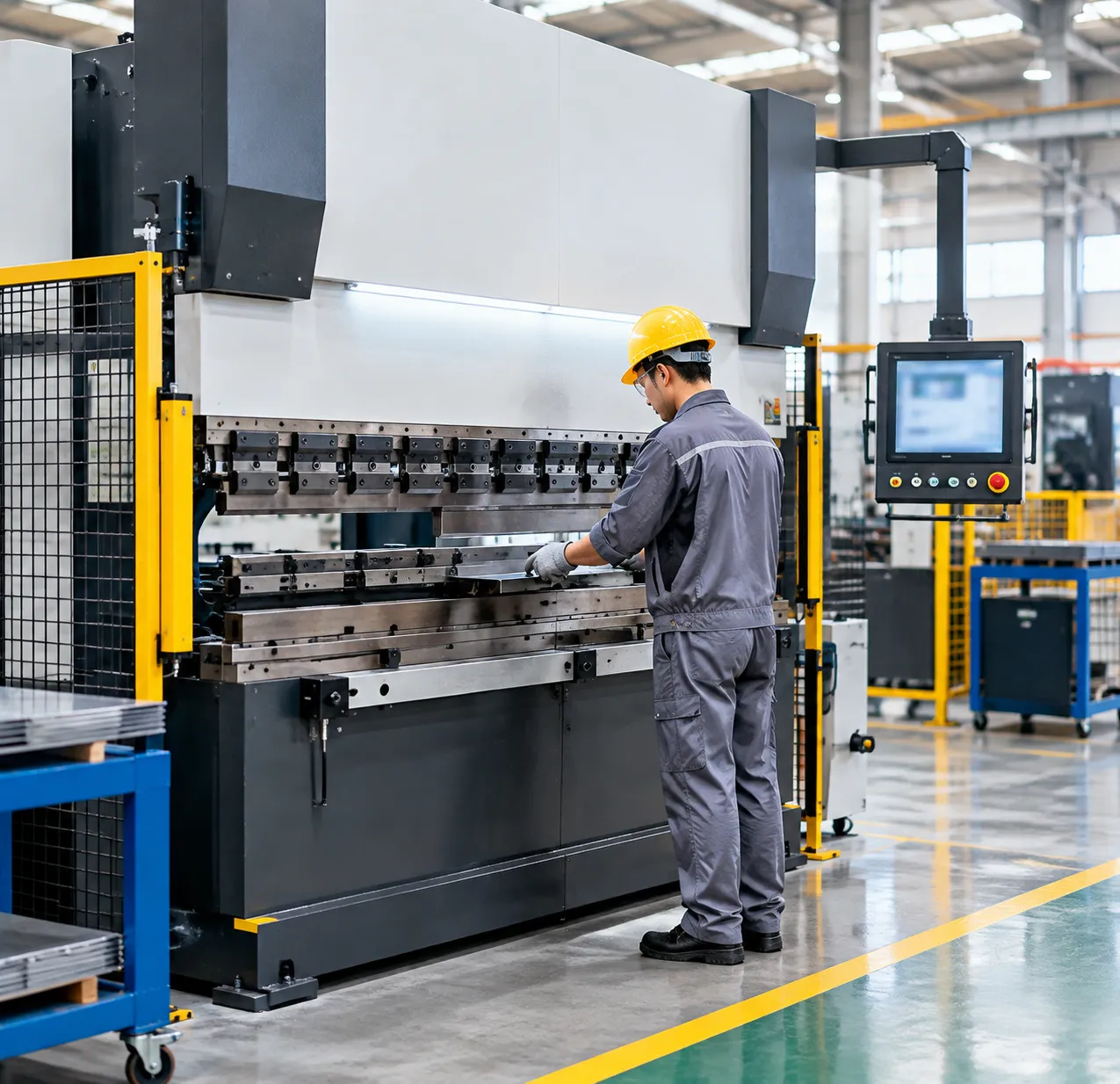
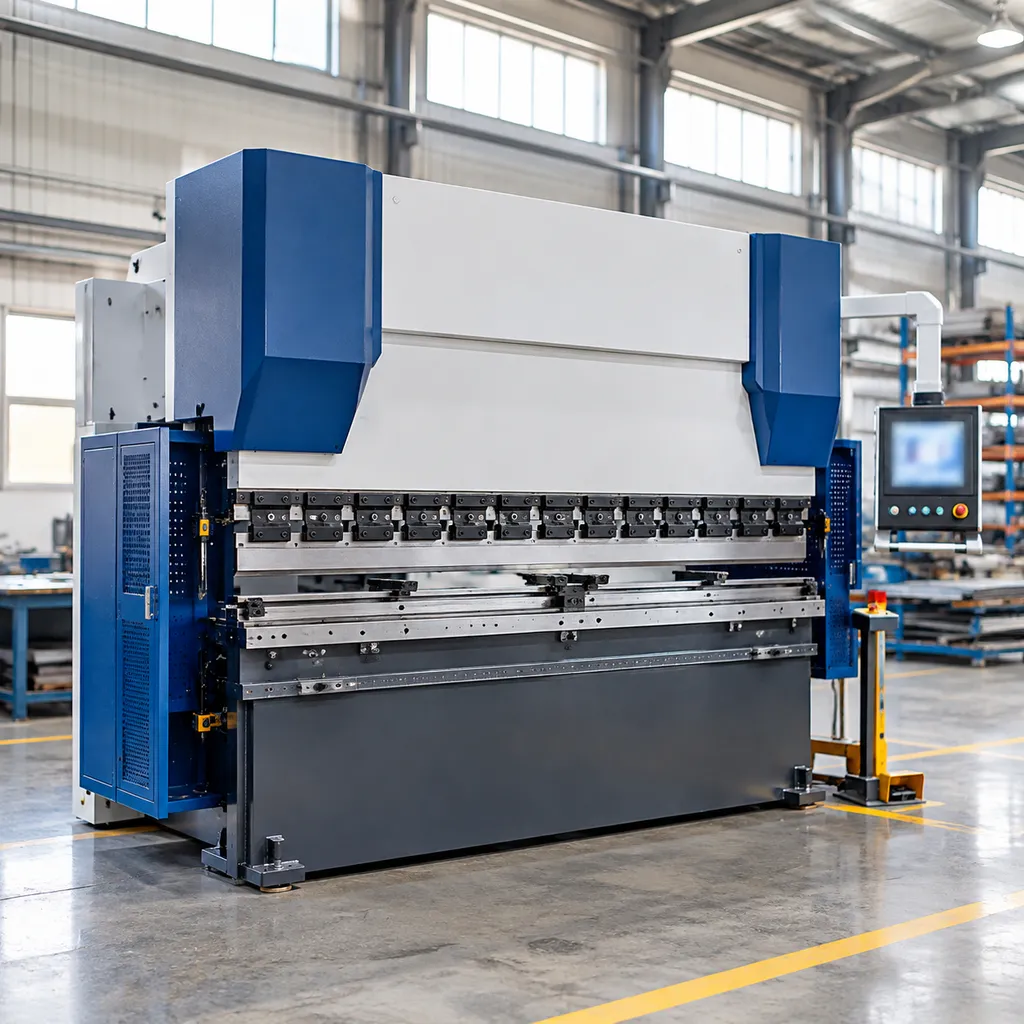
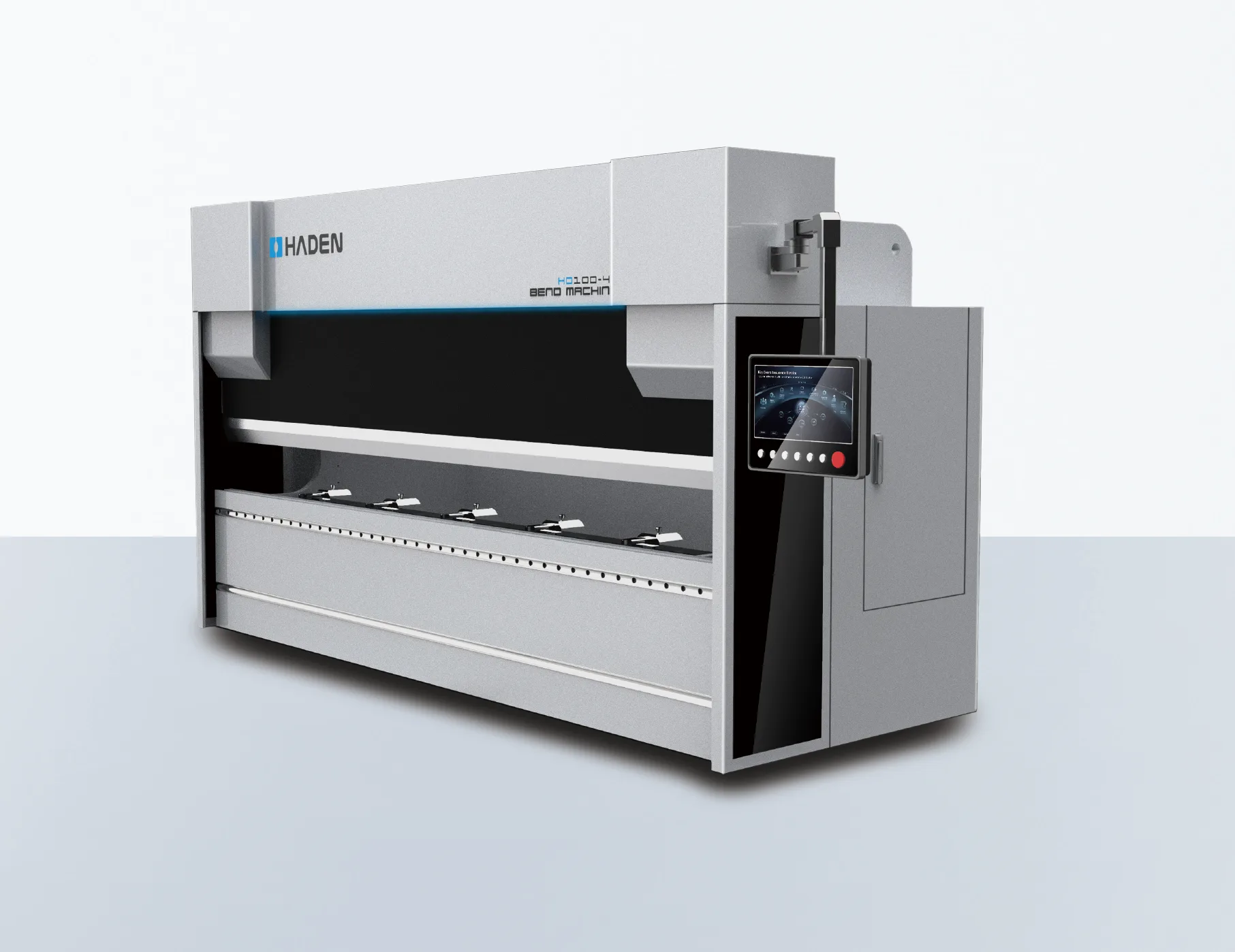
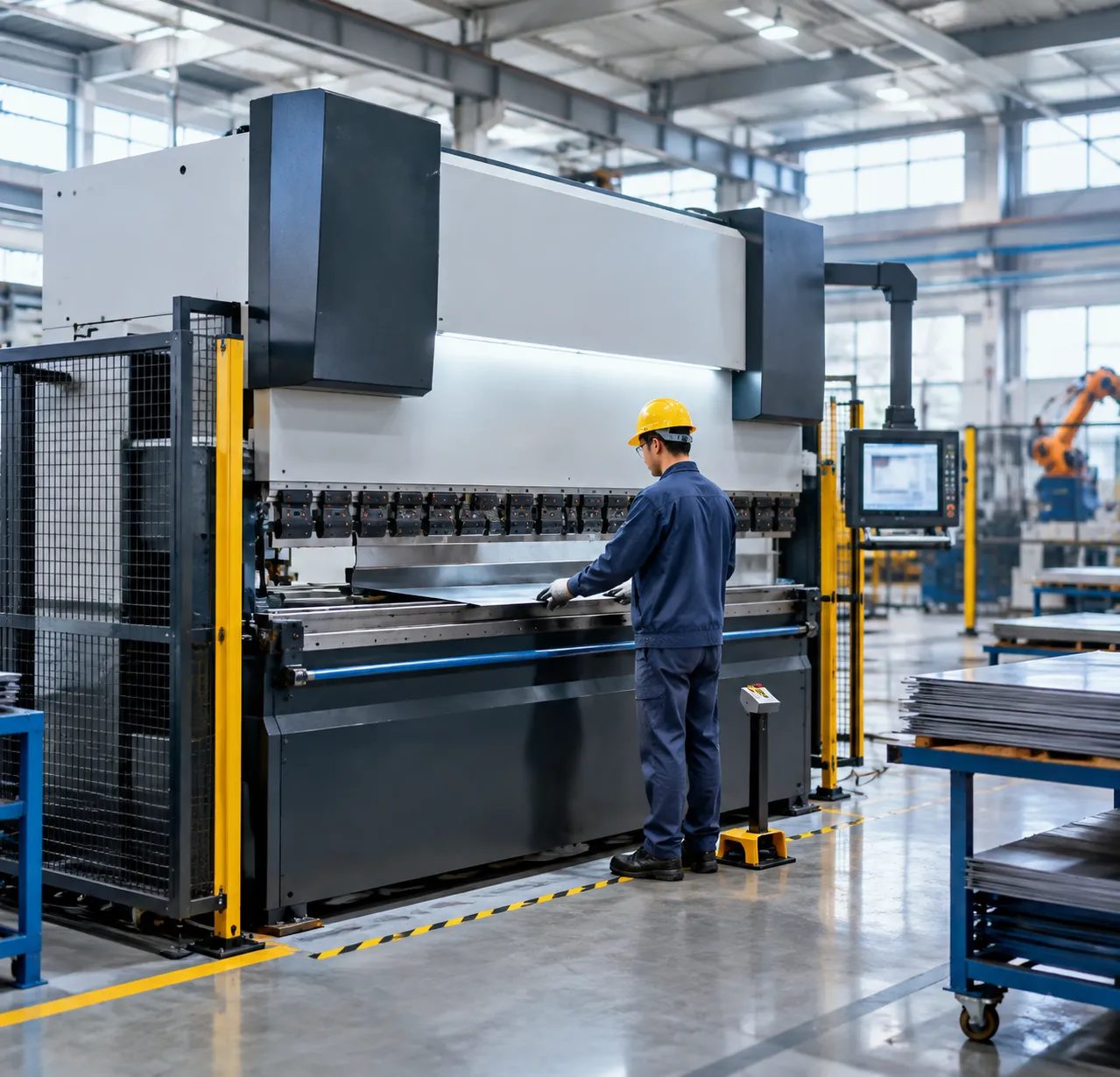
How Our 3-Axis CNC Press Brake Works
A modern 3 axis cnc press brake delivers precise sheet metal bends by orchestrating three primary axes: the Y1 and Y2 cylinders for vertical ram stroke, and the high-speed X-axis for backgauge depth.
Dual Y1 and Y2 Electro-Hydraulic Cylinder Synchronization
Our 3-axis cnc press brake does away with outdated mechanical leveling links. We control the left (Y1) and right (Y2) hydraulic cylinders independently through proportional servo valves:
-
- Closed-Loop Regulation: Each cylinder constantly reads position commands directly from the CNC controller, making hundreds of micro-adjustments per second.
- Balanced Parallelism: The ram maintains dynamic parallel alignment across the entire bed length, even under full tonnage.
- Off-Center Loading: You can bend parts off-center without twisting the ram or blowing out hydraulic seals.
Optical Linear Encoder Feedback for Real-Time Deflection Control
Frame flex under high pressure is an inevitable reality on the shop floor. We neutralize its effect on bend angles by isolating measurement from the main side frames:
-
- Independent C-Frame Mounting: High-resolution optical linear glass scales mount directly to secondary sub-frames, reading the true gap between the bed and ram.
- Dynamic Deflection Compensation: The controller reads real-time elastic deformation during the pinch point, correcting cylinder depth instantly to maintain consistent ±0.01 mm ram repeatability.
- Uniform Flange Angles: Eliminates open angles at the center and over-bent edges along long workpieces.
High-Speed Servo-Driven X-Axis Backgauge Positioning
Part consistency depends entirely on the speed and stability of the backgauge stop fingers:
-
- Servo Drive Performance: Driven by an AC digital servo motor coupled to ground precision ball screws and dual linear guide rails.
- Fast Axis Travel: Reaches high traverse speeds up to 300 mm/s, slashing non-productive wait times between consecutive bend steps.
- Positioning Accuracy: Delivers reliable stop-finger precision within ±0.02 mm, ensuring tight flange tolerances across multi-bend sequences.
Upgrading from Conventional Torsion-Bar Brakes to Dynamic Synchro
Moving from an old mechanical torsion-bar bender to an electro-hydraulic synchro system solves everyday fabrication bottlenecks:
| Performance Factor | Conventional Torsion-Bar Brake | Our 3-Axis CNC Press Brake |
|---|---|---|
| Ram Synchronization | Mechanical hex shaft (prone to twist & wear) | Dual independent proportional valves (electronic synchro) |
| Ram Repeatability | Typically ±0.05 to ±0.10 mm | Tight ±0.01 mm via optical linear scale feedback |
| Angle Correction | Manual mechanical stop adjustments | Direct digital input at the controller screen |
| Off-Center Capability | Weak; risks mechanical binding and failure | Full dynamic leveling support for staged tooling setups |
| Scrap Rate | High test-bend scrap on new setups | Minimal test bends with fast, direct target angle inputs |
Heavy-Duty Frame and Core Mechanical Components
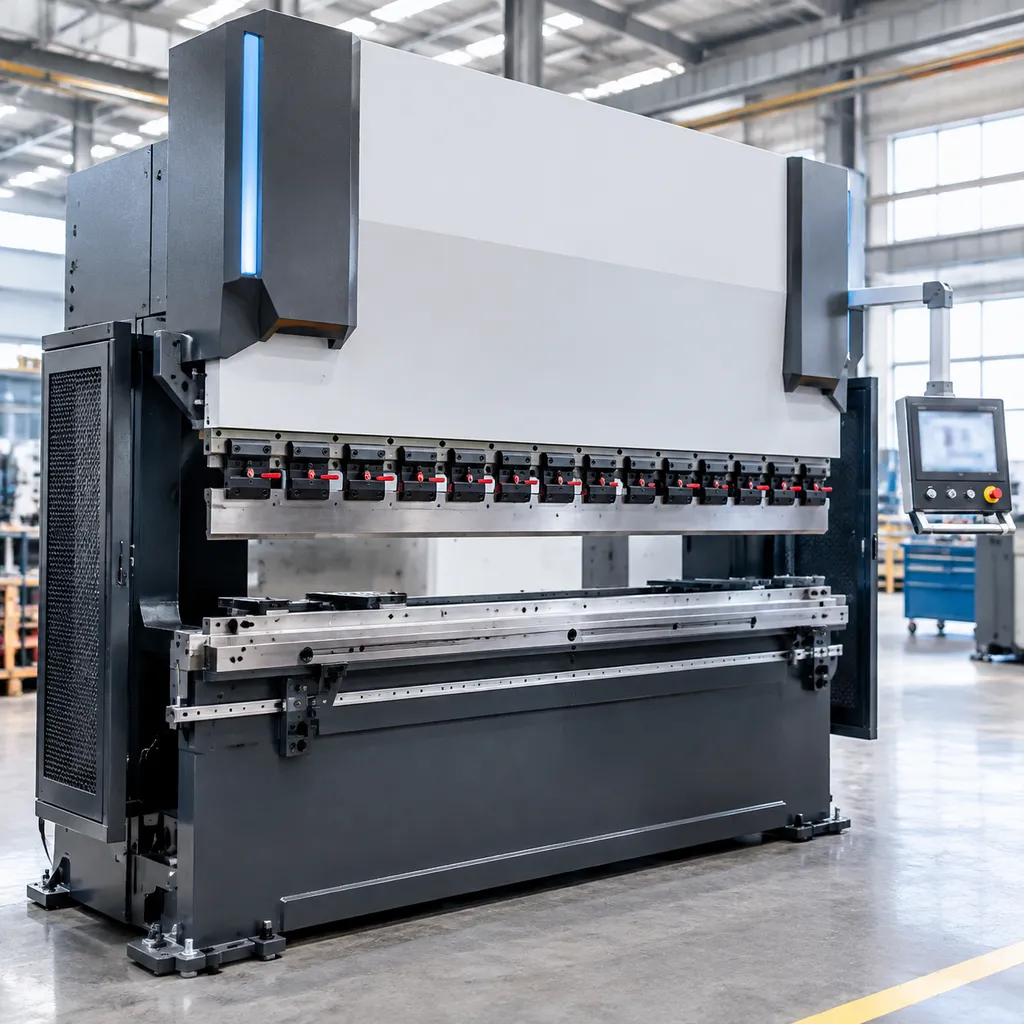
We build our 3 axis cnc press brake frame to withstand high-tonnage deflection, side loads, and long production shifts without drifting out of square. Every structural weldment undergoes finite element analysis (FEA) and full thermal stress relief annealing before machining. This guarantees a rigid monoblock bed and side frames that do not twist under peak hydraulic pressure.
Key Mechanical & Hydraulic Specifications
| Component | Standard Configuration | Operational Benefit |
|---|---|---|
| Monoblock Frame | FEA-optimized welded structural steel, stress-relieved | Eliminates frame distortion under full forming tonnage |
| Hydraulic Valves | German Bosch Rexroth / Hoerbiger manifold blocks | Instant, leak-free proportional valve response for Y1/Y2 |
| Position Encoders | Sub-frame mounted optical linear glass scales | Real-time ram depth tracking isolated from side-frame stretch |
| Backgauge Drives | Precision ball screws & dual linear guide rails | High-speed, backlash-free positioning on the X-axis |
FEA-Optimized Monoblock Structure
The main chassis uses heavy-gage rolled steel plates, line-bored in a single setup on CNC floor-type milling centers. This engineering prevents parallel misalignment between the cylinders, the bed, and the upper ram. Whether running routine sheet work or pushing upper tonnage limits on thick plate, the machine maintains bed-to-ram parallel stability over decades of cycling. For operations handling extreme sheet thickness, the same stress-relieved architecture supports our heavy-duty platforms, including our 400-ton press brake for heavy-duty metal forming.
Hydraulic Valve Manifolds & Depth Tracking
-
- German Bosch Rexroth and Hoerbiger Hydraulics: We mount these proportional valves directly above the hydraulic cylinders to minimize piping run lengths. This reduces oil temperature spikes, shortens pressure buildup delays, and gives our 3-axis cnc press brake sub-millimeter ram reversal control.
- C-Frame Sub-Frame Mounted Linear Scales: Rather than bolting optical linear scales directly to the main load-bearing side frames, we isolate them on independent C-frames. When the main chassis flexes slightly under maximum bending pressure, the encoders measure only true tool penetration into the die, ensuring direct angle accuracy regardless of plate thickness variations.
- Dual Linear Guides for Backgauge Stability: The X-axis backgauge rides on dual hardened linear guide rails driven by ground ball screws and digital AC servos. This rigid drive prevents gauge finger bounce, deflection, or skewing when operators push heavy sheet blanks firmly against the stops.
Delem Touch Screen CNC Controller Features
Intuitive Color Touch Screen Interface
The Delem CNC controller system streamlines daily operation with a clear, color touch panel designed for harsh shop environments. Operators switch between part programming, tool setup, and live execution with a single touch.
-
- Graphical part design: Draw parts directly on screen or load bend sequences via USB.
- Direct angle input: Enter target degrees and flange dimensions instead of calculating ram travel.
- Clear 2D visual aids: Real-time visual feedback prompts the operator through every flip, rotation, and bend step.
Automated Bend Calculations and Sequence Planning
Our 3-axis cnc press brake uses integrated intelligence to prevent scrap before the ram moves. Once you enter material type, sheet thickness, and target bend angle, the controller takes over the math:
| Function | CNC Automation Feature | Practical Shop Benefit |
|---|---|---|
| Bend Sequence | Auto-determines the most efficient bend order | Prevents part collisions with the bed or punch |
| Tonnage Calculation | Auto-calculates required bending force | Protects tooling from over-tonnage damage |
| Backgauge Position | Auto-positions the X-axis for each step | Eliminates manual stop adjustments between hits |
| R-Axis Reference | Displays manual backgauge height presets | Speeds up height changes for deep flange clears |
Real-Time Tool Profiles and Material Compensation
Sheet metal properties vary between batches. The Delem DA-53T CNC controller stores comprehensive upper punch and lower die profiles to safeguard your tooling and maintain angle consistency.
-
- Springback compensation: Automatically adjusts Y1 and Y2 cylinder depth based on programmed material yield strength.
- Tooling library: Store full punch, multi-V die, and adapter dimensions to prevent clamp interference.
- Quick angle corrections: Enter measured angle deviations directly on the run screen, and the controller immediately recalculates depth offsets for subsequent bends.
Integrated Mechanical Crowning Settings
Consistent angles across long workpieces require precise deflection control. The CNC system integrates directly with our bed crowning mechanics. The controller calculates frame deflection based on sheet length and required tonnage, directing the crowning adjustment automatically. Operators achieve uniform, repeatable angles from the center of the bed all the way to the side frames without manual shimming.
3-Axis CNC Press Brake Technical Specifications
We build our standard 3-axis CNC press brake lineup to handle everyday metal bending tasks without wasted cycle time or complex mechanical setups. Across our range of CNC hydraulic press brakes, the dual Y1-Y2 electro-hydraulic cylinders and servo-driven X-axis provide reliable accuracy across varying sheet gauges and bend lengths.
Standard Model Specifications (40T to 400T)
The table below outlines our core baseline models, covering light sheet metal work to heavy plate bending:
| Model Spec | Nominal Force (Tonnage) | Working Table Length | Ram Stroke | Open Daylight | Throat Depth | Main Motor |
|---|---|---|---|---|---|---|
| 40T / 1600 | 400 kN | 1,600 mm | 150 mm | 380 mm | 250 mm | 5.5 kW |
| 80T / 2500 | 800 kN | 2,500 mm | 200 mm | 420 mm | 320 mm | 7.5 kW |
| 100T / 3200 | 1,000 kN | 3,200 mm | 200 mm | 450 mm | 350 mm | 7.5 kW |
| 160T / 3200 | 1,600 kN | 3,200 mm | 250 mm | 500 mm | 400 mm | 11.0 kW |
| 200T / 4000 | 2,000 kN | 4,000 mm | 250 mm | 520 mm | 400 mm | 15.0 kW |
| 300T / 4000 | 3,000 kN | 4,000 mm | 300 mm | 600 mm | 450 mm | 22.0 kW |
| 400T / 4000 | 4,000 kN | 4,000 mm | 320 mm | 650 mm | 500 mm | 30.0 kW |
Ram Velocity and Axis Dynamics
Cycle speed directly impacts shop productivity. Our electro-hydraulic synchro press brake systems deliver balanced ram cycles without hydraulic shocks during speed transitions:
-
- Approach Speed: 120 mm/s to 180 mm/s for fast positioning to the pinch point
- Pressing Speed: 8 mm/s to 12 mm/s for precise, uniform material deformation
- Return Speed: 100 mm/s to 150 mm/s for rapid cycle completion
- X-Axis Gauge Speed: Up to 350 mm/s driven by high-torque AC servo motors
- X-Axis Travel Range: Standard 500 mm to 800 mm with +/-0.03 mm positioning accuracy
Drive Power and Hydraulic System Capacities
Each 3 axis cnc press brake is engineered with balanced drive motors and high-efficiency gear pumps to eliminate heat build-up under continuous duty:
-
- Hydraulic Reservoir Volume: 180 L to 650 L depending on machine tonnage, fitted with sight-level gauges and fluid temperature sensors
- Operating Pressure: Maximum working pressure rated at 28 MPa to 31.5 MPa
- Hydraulic Valving: Independent proportional servo valves for Y1 and Y2 cylinder regulation
- Filtration System: High-pressure line filters with 10-micron return filtration to keep hydraulic oil clear of particulates
Tooling Packages and Workholding Systems for 3-Axis CNC Press Brakes
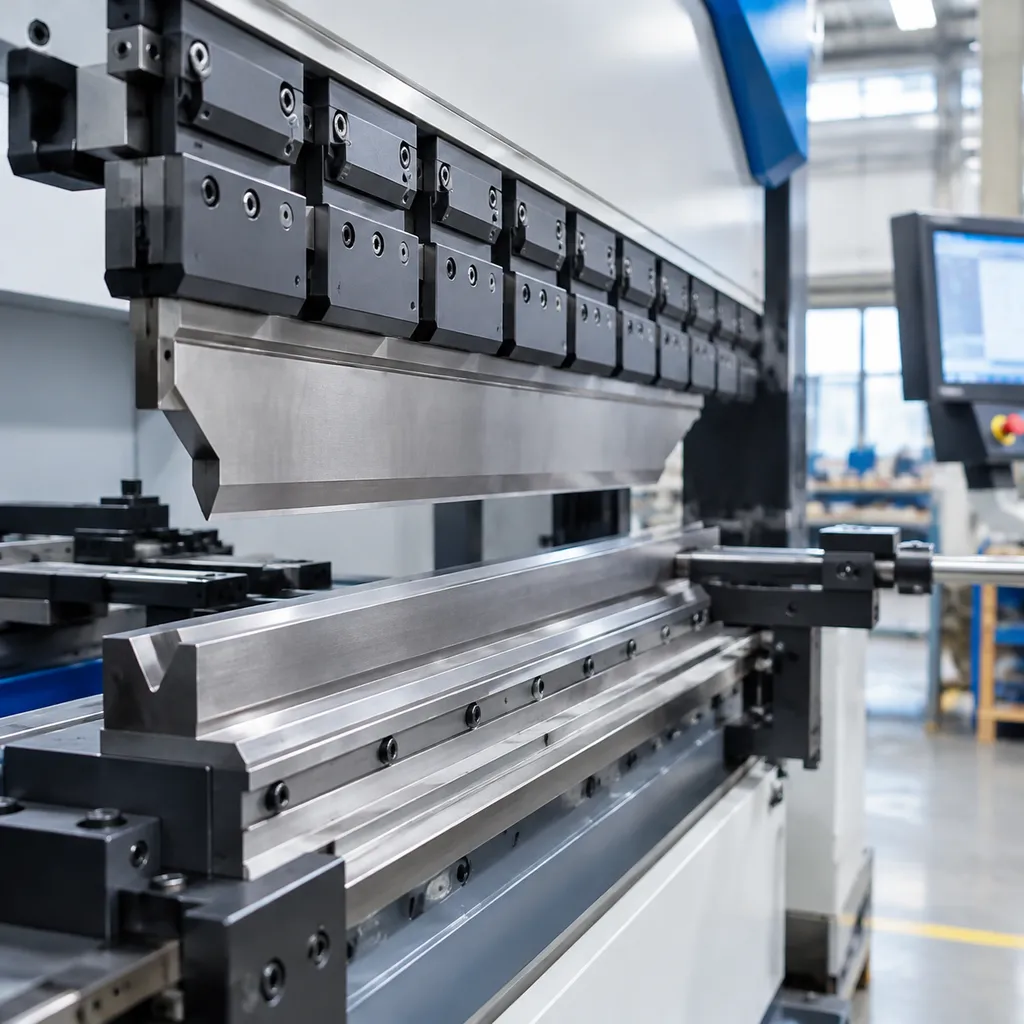
We match our machines with versatile workholding options so your operators spend less time swapping setups and more time running production. You can review our full range of sheet metal bending solutions to see how our standard and custom tool packages support demanding workshop schedules.
Hardened Segmented Punches and Multi-V Die Blocks
Our tooling packages are engineered to tackle diverse bend radii and material thicknesses without unnecessary tool changes.
-
- 42CrMo Alloy Steel Construction: Fully through-hardened and induction-treated to 56–60 HRC for long service life under continuous industrial tonnage.
- Precision Segmented Sections: Standard sectional punches (including horn segments for box bends) let operators assemble custom bending lengths in minutes.
- Self-Centering Multi-V Die Blocks: Solid block designs with standard V-openings provide fast setup adjustments across mild steel, stainless steel, and aluminum plates.
Mechanical Quick-Clamp Systems for Fast Tool Changes
Setup delays eat into daily output. To solve this, our 3-axis cnc press brake models come equipped with heavy-duty mechanical quick-clamp holders on the upper ram:
-
- Single-Lever Actuation: Locks and releases punch segments instantly without requiring individual set-screw adjustments.
- Vertical Tool Loading: Punches click in vertically from the front, preventing tool fallouts and eliminating the hassle of sliding tools in from the side frame.
- Automatic Alignment: Clamps seat and self-align the punch tang directly against the ram face under initial clamping force.
Adjustable Sliding Front Sheet Support Arms
Handling wide or heavy sheets without proper support leads to backgauge kick-up and operator fatigue. We mount our front support arms directly on heavy-duty linear guide rails spanning the length of the bed:
-
- Dual Linear Bearings: Ensure smooth side-to-side gliding along the entire bed length.
- Quick Vertical Adjustment: Operators can match the front arm height to varying bottom die heights using an integrated handwheel and scale.
- Flip Stops and Squaring Guides: Built-in side stops help operators align bulky sheets quickly before initiating the bend cycle.
Crown Compensation: Manual Mechanical Crowning vs. Motorized Table
Proper deflection compensation prevents canoe-shaped parts with open angles in the middle. Depending on your throughput requirements and budget, we configure our CNC press brake forming machine for precise metal bending with either manual or CNC-driven crowning tables:
| Feature | Manual Mechanical Crowning | Motorized CNC Crowning Table |
|---|---|---|
| Adjustment Method | External hand-crank with digital counter readout | Controller-driven motorized wedge system |
| Setup Speed | 15–30 seconds per thickness change | Instant and automated via bend program |
| Wedge Configuration | Dual opposing bi-directional alloy steel wedges | Multi-point synchronized dynamic mechanical wedges |
| Best Used For | Consistent batch jobs and standard thickness runs | High-mix production runs with frequent material changes |
| Maintenance Needs | Basic seasonal lubrication check | Minimal periodic grease maintenance |
Operator Safety Systems and Compliance Standards
Safety is non-negotiable on any production floor. When bending heavy parts or small components that have been prepared on high-precision sheet metal laser cutting machines, your operators need to work fast without putting their hands in harm's way. We configure every 3 axis cnc press brake with multi-layered, active and passive safety systems that meet rigorous international workplace safety standards without compromising bending productivity.
Dual-Beam Optical Laser Guarding for Point-of-Operation Protection
The primary point-of-operation hazard on any electro-hydraulic synchro press brake is the pinch point between the punch tip and the V-die. Our machines feature dynamic optical laser guarding mounted directly to the moving ram:
-
- Continuous Beam Tracking: Dual laser beams travel just beneath the punch tip, monitoring the exact zone where fingers could enter.
- Automatic Muting Transition: The system allows the ram to descend at maximum approach speed until it reaches the safe mute position (typically 2 mm to 6 mm above the sheet surface), shifting instantly to slow pressing speed.
- Instant Ram Braking: If an obstruction breaks the optical field during the fast-approach stage, the system dumps hydraulic pressure instantly, halting ram travel in milliseconds.
- Box and Flange Modes: Dedicated controller modes automatically blank out side beams to allow box bends and pre-formed side flanges to pass without triggering nuisance stops.
Interlocked Side Gates and Rear Safety Enclosures
Physical barriers protect secondary zones around the machine frame and the high-speed backgauge assembly:
-
- Side Safety Doors: Heavy-duty steel side gates block access to the bending zone from the sides. Electrical interlock switches automatically disengage machine movement if a gate swings open during operation.
- Rear Enclosure: The rear access area is fully enclosed with a mechanical safety fence or optical light curtain. This prevents shop personnel from entering the travel perimeter of the motorized X-axis backgauge and gauge fingers while active cycles run.
- Keyed Interlocks: Servicing and lubrication points behind the rear barrier require keyed access that automatically isolates backgauge drives.
Dual-Channel Emergency Stop Circuits and Hydraulic Pressure Monitors
To eliminate single-point mechanical or electrical failures, our 3-axis cnc press brake uses redundant hardware architecture across all control circuits:
| Safety Component | Specification / Standard | Operational Function |
|---|---|---|
| Safety Relay Logic | Dual-channel Category 4 / PLe certified | Monitors all emergency stops, optical lasers, and foot pedal circuits simultaneously. |
| Hydraulic Redundancy | Dual-monitored proportional valves | Redundant poppet and proportional valves prevent uncommanded ram descent under gravity. |
| Pressure Transducers | Real-time digital line monitors | Detects overpressure or sudden pressure drop; immediately triggers system dump to tank. |
| Emergency Stops | Twist-to-reset latching pushbuttons | Strategically located on the mobile foot pedal, main CNC swivel pendant, and main electrical panel. |
| Foot Pedal Enclosure | Heavy cast-iron housing with double switch | Three-position pedal (Release - Run - Emergency Press) stops ram motion instantly if pressed past the working point. |
Sheet Metal Applications and Material Capabilities
Our 3-axis CNC press brake lineup handles day-in, day-out forming demands across diverse commercial metals. Whether your shop processes thin aluminum trim or heavy structural plate, our electro-hydraulic synchronization maintains tight angular tolerances across every bend line.
Bending Mild Steel, Stainless Steel, and Aluminum
Different alloys react differently under the ram. We configure our tooling and stroke parameters to balance tensile strength, springback, and surface finish:
-
- Mild Steel (CRS/HRS): Delivers clean 90-degree and acute bends up to high tonnages with standard V-dies. Ideal for structural brackets, framing, and baseplates.
- Stainless Steel (304/316): Stronger springback and higher yield points require stiff frame stability. The dynamic Y1/Y2 positioning prevents angle variations over long production runs.
- Aluminum Alloys (5052/6061): Clean ram motion eliminates micro-cracking and material marking, providing sharp radii on architectural panels and light aircraft parts.
| Material Type | Typical Thickness Range | Common Tooling Profiles | Primary Shop Focus |
|---|---|---|---|
| Mild Steel | 0.8 mm – 12.0 mm | 85° / 88° Punches, Multi-V Dies | General fabrication, heavy brackets |
| Stainless Steel | 0.6 mm – 6.0 mm | Hardened acute punches, 30° dies | Food-grade & sanitary equipment |
| Aluminum | 1.0 mm – 8.0 mm | Large radius punches, urethane dies | Architectural trim, heat shields |
Fabricating Enclosures, HVAC Ducts, and Brackets
The precision backgauge and fast stroke cycles of our 3 axis cnc press brake excel at high-repetition industrial components:
-
- Electrical Enclosures & Cabinets: Flanging, return bending, and multi-sided box builds for industrial switchgear and custom electrical enclosures.
- Commercial HVAC & Ductwork: Smooth hems, large-panel transitions, and clean channel forming for ventilation systems.
- Structural Hardware: Gussets, mounting plates, and high-load supports formed without edge drift.
High-Mix Production for Job Shops and OEMs
Job shops survive on quick job switchovers. When running batches from 5 parts to 5,000, our hydraulic press brakes eliminate lengthy setup delays. Operators call up saved bend sequences, position the X-axis backgauge automatically, and start bending right on spec with zero wasted test blanks.
Cost and ROI: 3-Axis CNC Press Brake vs Other Bending Machines
Investing in shop equipment comes down to payback speed, daily operating costs, and eliminating part re-work. A 3-axis cnc press brake delivers the optimal sweet spot between low acquisition cost and production-grade precision.
Cutting Cycle Times and Scrap vs NC Torsion Bar Machines
Upgrading from an NC torsion bar machine changes your bottom line immediately. Conventional NC benders rely on manual trial bends, mechanical stop nuts, and high scrap rates on every changeover.
-
- Zero Test-Bend Scrap: Our electro-hydraulic synchro system calculates bend angles instantly via the controller, eliminating scrap sheet metal during run starts.
- 80% Faster Changeovers: Automatic backgauge positioning and programmed depth targets replace manual hand-wheel adjustments.
- Consistent Part Accuracy: Real-time scale feedback prevents angle deviation caused by oil temperature shifts or frame flex.
Understanding the NC vs CNC press brake key differences highlights how stepping up to a dynamic Y1-Y2-X configuration eliminates operator error and keeps your machines running rather than idling during setups.
Real Capital Savings Over 4-Axis and 6-Axis Setups
Many job shops pay 25% to 40% more for 4-axis or 6-axis configurations with motorized R-axes and independent Z-stops they rarely utilize. For 90% of structural brackets, standard chassis, electrical enclosures, and sheet metal panels, our 3 axis cnc press brake provides all the control you need at a fraction of the capital investment.
| Feature / Metric | Conventional NC Torsion Bar | Our 3-Axis CNC Press Brake | Complex 4-Axis / 6-Axis CNC |
|---|---|---|---|
| Initial Machine Cost | Low baseline | Moderate (High ROI) | High (+30% to +50%) |
| Controlled Axes | Ram limit + manual/NC stop | Y1, Y2, X (Dynamic Synchro) | Y1, Y2, X, R, Z1, Z2 (or crowning) |
| Typical Setup Duration | 15–25 minutes | 2–4 minutes | 2–5 minutes |
| Trial Bend Scrap | 2–4 parts per run | Zero scrap on standard gauges | Zero scrap on standard gauges |
| Maintenance Profile | Mechanical wear on linkage | Minimal (Simplified hydraulics) | Higher (Multi-servo backgauges) |
Faster Setup Reductions and Lower Maintenance Costs
A streamlined 3-axis cnc press brake limits shop overhead through sheer mechanical simplicity:
-
- Fewer Moving Components: With a single, heavy-duty servo-driven X-axis backgauge and independent hydraulic cylinders, there are fewer drive motors, belts, and electronics to service.
- Short Learning Curve: Operators program bends in seconds via intuitive touch screen interfaces without navigating unnecessary multi-axis clearance parameters.
- Fast Capital Payback: Reduced machine downtime, minimal tool changeover delays, and reliable first-bend accuracy yield full equipment payback in 8 to 14 months under standard single-shift production.
3-Axis CNC Press Brake FAQs
What is the difference between a 3-axis and a 4-axis CNC press brake?
The fundamental difference comes down to automated backgauge height adjustment or CNC crowning:
| Feature / Axis | 3-Axis CNC Press Brake | 4-Axis CNC Press Brake |
|---|---|---|
| Ram Synchronization | Y1 + Y2 (Independent electro-hydraulic) | Y1 + Y2 (Independent electro-hydraulic) |
| Backgauge Depth | X-axis (CNC servo-driven) | X-axis (CNC servo-driven) |
| Backgauge Height | Manual R-axis (Handwheel or pinned steps) | CNC R-axis (Servo-driven height) |
| Crowning Control | Manual mechanical wave wedge | CNC motorized dynamic crowning (V-axis) |
| Best Used For | Consistent flange heights, single-thickness runs | Complex stepped parts, multi-height bends |
A standard 3-axis CNC press brake controls the dual cylinders (Y1/Y2) and horizontal depth (X) under direct CNC command, giving you production-grade angle accuracy without the extra cost of motorized auxiliary axes.
How do we adjust backgauge height without a dedicated CNC R-axis?
When working with drop flanges or varied die heights on a 3-axis cnc press brake, you set the backgauge elevation manually:
Micro-Metric Handwheels: Smooth adjustment along heavy-duty vertical linear guides with quick mechanical digital readouts.
Multi-Tier Gauge Fingers: Finger stops feature tiered steps (e.g., 5mm, 10mm, 20mm steps) to catch workpieces at different flange elevations instantly.
Positive Clamping Levers: Quick-lock mechanical levers secure the finger assemblies rigidly against work contact.
How does electro-hydraulic synchro handle off-center bending?
Our Y1 Y2 X axis bending machine configuration prevents ram jamming and angle variance during off-center operations:
Closed-Loop Feedback: Optical linear scales read the true physical position of each cylinder side at micro-level resolution.
Real-Time Valve Balancing: Independent German proportional valves compensate oil flow to each cylinder immediately when eccentric load is detected.
Frame Twist Isolation: Scales are mounted on side sub-frames, reading direct ram-to-bed distance without being distorted by throat deflection.
What sheet thickness can standard multi-V tooling bend?
Tooling capacity follows the standard sheet-to-opening rule: V-opening = 8 × sheet thickness ($t$).
-
- Thin Gauges (0.5 mm – 1.5 mm): Runs on V6 to V12 openings for tight radius bends. For thin sheet operations requiring pure high-speed cycles, some shops also evaluate our 110-ton electric press brake.
- Medium Gauges (2.0 mm – 4.0 mm): Uses standard V16 to V32 multi-V blocks for structural brackets and chassis.
- Heavy Plate (5.0 mm – 8.0 mm+): Handled via larger V50 to V80 single-V or wide multi-V blocks, matched to your brake's nominal tonnage rating.
What electrical, hydraulic, and floor foundation requirements do we need?
Preparing your shop floor for a synchronized hydraulic sheet bender requires three basic utility provisions:
Foundation: A reinforced, crack-free industrial concrete slab (minimum 150 mm to 250 mm thickness depending on tonnage) leveled to within 1 mm/m. Standard tonnages under 160T do not require isolated pits.
Power Supply: Standard 3-phase industrial power (220V, 380V, 440V, or 480V at 50/60 Hz). A dedicated ground circuit prevents electromagnetic noise from interfering with the CNC controller and optical scales.
Hydraulic Fluid: Premium ISO VG 46 anti-wear hydraulic oil filled to reservoir capacity prior to system purge and calibration.
Service Support, Warranty, and Ordering Details
Purchasing a 3-axis cnc press brake is an investment in your shop’s long-term output. We back every build with direct technical assistance, clear warranty terms, and streamlined worldwide shipping so you experience zero avoidable downtime.
Comprehensive Machine Warranty Coverage and Spare Parts
Every 3 axis cnc press brake ships with full factory protection and long-term part availability:
-
- Coverage Period: Standard 12-month complete machine warranty covering mechanical structures, hydraulic manifold assemblies, linear encoders, and servo drives.
- Component-Level Backing: Core components—including CNC controllers, proportional valves, and electrics—carry direct replacement support.
- Parts Inventory: We stock essential seals, relays, solenoid valves, backgauge fingers, and wear parts for immediate dispatch.
- Dedicated Help Desk: You get direct access to our engineering team through our dedicated machinery service and technical support channel for fast troubleshooting and remote diagnostics.
On-Site Commissioning, Installation, and Operator Training
We ensure your new 3-axis cnc press brake hits production targets the day it is powered on:
-
- Foundation and Leveling: Complete pre-installation checklists covering hydraulic oil specs, electrical hookups, and floor anchoring.
- On-Site Setup: Optional dispatch of certified field technicians for leveling, axis calibration, ram parallelism verification, and backgauge homing.
- Hands-On Operator Training: Practical training covering axis referencing, program input, tool library setup, bend sequence optimization, and daily lubrication protocols.
Export Packaging, Logistics Tracking, and Delivery Timelines
We protect your machinery against moisture, corrosion, and transit shifts across international freight routes:
-
- Seaworthy Packaging: Machines are sprayed with anti-rust oil, wrapped in thick waterproof polyethylene shrink film, secured on heavy steel skids, and braced with reinforced tie-downs inside open-top or flat-rack containers.
- Lead Times: Standard configurations ship within 20 to 30 business days; customized tooling and bed lengths ship within 40 to 45 business days.
- Logistics Tracking: Full documentation provided upon dispatch, including commercial invoices, packing lists, bill of lading, and real-time container tracking until port arrival.