High-Precision Press Brake Machines for Industrial Sheet Metal Bending
Haden press brake systems cover forming capacities from 30T to 2000T+ and bending lengths from 1.2 m to 12 m, supporting precision sheet metal fabrication through heavy-plate bending applications with hydraulic, servo-electric and hybrid configurations.
Configure tonnage, bending length, CNC control, backgauge axes and automation around your material, thickness and production requirements. Press brake systems can also be integrated with industrial laser cutting machines for complete sheet metal processing workflows.
Configurations ranging from precision sheet bending to demanding heavy-plate forming applications.
Machine lengths can be matched to compact sheet-metal work or large-format fabrication requirements.
Select the drive architecture around forming capacity, cycle requirements and production workflow.
Multi-axis backgauge configurations support complex bends, stepped parts and repeat production.
Press brake sizing depends on material type, tensile strength, plate thickness, bending length, V-die opening, bend angle and tooling configuration.
Three Core Bending Drive Architectures & Series Navigation
Drive architecture influences production cycle time, bending consistency, energy demand and maintenance requirements. Haden press brake systems include electro-hydraulic, servo-electric and hybrid servo configurations for different tonnage ranges, material thicknesses and production workflows, with integration options for industrial laser cutting machines .
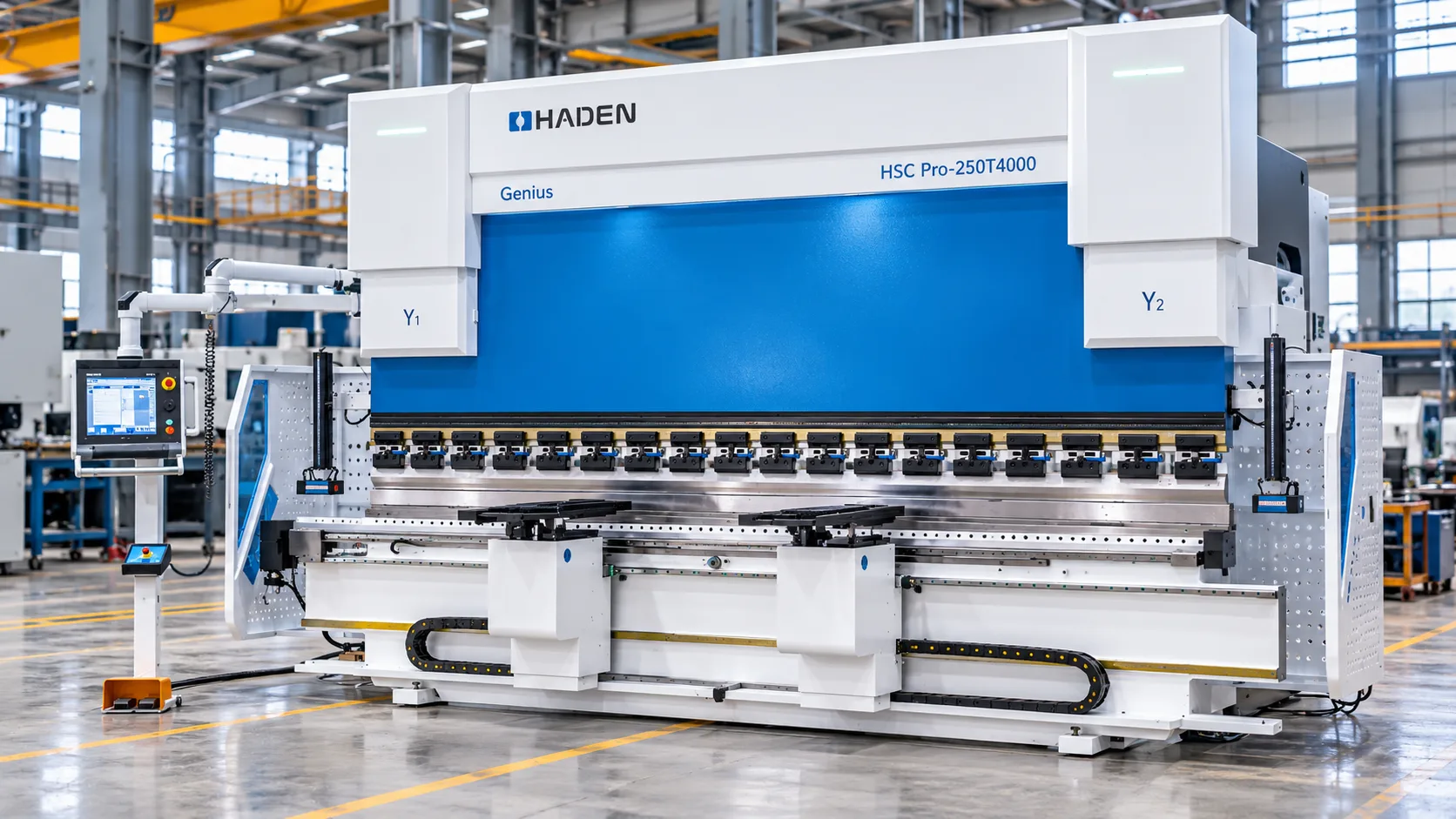
HDC / HDP Series CNC Press Brakes
Designed for structural fabrication, thick-plate bending and wide workpieces where high forming force and controlled ram synchronization are important production requirements.
Architecture Highlights
- Closed-Loop Synchronization: CNC-controlled Y1/Y2 axes coordinate ram movement throughout the bending cycle.
- Crowning Options: CNC compensation systems can be configured for long-part bending and deflection management.
- Large-Format Configurations: Machine size and tonnage can be configured around demanding structural fabrication requirements.
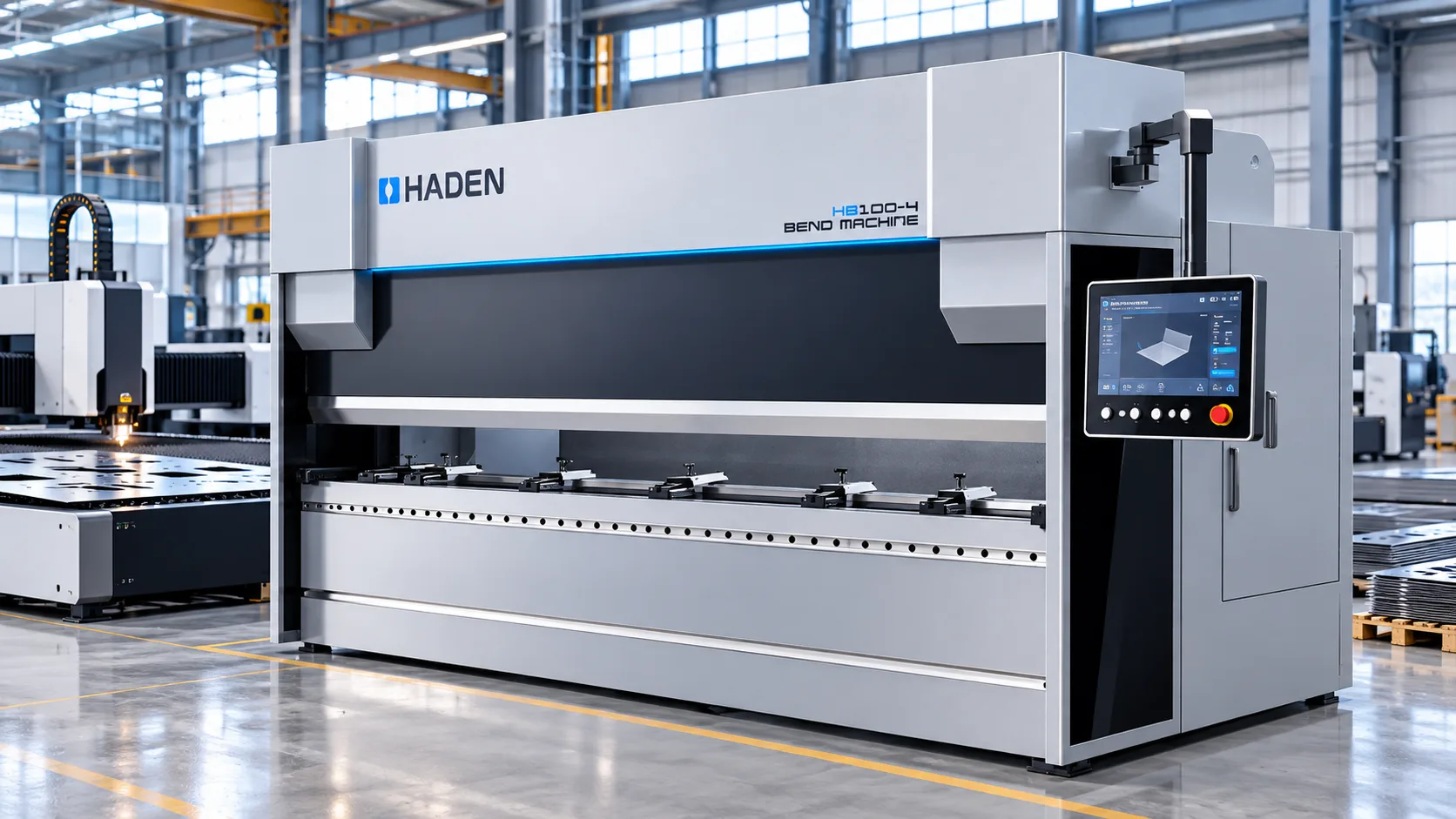
HDES Series All-Electric Press Brakes
Servo-electric press brakes are suited to precision sheet-metal production where responsive motion, compact drive architecture and reduced hydraulic maintenance are important. They can be integrated with blanking workflows from sheet metal laser cutting machines .
Architecture Highlights
- Servo Motion Control: Electric actuation provides responsive ram movement for repetitive precision bending.
- Oil-Free Drive: Eliminating the main hydraulic drive reduces oil-related maintenance requirements.
- Precision Production: Well suited to enclosures, electrical cabinets and repeat sheet-metal components.
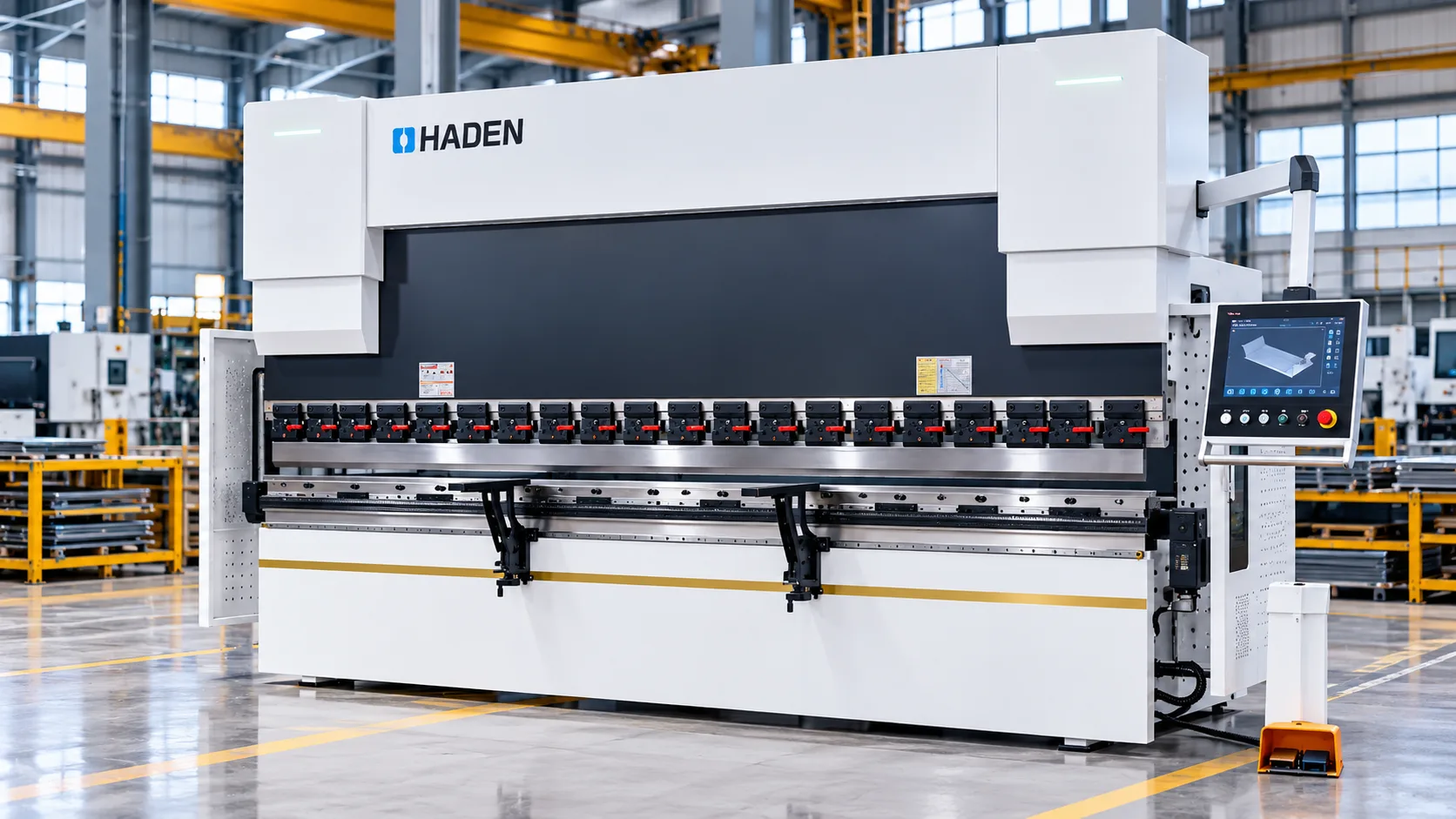
HDE Series Hybrid Press Brakes
Hybrid press brakes combine hydraulic forming force with servo-controlled pump technology, providing an alternative architecture for manufacturers balancing forming capacity, energy demand and machine response.
Architecture Highlights
- Servo Pump Control: Pump output can be matched to the bending cycle rather than relying on continuous full-speed operation.
- Integrated Architecture: Compact hydraulic layouts can reduce unnecessary piping and simplify machine packaging.
- Production Flexibility: Suitable for applications requiring a balance between hydraulic capacity and servo-controlled operation.
Match the Press Brake Architecture to Your Production Requirements
Machine selection should consider material type, tensile strength, plate thickness, bending length, required tonnage, tooling, production volume and automation requirements. For integrated fabrication lines, Haden can also evaluate upstream sheet metal laser cutting and downstream bending requirements as one workflow.
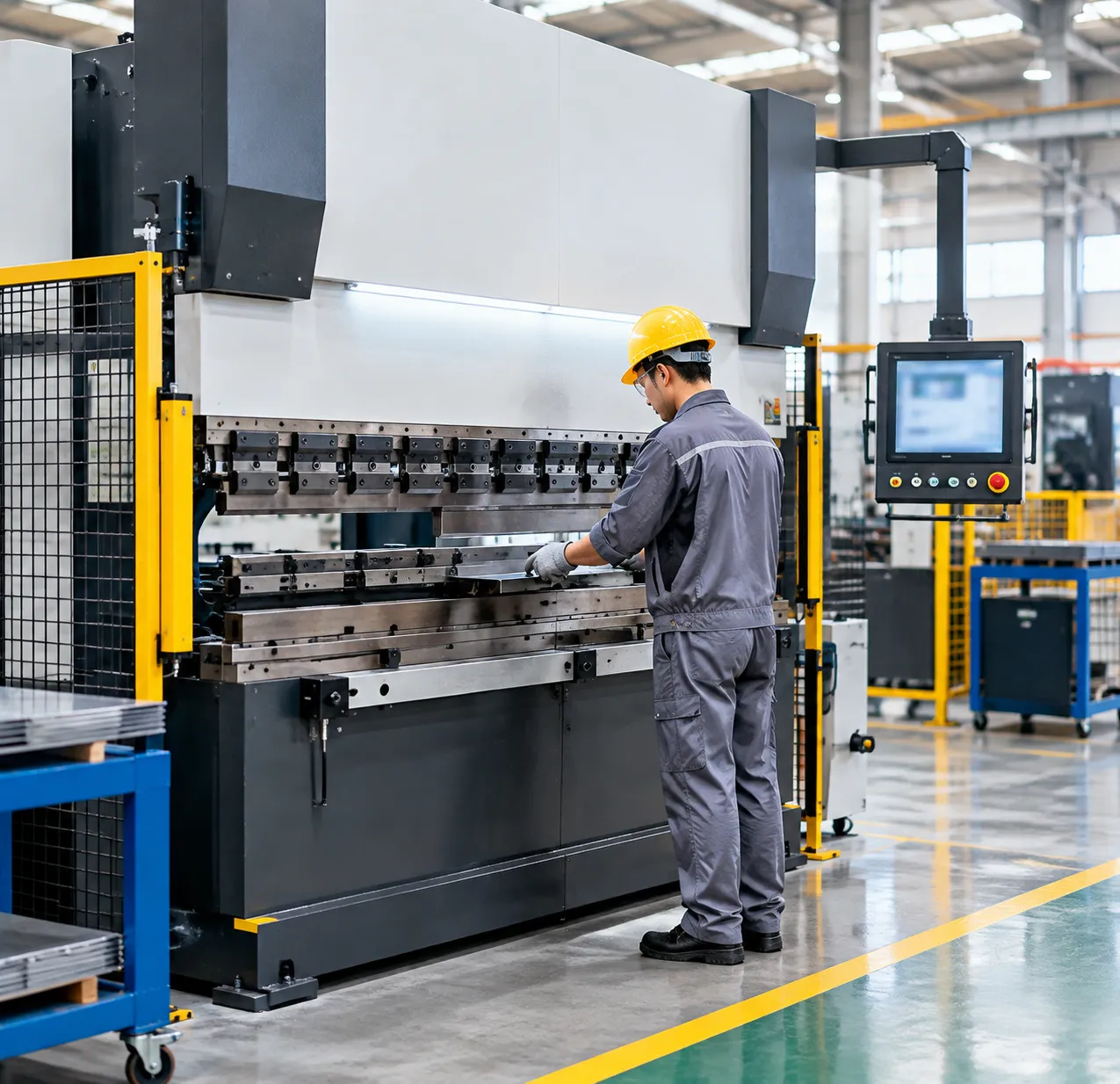
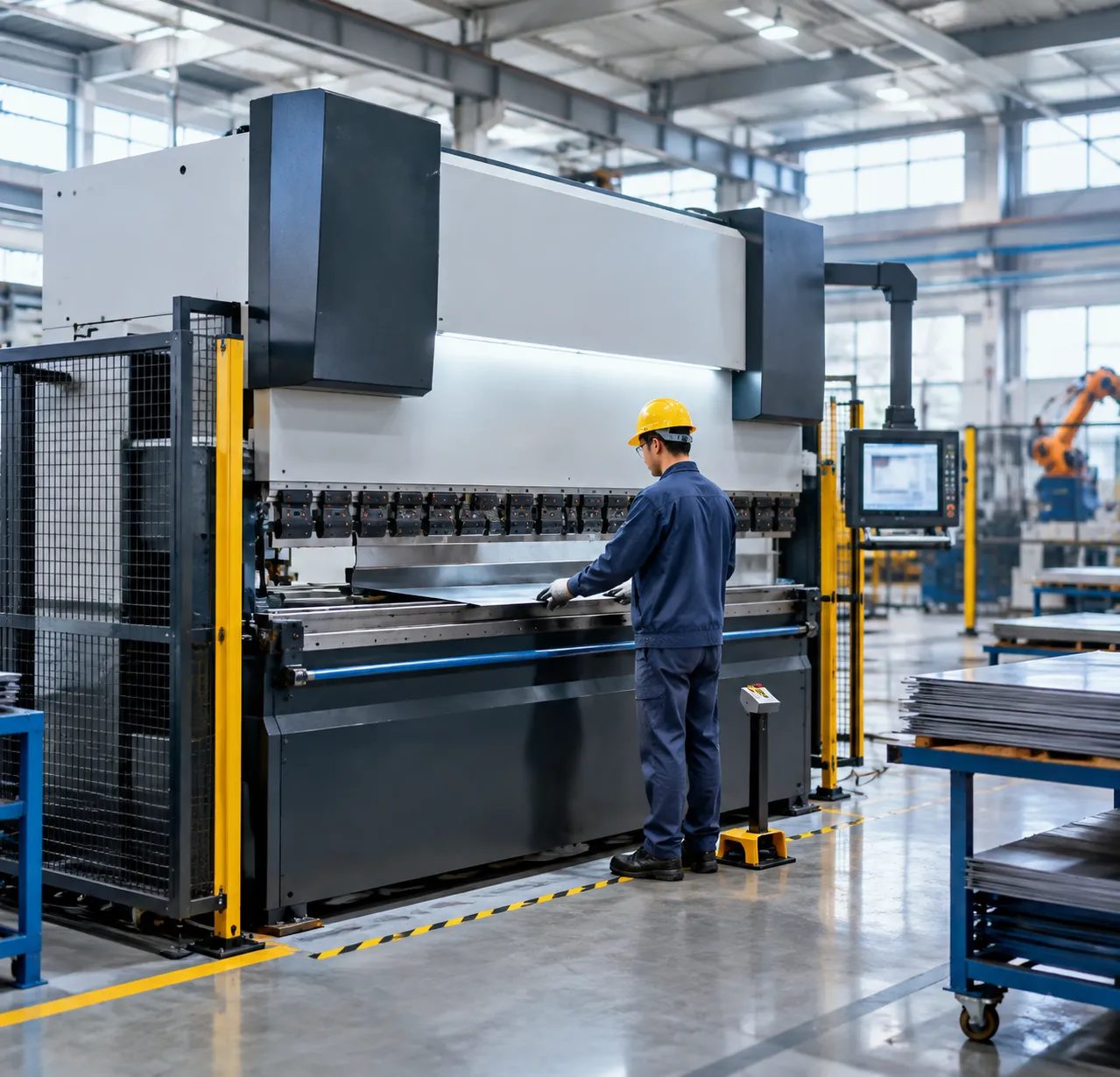
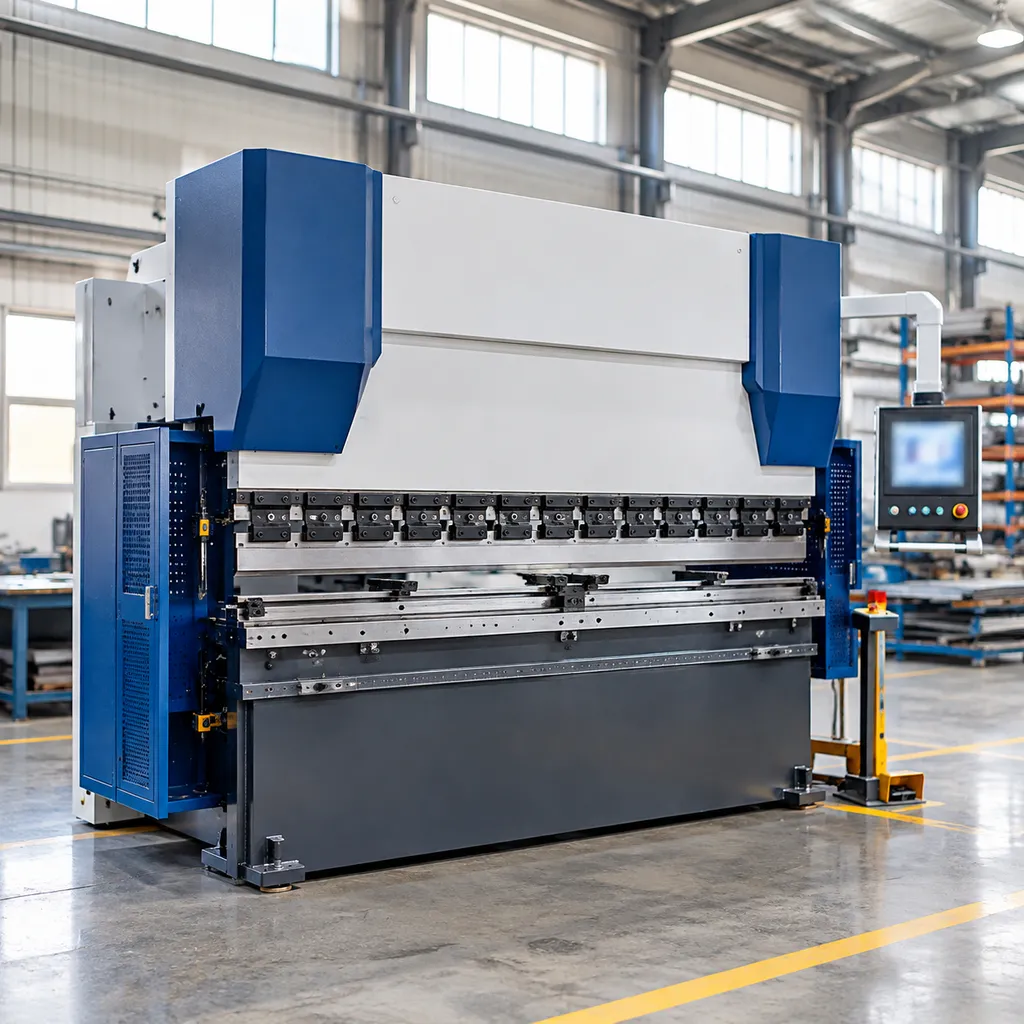
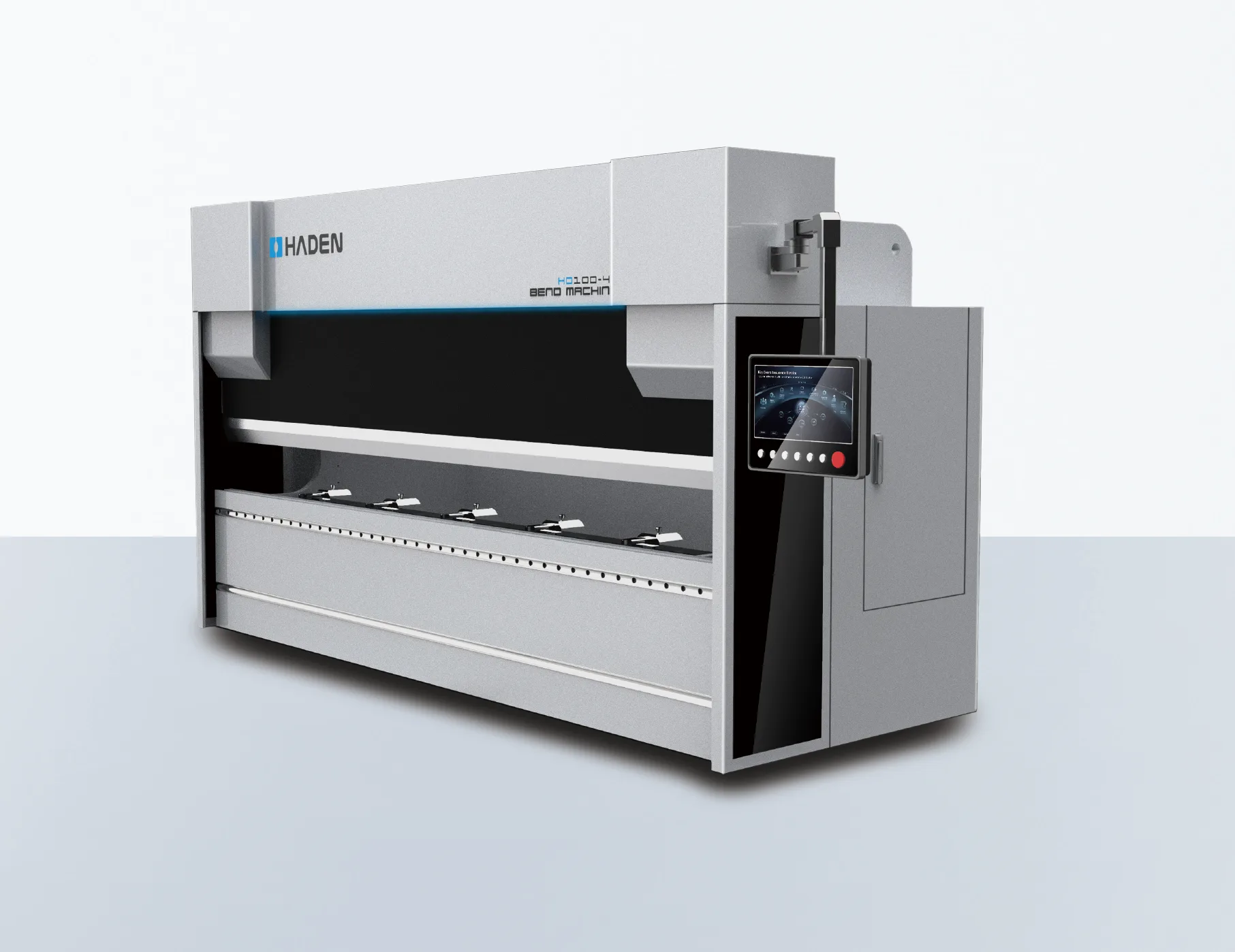
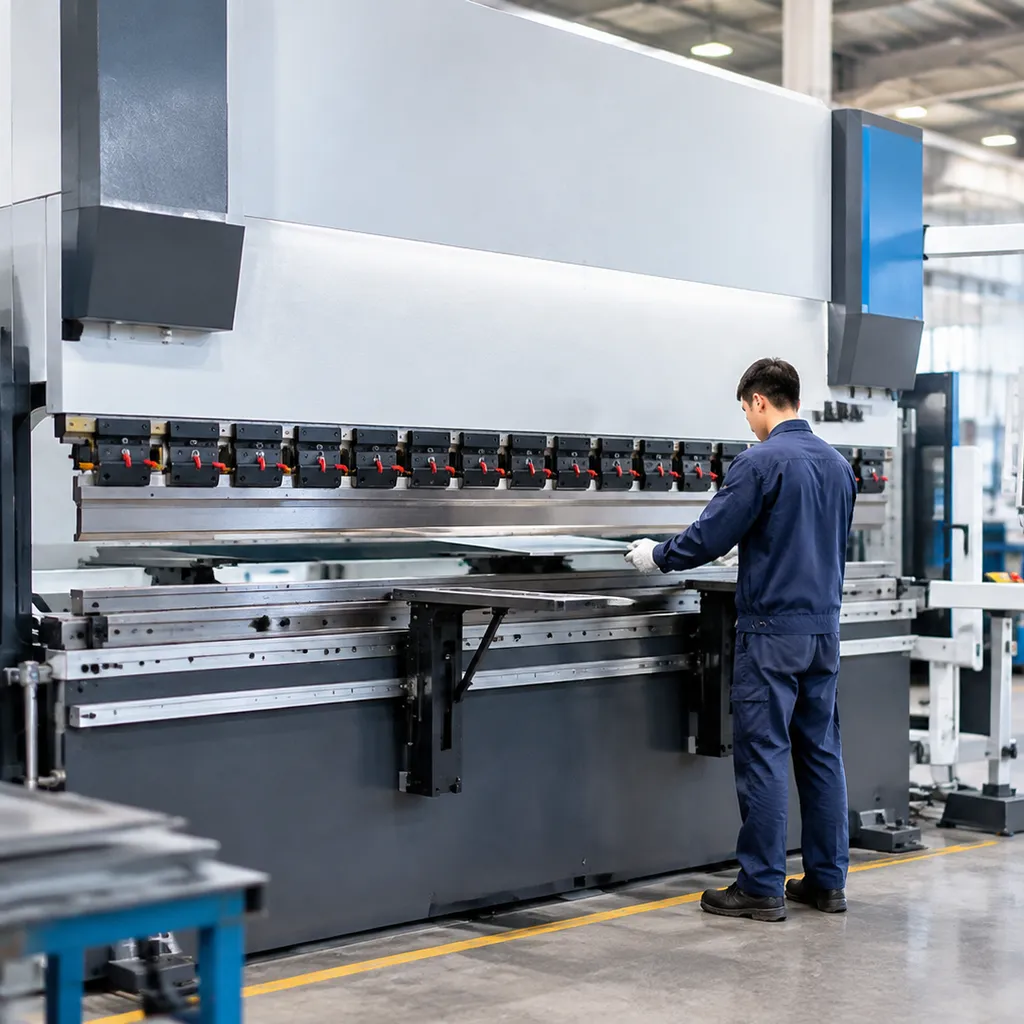
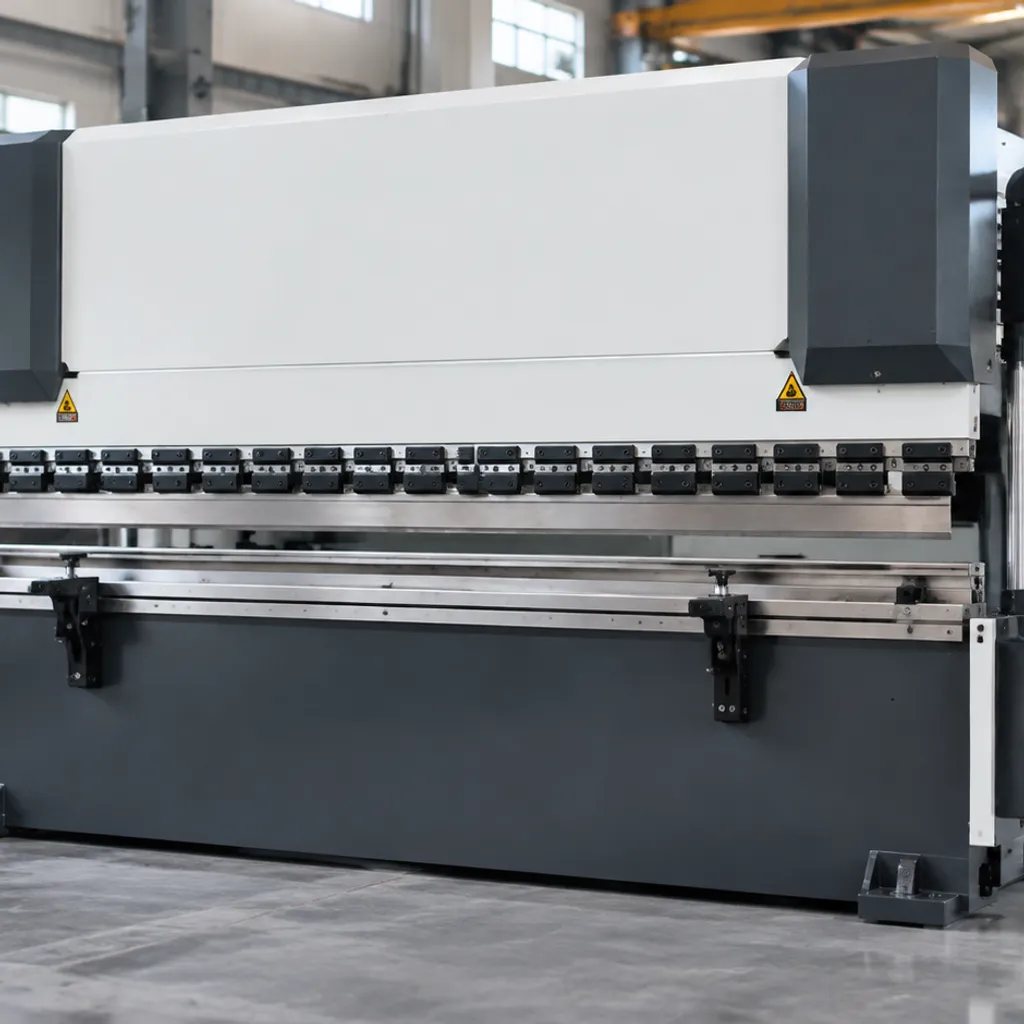
Electric, Hydraulic, and Hybrid Press Brake Comparison and Selection Guide
Selecting the right sheet metal bending machine requires evaluating drive mechanisms, capital investment, power consumption, and finished-part angular tolerances. When integrated seamlessly with high-speed laser cutting machines, modern fabrication facilities achieve an optimal balance between bending force capacity, dynamic ram acceleration, and ongoing operational overhead.
Haden designs and manufactures CNC electro-hydraulic synchro, pure servo electric, and hybrid servo press brakes. Each architecture is engineered to address distinct sheet thickness ranges, cycle frequencies, and shop-floor energy benchmarks. Use this technical comparison matrix and lifecycle cost guide to match your production parameters with the ideal bending equipment.
Highlight recommended drive systems by primary fabrication profile:
| Evaluation Parameter | CNC Electro-HydraulicProportional Valve Synchro System | Pure Servo ElectricDirect Belt & Roller-Screw Drive | Hybrid Servo HydraulicBi-Directional Servo Pump Drive |
|---|---|---|---|
| Kinematic Drive Mechanism | Continuous induction motor with high-frequency proportional servo valves and dual-cylinder hydraulic synchronization | Dual AC synchronous servo motors coupled with heavy-duty planetary roller screws or composite belt transmission | Dual reversible servo motor pump units mounted directly on independent, closed-loop cylinder manifolds |
| Bending Force Range | 100T to 2,000T+ (Tandem and tridem configurations scalable to 4,000T) | 35T to 150T (Engineered for high-mix, precision sheet blanks) | 60T to 400T (Heavy-duty platforms scalable upon engineering review) |
| Y1 / Y2 Positioning Repeatability | ±0.010 mm (Sub-micron optical linear glass scale closed-loop feedback) | ±0.003 mm (Direct absolute rotary encoder closed-loop feedback) | ±0.005 mm (Micro-pulse pressure and displacement closed loop) |
| Ram Speed (Approach / Return) | 120 to 180 mm/s approach | 100 to 150 mm/s return | Up to 220 mm/s approach | Up to 220 mm/s return | Up to 200 mm/s approach | Up to 190 mm/s return |
| Standby Power Consumption | Continuous idle draw (Main hydraulic pump motor runs throughout the shift) | Zero Watts (Servo motors draw power only during programmed ram motion) | Near Zero (Pump motors power down completely during workpiece positioning) |
| Lifecycle Energy Efficiency | Baseline standard reference for industrial sheet metal bending machines | 60% to 70% reduction compared to conventional hydraulic systems | 45% to 55% reduction compared to conventional hydraulic systems |
| Hydraulic Fluid & Oil Maintenance | 250 to 800+ Liters (Scheduled filter and fluid replacement every 4,000 hours) | 100% Oil-Free (Zero hydraulic fluid, eliminate leakage risks and disposal costs) | Compact sealed reservoirs (35 to 70 Liters; reduces fluid requirements by 70%) |
| Target Material Thickness | 3 mm to 30+ mm (Carbon steel, structural plate, Hardox, stainless alloys) | 0.5 mm to 4 mm (Aluminum, cosmetic stainless, galvanized, cold-rolled) | 1 mm to 12 mm (Versatile multi-shift job shop and OEM production) |
| Operational Noise Level | 72 to 78 dBA continuous pump background noise | < 62 dBA (Ultra-quiet direct electric drive mechanism) | < 66 dBA (Pumps actuate on-demand exclusively during ram travel) |
| Initial Capital Investment & ROI | Lowest initial acquisition cost per ton of bending force capacity | Higher initial hardware outlay; shortest payback on high-volume, rapid-stroke parts | Moderate investment threshold with lowest total cost of ownership in multi-shift plants |
Intelligent Sizing Rules: Matching Drive Systems to Your Production Volume
Calculating nominal bending force is only the starting point for equipment selection. Factoring in thermal stability, cycle frequency, tooling clearance, and operating duty cycles ensures your machine maintains angular consistency and reliable uptime over years of continuous production.
Precision Electronics Enclosures & High-Frequency Parts
Best suited for thin-gauge blanks prepared by sheet metal laser cutting machines under 3.5 mm thickness where cycle counts exceed 600 bends per hour. The absence of hydraulic fluid eliminates heat buildup and viscous thermal drift entirely, ensuring identical bend angles from the first morning cycle to the shift end.
- ✓Zero contamination: Essential for medical, food equipment, and cleanroom hardware.
- ✓Instant acceleration: Dual servo drives cut cycle durations by 30% to 40%.
- ✓Zero idle consumption: Electricity is consumed only during active ram travel.
Structural Components, Heavy Plates & Long Workpieces
The premier industrial solution for bending cross-sections above 6 mm and broad bed spans exceeding 4 meters. Electro-hydraulic proportional valve technology produces immense sustained hydraulic pressure without mechanical overload risk.
- ✓Extreme tonnage ceiling: Scales up to 2000 tons for yellow-goods and shipbuilding.
- ✓Heavy tool compliance: Accommodates deep box tools, high dies, and custom goosenecks.
- ✓Overload resilience: Internal relief valves prevent mechanical damage under severe shock loads.
Continuous Heavy-Duty Cycles with Strict Energy Targets
The ultimate balance for high-volume automated stamping and bending cells. Independent dual servo motors run bi-directional pumps directly on cylinder manifolds, supplying oil volume strictly when movement is commanded.
- ✓Minimal oil volume: 70% less fluid reduces environmental risks and waste disposal.
- ✓Reduced thermal drift: Tight oil temperature retention preserves angular repeatability.
- ✓Low operational noise: Near-silent idle mode optimizes workplace ergonomics.
Uncertain Which Drive Architecture Maximizes Your Capital Return?
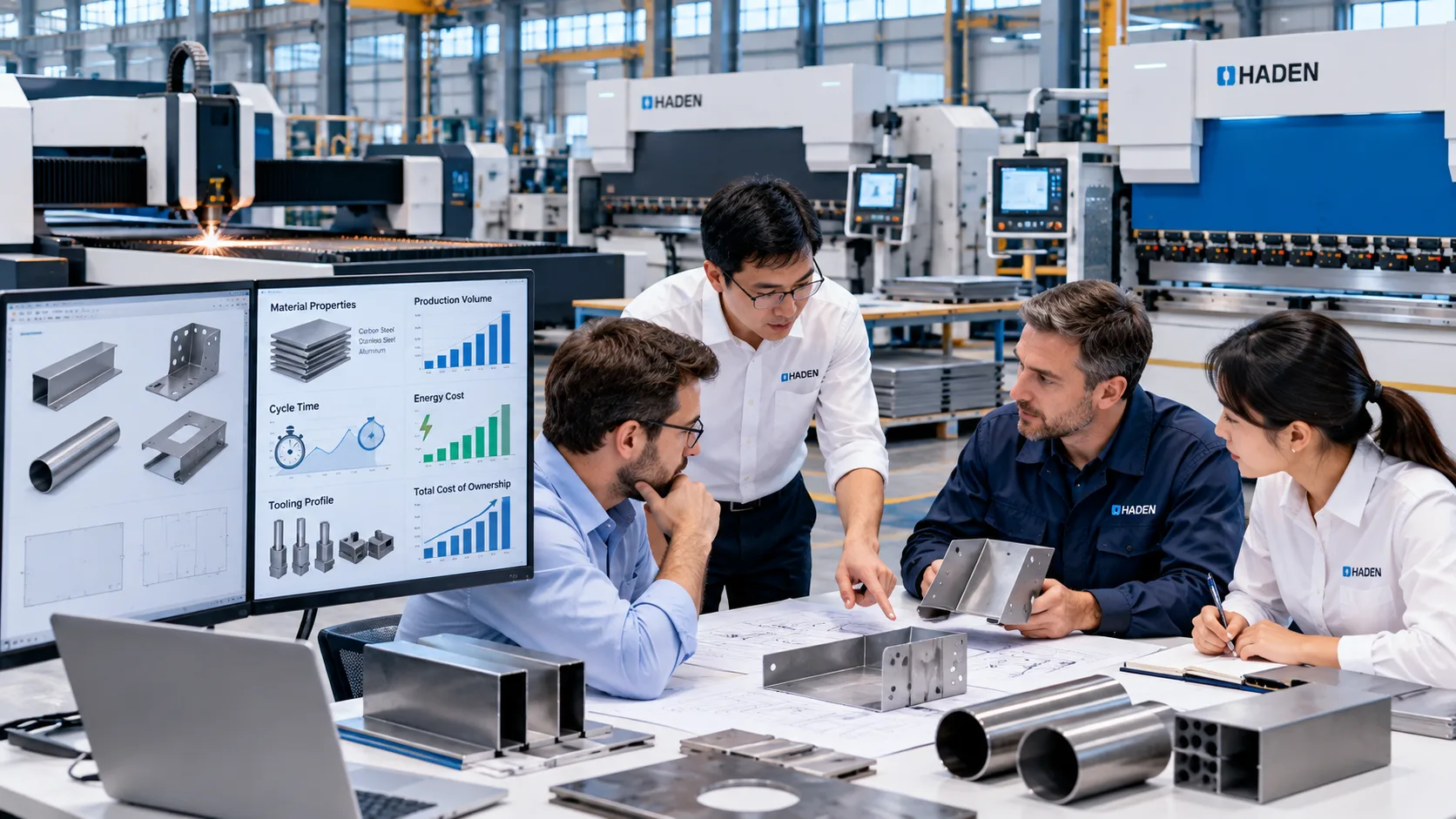
The Haden application engineering team conducts thorough lifecycle cost and cycle-time evaluations tailored to your specific bill of materials. By analyzing material tensile yield, parts prepared on versatile sheet and tube laser cutting machines, annual production volume, local electricity tariffs, and tooling profiles, our engineers prevent over-specification while ensuring your shop achieves repeatable, high-precision bending results.
Structural Engineering and High-Precision Bending Assurance Systems
Industrial metal forming demands absolute mechanical rigidity, dynamic real-time deflection compensation, and sub-millimeter gauging accuracy. Seamlessly integrated alongside high-efficiency laser cutting machines , Haden engineers every precision bending machine with an FEA-optimized, stress-relieved monoblock frame, multi-axis servo backgauge kinematics, closed-loop CNC crowning systems, and high-level graphic controls to ensure repeatable angular precision across the entire bending length.
Stress-Relieved Annealed Monoblock Machine Bed
Structural rigidity is the foundation of angular repeatability over decades of demanding industrial fabrication. Haden builds heavy-duty press brake frames from an integrated, all-steel welded monoblock structure. Every assembled chassis undergoes full thermal annealing in dedicated heat-treatment furnaces to eliminate internal molecular stresses before precision machining.
Finite Element Analysis (FEA)
Optimized structural load dispersion eliminates frame yaw, deflection, and side-housing fatigue under continuous maximum tonnage cycles.
Floor-Type Boring & Milling
Precision single-setup five-axis machining ensures exact cylinder perpendicularity, gibbing squareness, and guide parallel alignment.
- ✓ Zero Frame Distortion: Heavy-duty throat depth gusseting prevents side-frame spreading during high-tonnage off-center bending.
- ✓ Ultrasonic-Tested Plate: Constructed exclusively from premium structural steel plate, fully inspected for internal laminations and weld homogeneity.
| Structural Parameter | Haden Monoblock Standard | Standard Market Benchmark |
|---|---|---|
| Stress-Relief Process | Full-furnace thermal annealing at 600°C | Vibratory stress relief or natural room aging |
| Machining Execution | CNC floor-type boring mill, single setup | Multi-stage repositioned machine routing |
| Frame Safety Factor | ≥ 2.8 Design Factor at full rated tonnage | 1.5 - 1.8 Design Factor |
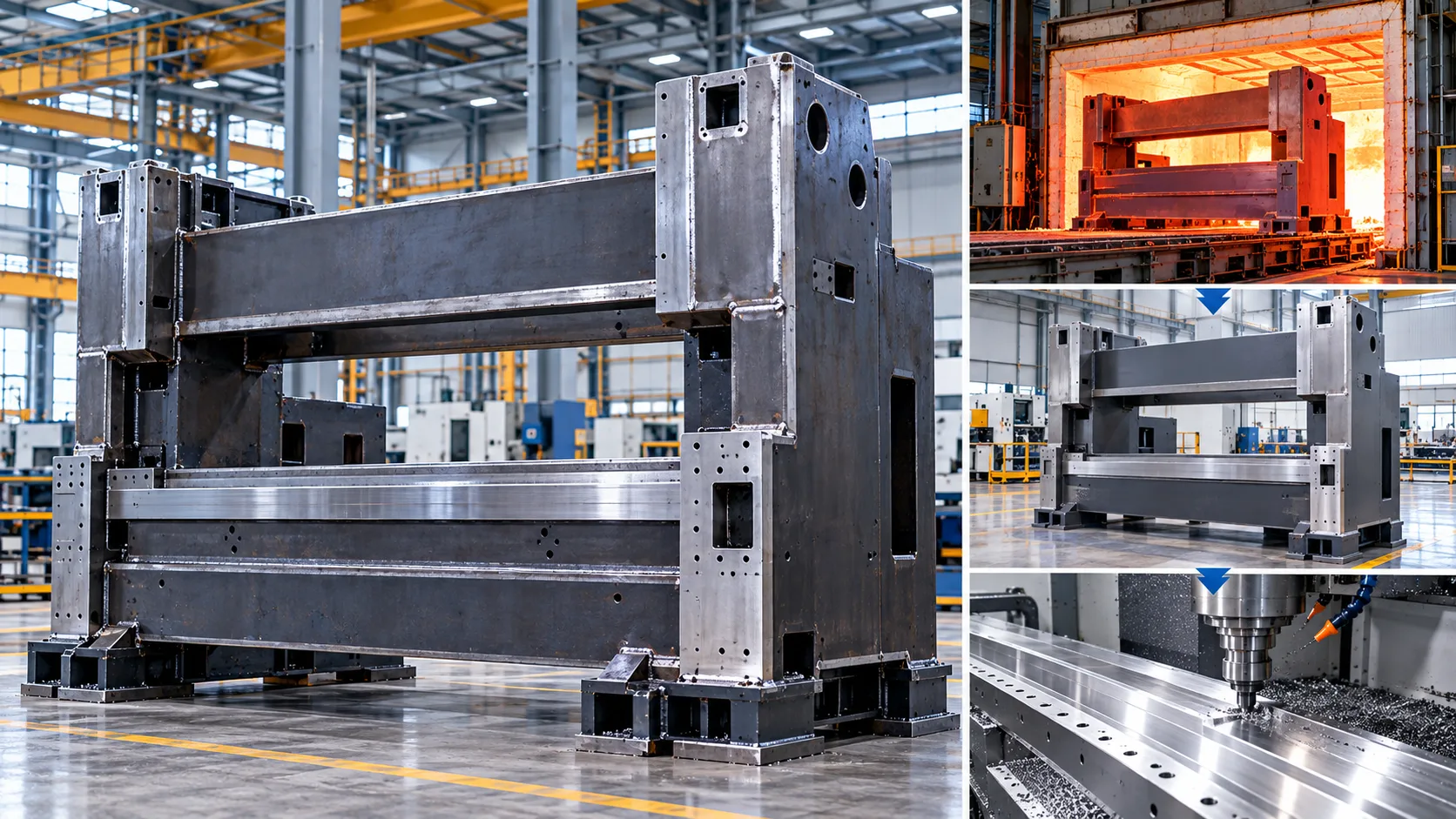
Haden applies controlled heat treatment and normalization standards to ensure the machine geometry remains unchanged under fluctuating workshop temperatures and round-the-clock forming loads.
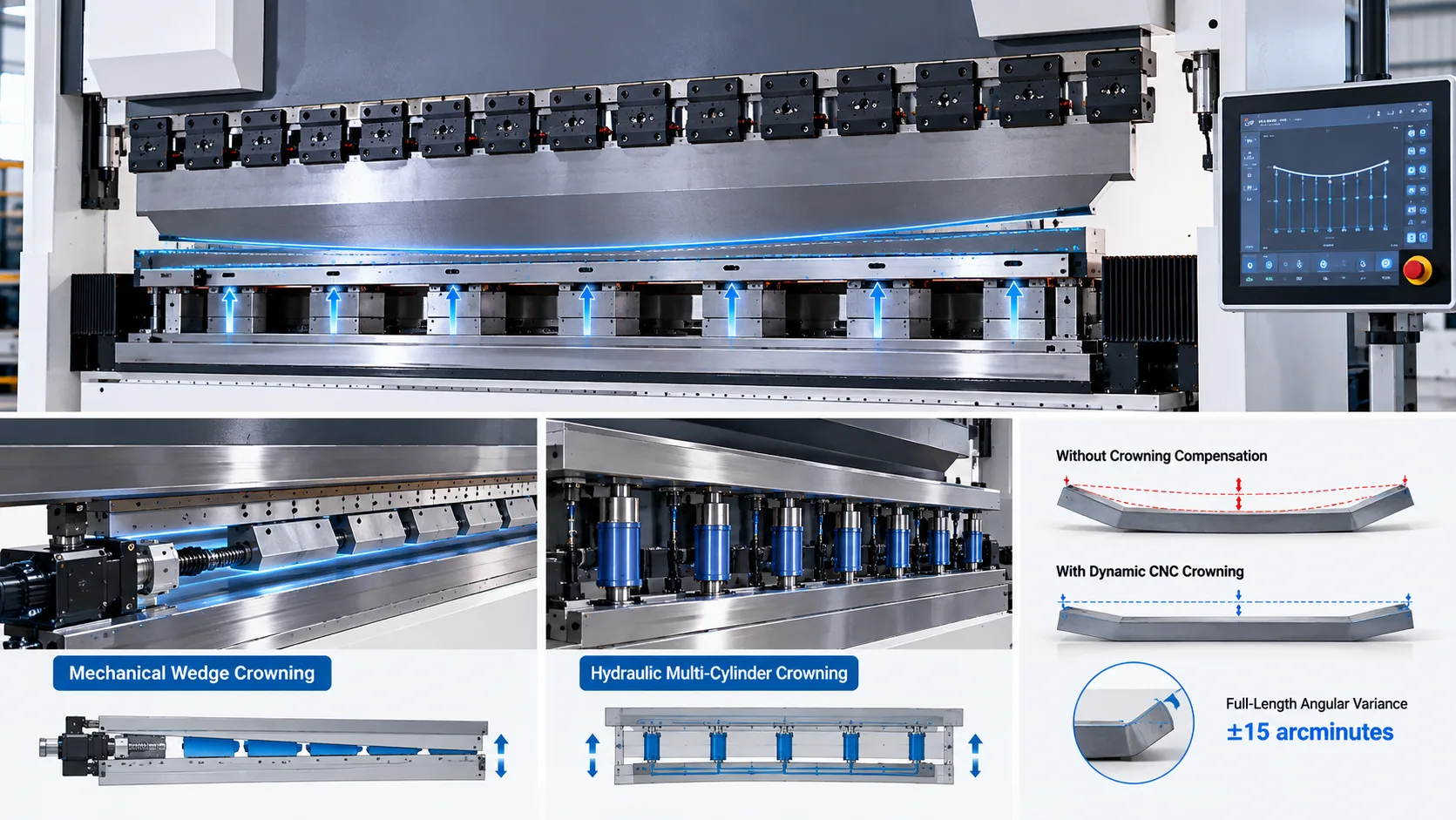
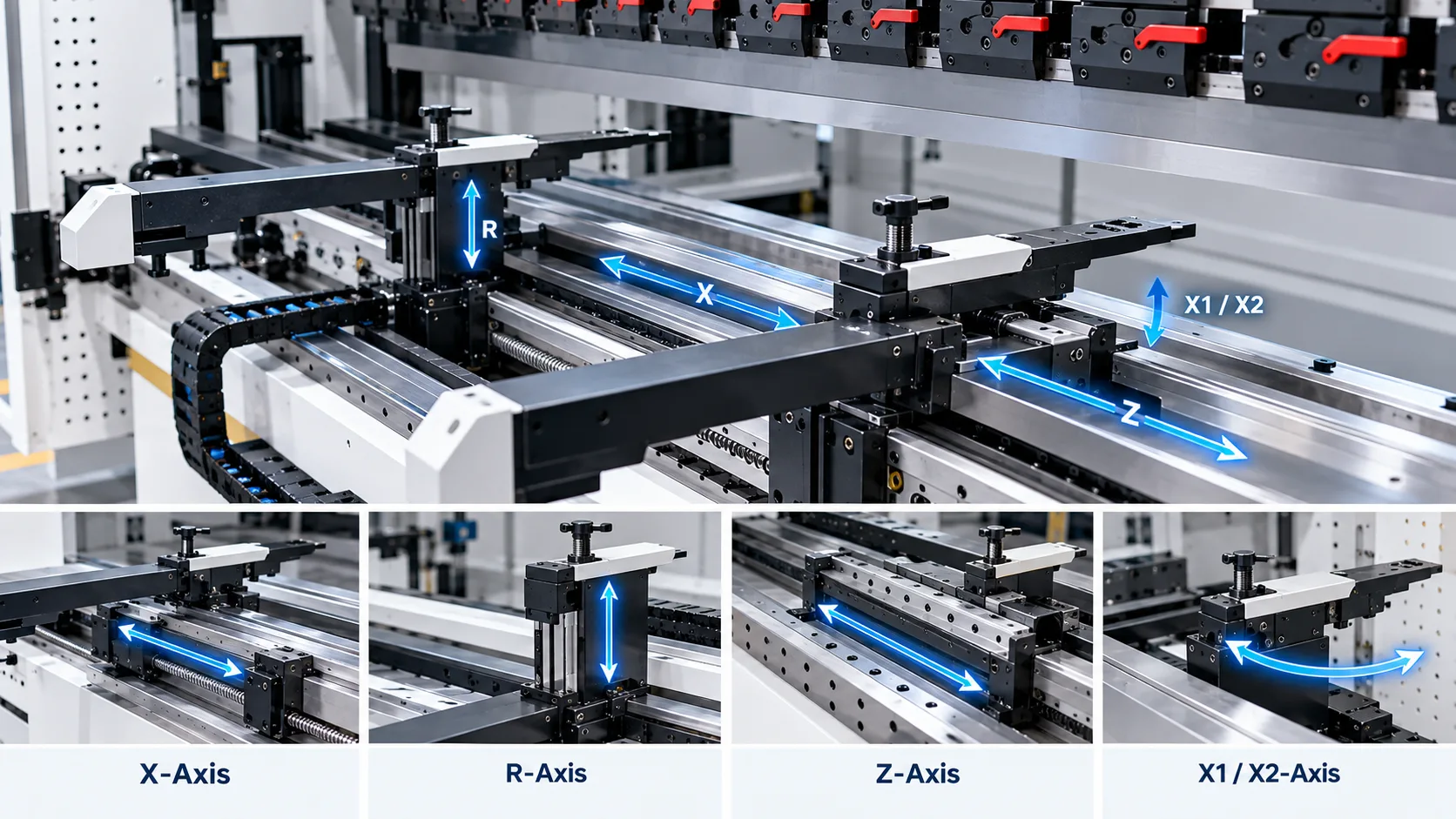
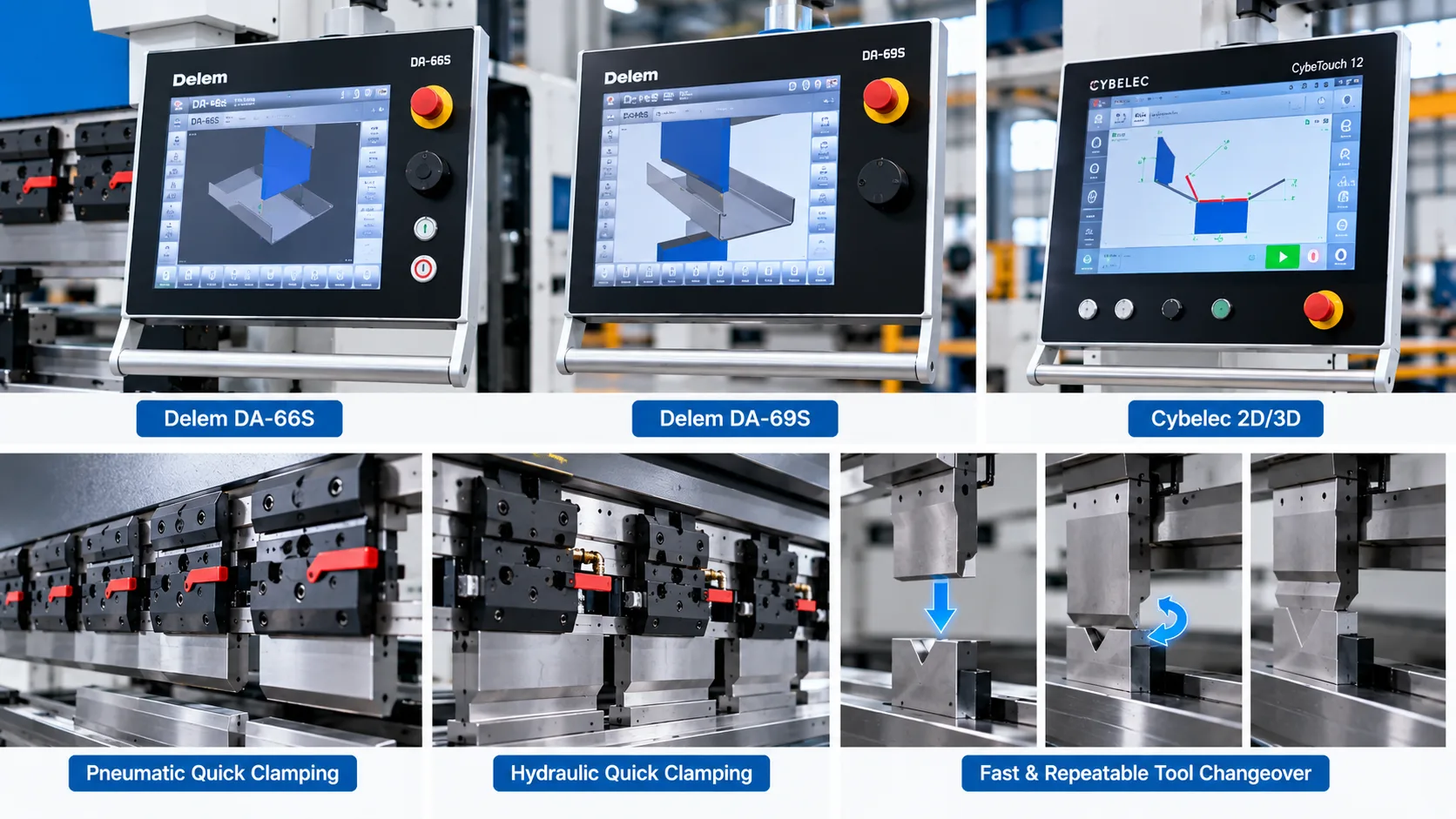
Need a specific backgauge layout, extended throat depth, or custom open-height configuration?
Haden application engineers provide customized FEA load verifications, tooling ecosystem layouts, and system integration support.
Typical Industrial Applications and Complex Sheet Metal Forming Solutions
High-precision sheet metal fabrication requires stable angle consistency, zero scrap on sensitive finishes, and predictable tonnage distribution across varied alloys. Seamlessly integrating upstream parts processed on sheet metal laser cutting machines, Haden press brake systems deliver certified forming accuracy for mission-critical parts—from intricate electronic enclosure bending and multi-flange panels to heavy structural components. Built with high-response multi-axis backgauging and dynamic CNC crowning, our machines eliminate springback discrepancies and keep tight tolerances across small batch runs and high-volume operations.
Electrical Enclosures & Server Cabinets
Engineered for multi-sequence box bending, tight micro-gap return flanges, and four-side door folding with micron-level positioning repeatability.
Key Technical Focus
- •Process: Rapid 4-side panel folding & deep window hems
- •Tolerance: Micro-gap seam closure within ±0.1 mm
- •Automation: Multi-axis backgauge for rapid step clearance
Architectural Facades & Elevator Panels
Developed for long-span aluminum and decorative stainless steel profiles that require scratch-free finishes and uniform straightness across the entire bed length.
Key Technical Focus
- •Process: Long-span scratch-free air bending & deep channels
- •Compensation: Dynamic CNC crowning for angular uniformity
- •Tooling: Wide-bed gooseneck punches with protective film
Commercial Vehicles & Heavy Equipment
Heavy-tonnage bending for high-strength steel grades such as Hardox and DOMEX, delivering rigid forming on chassis members, boom sections, and wear plates cut via heavy-duty laser cutting machines.
Key Technical Focus
- •Materials: High-yield structural steel up to 1300 MPa
- •Kinematics: Large-radius multi-pass bump forming
- •Setup: Tandem machine synchronization for extra lengths
HVAC Ductwork & Foodservice Equipment
Rapid single-stroke hemming, Dutch flattening, and sanitary radius bends on galvanized sheet, mirror-finish stainless steel, and aluminum alloys.
Key Technical Focus
- •Tooling: Spring-loaded automatic hemming tables
- •Finishing: Polyurethane inserts for zero tooling contact marks
- •Cycle: High-frequency repeat bending with minimal setup
Manufacturing Parameters Across Core Sheet Metal Forming Sectors
Accurate precision metal forming requires aligning press brake drive kinematics, ram tonnage, and tooling geometry with material yield strengths, whether handling flat sheets or profiles prepared on tube laser cutting machines. The matrix below outlines standard configurations across common industrial fabrications.
| Application Sector | Common Materials | Thickness Range | Recommended Drive Architecture | Critical Tooling Profile |
|---|---|---|---|---|
| Electronics & Server Racks | Cold Rolled Steel (SPCC), Aluminum 5052-H32 | 0.6 mm – 2.5 mm (0.024″ – 0.098″) | Pure Servo Electric (35T–80T) | Segmented 30° Acute Punches & Narrow 2V Sliding Dies |
| Architectural Cladding & Elevators | AISI 304/316 Stainless, Anodized AlMg3 | 1.2 mm – 4.0 mm (0.047″ – 0.157″) | Hybrid Servo / CNC Synchro (100T–250T) | Deep Gooseneck with Protective Non-Marking Inserts |
| Commercial Chassis & Yellow Goods | Hardox 450/500, S355MC, Weldom 700 | 6.0 mm – 25.0 mm (0.236″ – 0.984″) | Heavy CNC Hydraulic Tandem (400T–2000T) | CNC Variable Multi-V Dies & Hardened Radius Tooling |
| HVAC Ducting & Kitchen Equipment | Galvanized DX51D, Food-Grade 304 #4 Finish | 0.8 mm – 3.0 mm (0.031″ – 0.118″) | Pure Servo / Hybrid (60T–135T) | Integrated Hemming Tables & Flattening Bench Assemblies |
Over 1,000 Verified Bending Profiles for Custom Machine Optimization
Haden maintains an extensive empirical database capturing metallurgical springback indices, bend deduction parameters, and tonnage curves across global sheet metal alloys. Whether your production calls for off-center specialized punches, complex multi-bend returns, or non-marking cosmetic bending, our application engineering team designs bespoke tooling configurations and CNC bending programs tailored directly to your blueprint tolerances.
±15′
Full-Span Angular Accuracy
±0.005 mm
Ram Repeatability Index
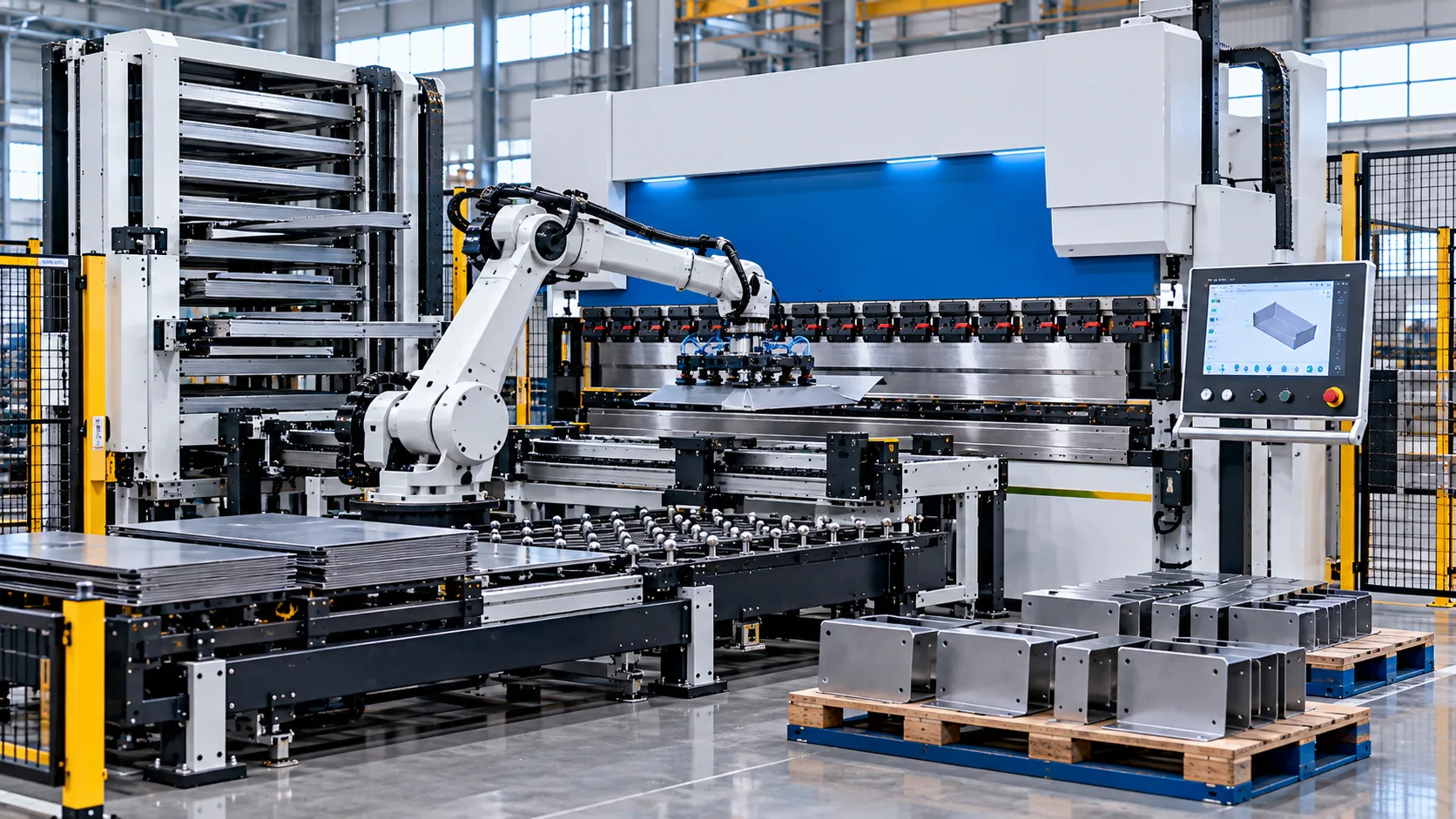
Flexible Robotic Bending Cells for Lights-Out Sheet Metal Production
Scale your fabrication workflow from standalone CNC hydraulic press brakes to fully autonomous robotic bending cells engineered for high-mix batch flexibility, zero-defect consistency, and 24/7 unmanned smart factory operation.
6-Axis Industrial Robotic Handling & Active Sheet Following
High-payload 6-axis articulation delivers synchronized dynamic sheet following throughout the bending stroke, paired with dual magnetic/vacuum destackers and ultrasonic double-sheet detection to safeguard tooling.
Intelligent 3D Offline CAM & Collision Avoidance
Direct CAD-to-program offline software automates bend sequencing, tool selection, gripper trajectory, and real-time interference checks—eliminating machine teach-in delays and reducing setup time to minutes.
Modular Turnkey Cell Architecture
Fully configurable modular workcells integrate precision centering tables, automatic sheet turnover stations, regripping fixtures, and finished-part palletizing conveyors for continuous production loops.
Documented Automation ROI & Productivity Gains
Reduction in direct labor and operator intervention
Continuous lights-out unmanned manufacturing capability
Increase in overall bending throughput and cell OEE
Build a Complete Automated Sheet Metal Production Line
Connect precision cutting, CNC bending and robotic automation into a coordinated production workflow. Haden configures servo-electric press brakes , sheet metal laser cutting machines and automated bending systems around your part geometry, material range, production volume and automation requirements.
Turnkey Systems Engineering
Single-source accountability covering custom End-of-Arm Tooling (EOAT), safety light curtains, interlocking fences, and raw material logistics.
Synchronized Machine-to-Robot Control
Direct fieldbus communication links press brake ram dynamics with robotic arm tracking, eliminating micro-slippage and angle deflection.
Industry 4.0 MES/ERP Ready
Standard OPC-UA protocols provide real-time cell telemetry, automated part tracking, tool wear monitoring, and production analytics to your MES.
Press Brake Buying Guide & Technical FAQ
Get direct answers on bending tonnage calculation, tooling configurations, electric vs. hydraulic operating costs, and long-term sheet metal brake maintenance from Haden application engineers.
Bending Tonnage Calculation
Determine exact press brake tonnage requirements based on material tensile strength, sheet thickness, and lower V-die opening ratios.
Electric vs. Hydraulic Press Brakes
Compare kilowatt consumption, fluid replacement intervals, cycle speed differences, and thermal stability across continuous fabrication shifts.
Field Service & Maintenance
Haden provides factory-backed installation, CNC operator training, preventative maintenance schedules, and rapid-dispatch regional spare parts.
01
How do you accurately calculate the required press brake bending
tonnage?
Calculating precise bending force is essential to prevent machine frame overload, eliminate tool chipping, and maintain dimensional accuracy. In standard free air-bending, required tonnage depends directly on sheet thickness, material ultimate tensile strength (UTS), overall bend length, and bottom V-die opening width.
The industry standard empirical formula for mild steel (tensile strength approximately 450 N/mm² or 65,000 PSI) is:
- Stainless Steel (AISI 304 / 316): Multiply calculated force by 1.5× due to intense work hardening and higher tensile strength (~700 N/mm²).
- High-Strength Structural Steel (Hardox / DOMEX): Multiply by 2.0× to 2.5× depending on the specific yield point of the alloy.
- Aluminum Alloys (5052-H32 / 6061-T6): Multiply by 0.5× to 0.7× for ductile tempers, but account for larger bend radiuses to avoid cracking.
Haden CNC press brakes feature built-real-time calculation software within Delem and Cybelec controllers that automatically evaluates material tables, dynamic crowning compensation, and backgauge limits before every bend stroke.
02
What is the true operating cost difference between pure electric
servo and hydraulic press brakes?
Evaluating the total cost of ownership (TCO) between drive systems involves comparing electrical utility demand, routine fluid maintenance, environmental disposal fees, and cycle productivity across daily production shifts.
| Cost & Operational Metric | Servo Electric Press Brake | CNC Hydraulic Press Brake |
|---|---|---|
| Standby Power Consumption | < 0.5 kW (Zero idling motor draw) | 3.5 kW – 7.5 kW (Continuous motor/pump circulation) |
| Bending Cycle Energy Savings | 50% – 65% lower utility draw | Standard baseline industrial power draw |
| Hydraulic Oil & Filter Maintenance | $0 (100% oil-free drive system) | Periodic oil changes, seal replacements, and filter costs |
| Thermal Drift & Warm-Up Cycle | Zero warm-up; instant repeat precision | Requires oil stabilization to prevent angle variance |
For precision sheet metal fabrication under 4 mm thickness, deploying Haden servo electric press brakes in cell workflows with high-efficiency sheet metal laser cutting machines typically delivers full return on investment (ROI) in under 18 months through electricity savings, reduced scrap, and rapid acceleration rates.
03
Which tooling and clamping options prevent die marks and
scratches on sensitive metals?
Fabricating architectural panels, custom hollow sections prepared on tube laser cutting machines, electrical enclosures, elevator cabins, and food-grade stainless steel requires mark-free bending without post-processing or secondary polishing.
- Polyurethane Protective Films & Inserts: High-tensile elastomer protective films placed across lower V-dies prevent direct metal-to-metal contact and die galling.
- Roller V-Dies (Wing Bending Tools): Bottom dies with hardened rotating support rollers eliminate sliding friction as the sheet enters the die cavity.
- CNC Sheet Follower Supports: Heavy or large panels receive active servo-controlled upward support during the stroke to eliminate reverse deformation creases.
- Hydraulic & Pneumatic Quick Clamping: Precision quick-clamping systems (European standard, Wila, or Trumpf style) seat tooling vertically in seconds with zero manual alignment error.
04
What CAD/CAM software integrations and 3D offline file formats
are supported?
Haden press brakes support modern Industry 4.0 shop floor connectivity alongside automated laser cutting machines by integrating seamlessly with market-leading CNC controllers from Delem (DA-66S, DA-69S), Cybelec (Visitouch), and ESA:
Direct Geometry File Ingestion
Import 2D DXF/DWG files and native 3D solid models (STEP, IGES, SAT) directly at the machine console or through local network transfers.
Offline 3D Programming & Simulation
Full compatibility with Delem Profile-T, AutoPOL, Metalix, and Radan for automatic tooling assignment, collision avoidance, and bend sequencing.
Offline programming ensures zero machine downtime during setup changes. Part programs and tooling layouts are validated digitally and transferred via Ethernet or USB directly to the press brake.
05
What are standard lead times, on-site commissioning terms, and
warranty terms?
Haden maintains strict manufacturing standards, documented quality verification, and an international technical service network for every press brake shipment:
- Manufacturing Lead Times: Standard configured CNC press brakes ship within 25 to 35 business days; custom multi-axis or tandem systems require 45 to 60 days.
- Turnkey On-Site Commissioning: Factory-trained field engineers manage mechanical leveling, optical scale calibration, crowning verification, and staff safety training on your floor.
- Comprehensive Warranty: Full coverage protecting the stress-relieved steel monoblock frame, CNC controller units, linear optical encoders, and servo drive motors.
- Spare Parts & Remote Diagnostics: Direct IoT remote technical troubleshooting combined with regional spare part hubs ensures prompt dispatch of seals, valves, and electronics within 24 to 48 hours.
Get the Right Press Brake for Your Application
Tell us what you need to bend. Haden engineers will evaluate your application and recommend a suitable machine configuration, tooling and automation solution.
Machine Sizing
Tonnage, bending length and machine configuration.
Tooling & CNC Options
Tooling, backgauge and control options matched to your parts.
Automation Integration
Options for automated bending and integrated production lines.
Request a Machine Recommendation
Send us a few basic details about your bending application.