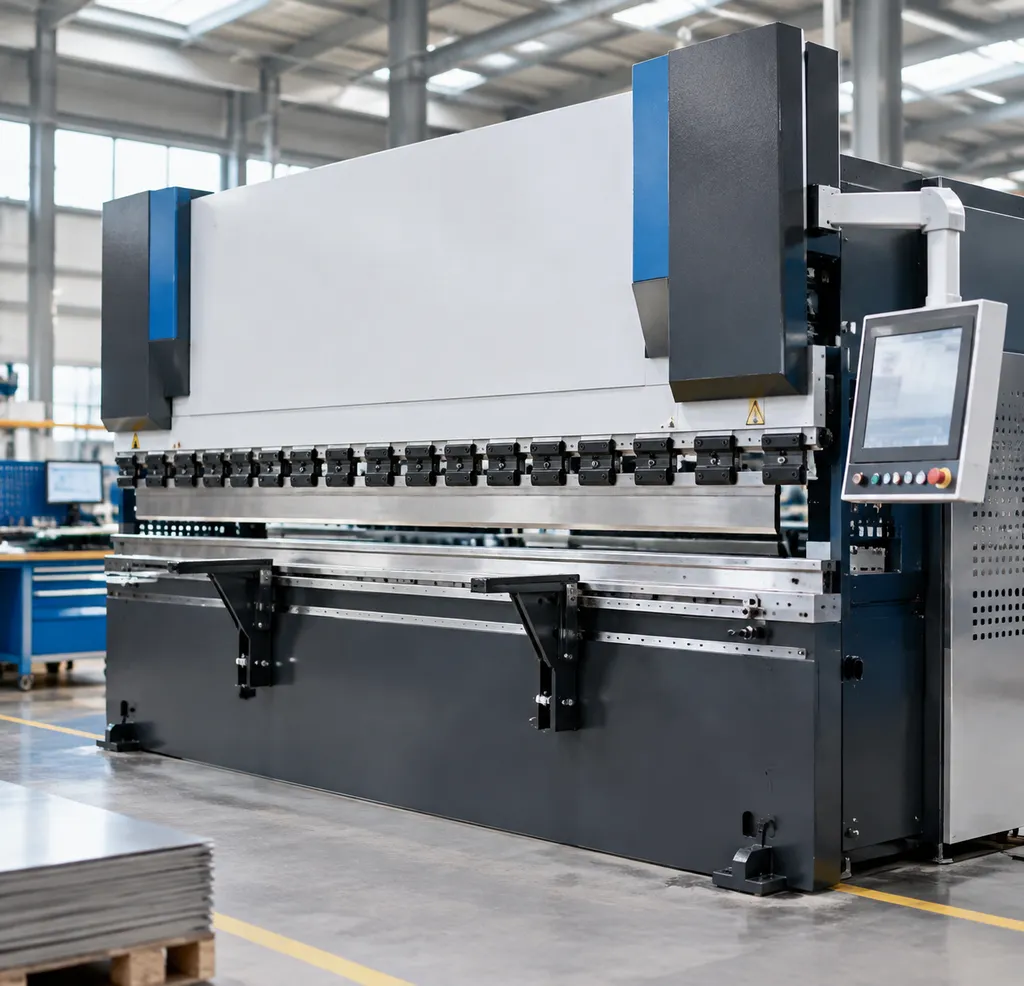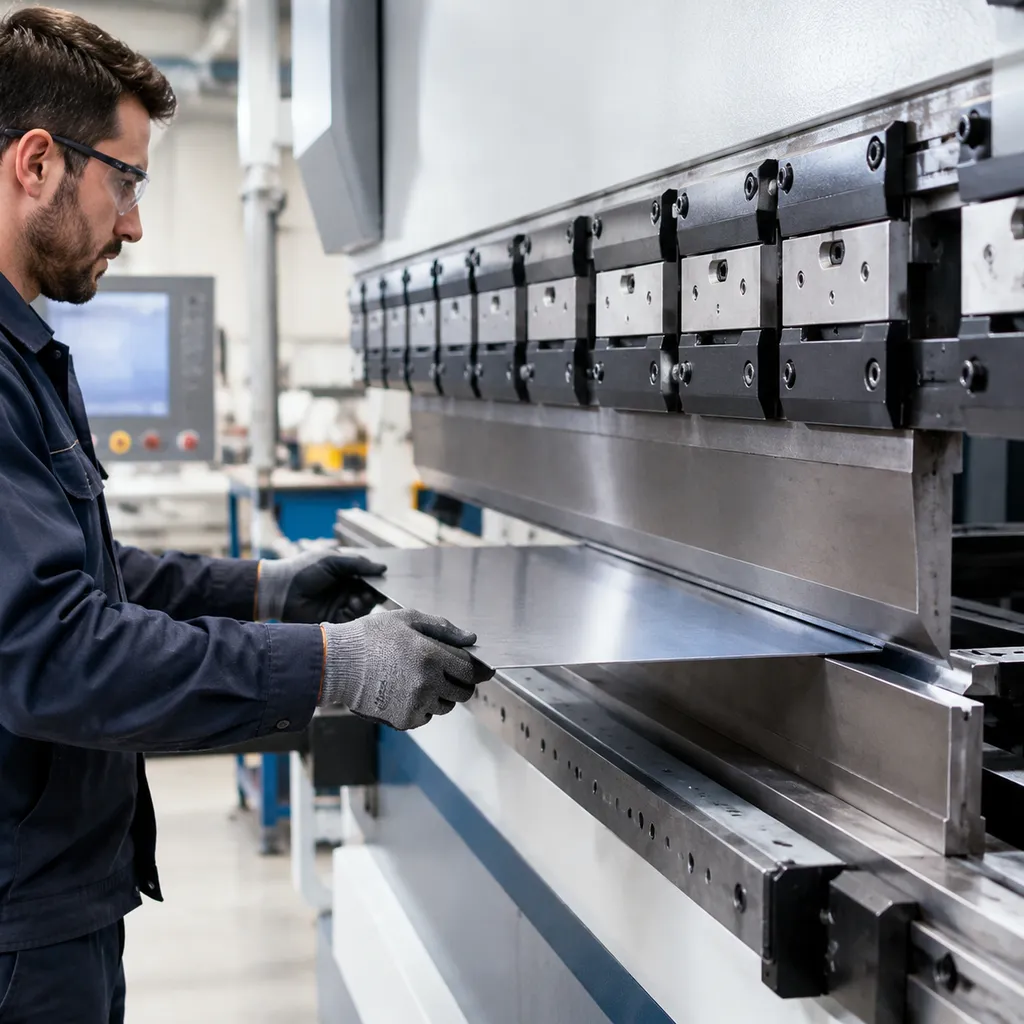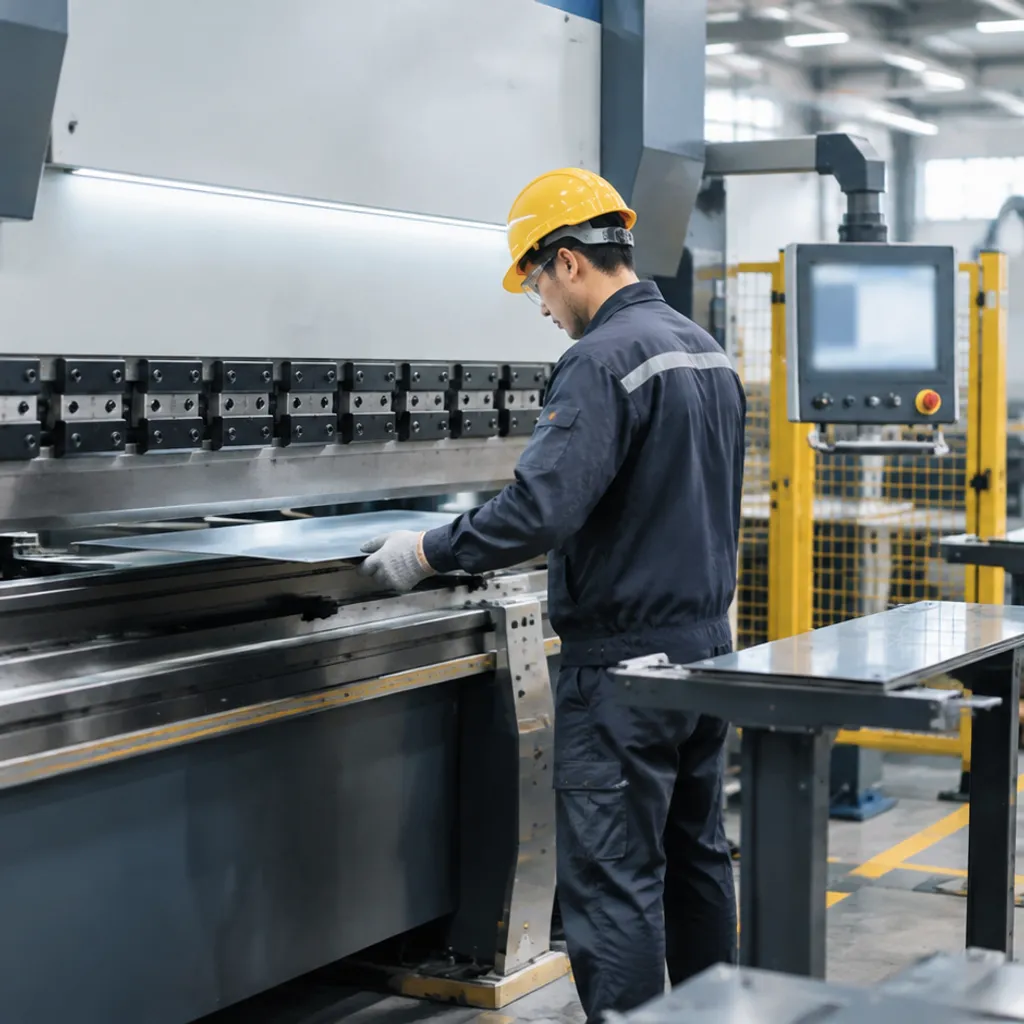

Anatomy of an NC Press Brake: Mechanics & Operational Limits
Understanding the core difference between nc and cnc press brake systems starts directly at the drive mechanism. A conventional NC (Numerical Control) press brake relies on rigid mechanical links to force parallel movement rather than dynamic electronic monitoring. While these workhorses handle simple 90-degree bends reliably, their mechanical architecture sets hard physical boundaries on speed, versatility, and precision.
Mechanical Torsion Bar Synchronization
In an NC press brake, ram parallelism is governed by a heavy mechanical torsion shaft running across the top or rear of the machine frame:
-
- Forced Mechanical Leveling: The torsion bar mechanically ties the left and right hydraulic cylinders together. When hydraulic fluid enters the cylinders, this rigid steel shaft forces both ends of the ram to move downward simultaneously.
- Lack of Independent Cylinder Control: Because both cylinders are physically tied to one shaft, the machine cannot adjust individual cylinder flow on the fly.
- Eccentric Load Vulnerability: If we bend off-center, uneven hydraulic resistance twists the torsion shaft slightly over time, resulting in uneven bend angles from left to right across the workpiece.
Stroke Control Mechanics and Lower Dead Point Limits
Ram penetration depth dictates your bend angle. In an nc vs cnc press brake comparison, the stroke control of an NC unit is strictly mechanical:
-
- Internal Mechanical Stops: Downward travel is physically halted by internal mechanical nuts built directly inside the hydraulic cylinders.
- Fixed Bottom Dead Center: The ram descends until the cylinder pistons physically hit these hard stops.
- Limited Angle Variation: Because the stroke relies on a physical dead stop, running multi-angle parts in a single pass is virtually impossible without stopping to mechanically reset stroke depths between steps.
Digital Display Control Units (E21 and E300 Capabilities)
Most NC machines run on entry-level controllers like the Estun E21 or E300:
-
- Basic Axis Positioning: These units are simple numerical positioning devices. They control an electric motor to position the backgauge (X-axis) and drive the mechanical stroke adjustment nuts inside the cylinders (Y-axis).
- Manual Parameter Input: You do not get automated bend sequence calculations. We must manually calculate the sheet metal bend allowance, stroke depth, and backgauge positions, then key those raw numbers into the numeric keypad.
- Basic Step Programming: Controllers like the E21 allow single-step positioning or simple multi-step programs, but they lack graphical interfaces, tool libraries, and dynamic angle correction algorithms.
Required Manual Adjustments and Mechanical Depth Stops
Operating an NC machine demands heavy operator involvement and constant manual fine-tuning:
-
- Trial-and-Error Calibrations: Setting a precise angle requires making test bends on scrap sheet metal, measuring with a protractor, and manually tweaking the mechanical stop position.
- Manual Crowning Shims: NC press brakes typically lack automated bed crowning. When long sheets suffer from the center "canoe effect" (over-bent ends and an open center), operators must manually insert paper or steel shims beneath the bottom die to level out the bend.
- Mechanical Drift: Physical wear on stop nuts, thermal expansion of hydraulic oil, and minor variations in sheet thickness require frequent manual recalibration throughout a long production run.
Anatomy of a CNC Press Brake: Electro-Hydraulic Precision
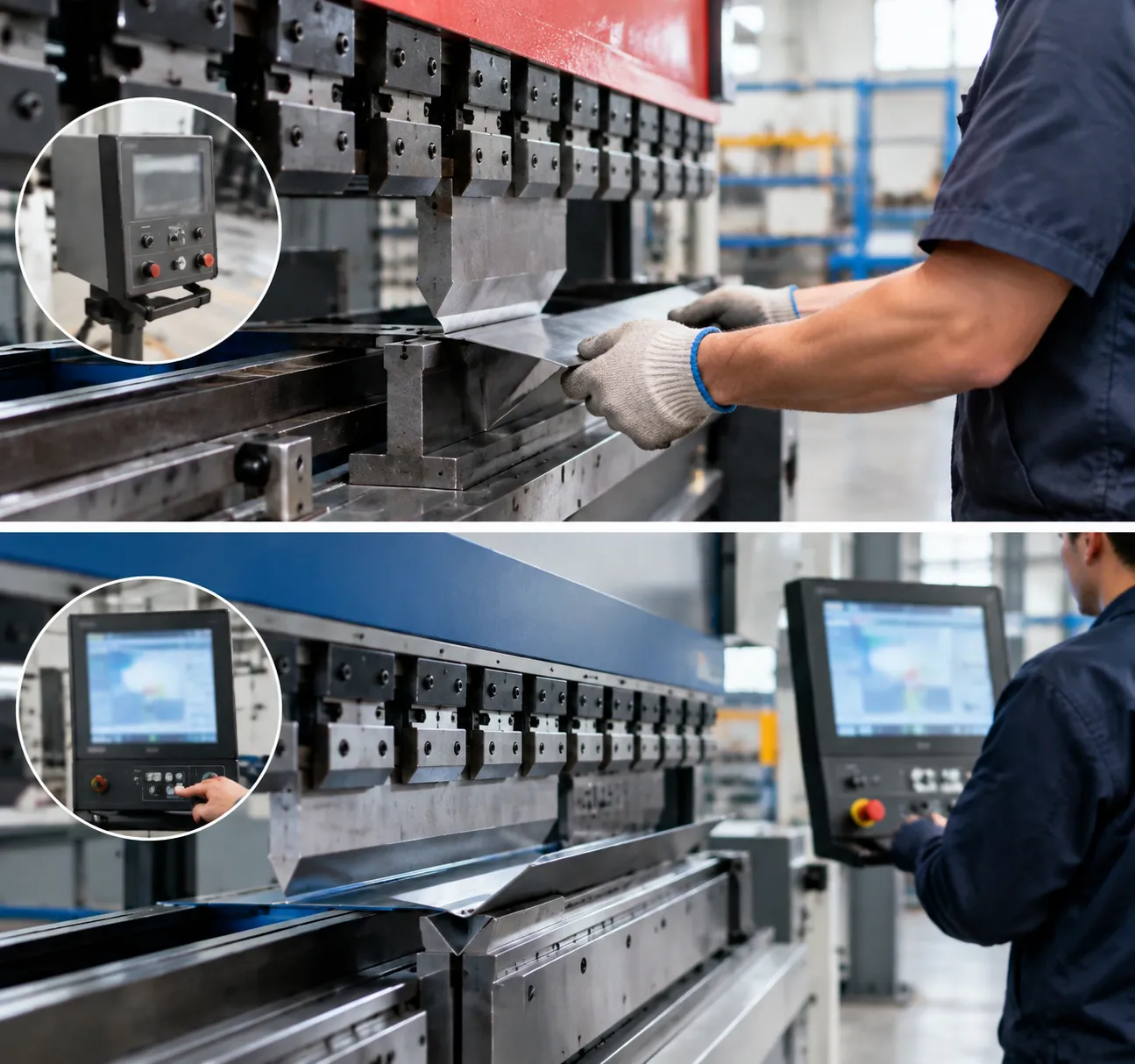
When evaluating the difference between nc and cnc press brake systems, the real technical divide lies in how the machine regulates hydraulic fluid and monitors ram movement in real time. Modern CNC hydraulic press brakes eliminate rigid mechanical links, replacing them with responsive electro-hydraulic servos and active digital feedback.
Closed-Loop Electro-Hydraulic Servo Synchronization
Rather than forcing both ends of the ram to move via a solid torque tube, a CNC machine treats each cylinder as an independent motion system:
-
- Proportional valve hydraulics: High-response valves meter hydraulic oil into the left and right cylinders independently.
- Closed-loop hydraulic system: The controller continuously reads ram position and modulates valve spool positions hundreds of times per second to maintain level descent.
- Safe off-center bending: Because the cylinders self-adjust on the fly, we can bend parts off-center or set up multi-station stage tooling without twisting the frame or scuffing seals.
Linear Optical Scales and Independent Y1/Y2 Micro-Feedback
Ram positioning accuracy defines the core operational split in an nc vs cnc press brake setup:
-
- Independent Y1 and Y2 control: High-precision optical linear scale feedback systems mount directly to independent C-frames on each side of the machine.
- Frame-deflection immunity: When heavy tonnages cause the side housings to stretch, the scales measure only the true physical distance between the punch and die, ignoring machine deflection entirely.
- Micro-level correction: The system measures ram position down to ±0.01 mm, catching and leveling out micro-lags before they translate into angle variations.
Advanced CNC Controllers with 2D/3D Simulation
Modern CNC interfaces shift the setup burden from manual operator calculations to automated machine processing:
-
- Collision detection: Touchscreen controls load 2D or 3D part profiles, automatically calculating the safest bend sequence while flagging potential interference with tooling or backgauges.
- Automatic bend allowance calculation: The software derives correct stretch factors and punch penetration depths instantly based on sheet thickness, material type, and tooling geometry.
- Offline programming integration: We can configure jobs directly from office CAD/CAM software and send programs over the network, keeping the machine bending rather than sitting idle during programming.
Automated Dynamic Deflection Crowning (V-Axis)
Under load, press brake beds naturally deflect in the center, which leaves long parts under-bent in the middle. CNC automation resolves this mechanically:
-
- Dynamic crowning compensation (V-axis): The controller reads part length, sheet thickness, and tonnage, then commands motorized mechanical wedges or hydraulic cylinders inside the lower bed to mirror the ram deflection.
- Uniform bend angles: Real-time compensation provides straight, consistent bends along the full length of the part without shims, trial bends, or operator guesswork.
NC vs. CNC Press Brake: Technical Specification Matrix
| Feature / Metric | Conventional NC Press Brake | Electro-Hydraulic CNC Press Brake |
|---|---|---|
| Standard Controlled Axes | 1 to 2 axes (Y stroke depth, X backgauge) | 3+1 to 8+1 axes (Y1, Y2, X, R, Z1, Z2, V) |
| Ram Synchronization | Mechanical torsion bar linking both cylinders | Independent Y1/Y2 dual proportional servo valves |
| Positioning Accuracy | ±0.05 mm to ±0.1 mm | ±0.01 mm via optical linear scale feedback |
| Deflection Compensation | Manual mechanical wedge (or none) | Dynamic automatic CNC crowning (V-axis) |
| Programming Interface | Numerical keypad, manual data entry | Touchscreen with 2D/3D graphical simulation |
| Tooling & Collision Checks | None (visual operator inspection only) | Automated 3D real-time collision detection |
| Average Job Setup Time | 15 to 45 minutes (test bends required) | 2 to 5 minutes (automated job recall) |
Control Axis Comparison: 2-Axis vs. Multi-Axis Configurations
The most obvious constraint of an NC machine is limited axis control. A standard NC unit handles two axes:
Y-axis: Controls the vertical travel depth using a mechanical stop inside the cylinder.
X-axis: Drives the backgauge forward and backward for flange length.
If you need height adjustment for backgauge fingers (R-axis) or side-to-side spacing (Z1/Z2 axes), your operator must adjust them by hand with handwheels.
In an nc vs cnc press brake comparison, modern CNC systems give you full multi axis bending control. With synchronized Y1 and Y2 cylinders, independent X, R, and split Z1/Z2 backgauge fingers, the machine positions itself automatically for tapered bends, stepped flanges, and complex multi-station setups without manual intervention.
Positioning Repeatability and Ram Leveling Accuracy
We measure sheet metal bending accuracy by how consistently the ram hits its target depth across thousands of cycles:
-
- NC Press Brakes: Rely on mechanical cylinder depth stops and a rigid torsion bar. Over long shifts, thermal expansion of the hydraulic oil and mechanical play degrade angle repeatability tolerance, often drifting by ±0.05 mm to ±0.1 mm. The ram also cannot be electronically tilted for fade bends.
- CNC Press Brakes: Utilize closed-loop linear encoders mounted to independent C-frames. These scales read actual ram position in real time at ±0.01 mm precision, completely isolating the measurement from machine bed deflection. Proportional hydraulic valves constantly balance the Y1 and Y2 cylinders, ensuring uniform angles from one end of the bed to the other.
Tooling Protection and Real-Time Collision Avoidance
Tool crashes cost thousands in damaged punches, broken dies, and machine downtime.
On an NC machine, there are no software safeguards. If an operator miscalculates the bend sequence, sets the backgauge too close to the punch, or forgets part clearance, the machine completes the stroke regardless.
A CNC controller runs real-time collision detection. Before the ram moves, the 2D/3D graphical simulation verifies:
Flange clearance against the upper beam and machine frame
Backgauge finger positioning relative to the punch and die
Correct bend sequence to avoid trapping the part inside the tool
If a interference risk exists, the CNC system halts the cycle and alerts the operator before any steel touches.
Operator Skill Requirements and Setup Cycle Times
Finding experienced press brake operators is one of the toughest challenges in manufacturing today.
Running an NC press brake requires seasoned craftspeople. The operator must calculate bend allowances by hand, shim the tooling bed to offset center sag, and sacrifice scrap sheets on trial bends to dial in the correct angle. Switching between different profiles can take anywhere from 20 to 45 minutes.
A CNC press brake shifts that workload from operator skill to software automation. The controller automatically calculates bend deductions, tool assignments, and crowning values based on material thickness and tensile strength. A junior operator can recall a saved program, load the tooling shown on the screen, and achieve an accurate bend on the very first piece. This reduces setup cycles down to under five minutes, keeping overall throughput aligned with modern plate rolling and forming solutions across the plant.
5 Critical Technical Differences Impacting Production
When evaluating an nc vs cnc press brake, the real distinction comes down to how each machine manages mechanical forces, axis movement, and material variance. Here is a breakdown of the primary engineering differences that directly dictate daily output, scrap rates, and part quality.
| Feature / Mechanism | NC Press Brake | CNC Press Brake |
|---|---|---|
| Ram Synchronization | Mechanical torsion bar shaft | Independent Y1/Y2 dual proportional valves |
| Position Feedback | Motor encoder / cylinder mechanical stop | Dual optical linear scale feedback (+/- 0.01 mm) |
| Backgauge Capability | 1 to 2 axes (standard X, manual R) | Multi-axis (X, R, Z1, Z2, Delta X) |
| Bed Deflection Control | Manual shims or static hand wedges | Dynamic crowning compensation (V-axis) |
| Part Setup & Prototyping | Trial bends, manual calculation, test scrap | 2D/3D graphical simulation & offline CAD/CAM |
Synchronization Mechanism: Torsion Shaft vs. Dual Proportional Valves
The core mechanical difference between nc and cnc press brake systems lies in ram leveling:
-
- NC Torsion Bar Synchronization: A solid steel torque shaft mechanically connects the left and right hydraulic cylinders. This physical linkage forces both cylinders to travel together. However, it cannot correct for uneven hydraulic resistance in real time. If you attempt off-center eccentric bending, the torsion bar twists under load, causing severe angle variations across the part and premature bushing wear.
- CNC Electro-Hydraulic Synchronization: The ram eliminates mechanical links entirely. Instead, it relies on independent Y1 and Y2 control powered by proportional valve hydraulics. High-resolution optical linear scale feedback continuously monitors both ends of the ram, making dynamic fluid adjustments hundreds of times per second. Even under heavy off-center loads, both cylinders remain perfectly level within +/- 0.01 mm.
Backgauge Flexibility: Simple Stops vs. Multi-Axis (X, R, Z1, Z2) Control
Your backgauge determines whether you can form multi-stage, complex geometries in a single handling cycle:
-
- NC Backgauges: Typically limited to a basic single-axis motorized stop (X-axis) for depth. Adjusting finger height (R-axis) or moving fingers horizontally across the die requires the operator to pause, reach into the machine, and manually turn handwheels. Tapered flanges or stepped bends are nearly impossible without custom jigs.
- CNC Multi-Axis Backgauges: Offer fully synchronized multi-axis control, typically configurable from 3+1 up to 8+1 axes. The controller drives the depth (X), height (R), and independent lateral movement (Z1, Z2) automatically between each stroke. When integrating advanced sheet metal bending solutions, this multi-axis agility allows fabricators to stage different tool sets along the bed and complete complex parts in one uninterrupted setup.
Deflection Compensation: Avoiding the Canoe Effect Across Long Sheets
Under bending pressure, both the upper ram and the lower bed naturally bow away from each other. Without compensation, the punch penetrates deeper at the ends than in the center, producing the classic "canoe effect"—where the bend angle is tight on the edges and open in the middle.
-
- NC Compensation Limits: Torsion bar machines rely entirely on operator manual shimming underneath the dies or basic hand-crank mechanical wedges. Getting an even 90-degree bend across a 10-foot sheet often requires multiple test runs and tedious manual adjustments.
- CNC Dynamic Crowning (V-Axis): The CNC controller calculates the precise deflection based on sheet thickness, material tensile strength, tooling specs, and bending tonnage. It then engages hydraulic cylinders or motorized mechanical wedges embedded inside the lower bed to actively counteract machine bed deflection during the stroke. The result is a uniform bend angle across the entire working length on the very first hit.
Programming Workflow: Trial Bend Scrap vs. Offline CAD/CAM Automation
Programming efficiency separates low-volume bottlenecks from rapid job turnaround:
-
- NC Step-by-Step Programming: An operator on an NC machine inputs target stroke depths and backgauge positions into a numerical keypad (such as an E21 or E300 unit). Calculating the correct sheet metal bend allowance requires manual chart lookups. Fabricators routinely burn through two or three test blanks to dial in angle accuracy before running actual parts.
- CNC 2D/3D Simulation: Parts are programmed either directly via touch-screen controllers or imported from offline 3D CAD/CAM software. The control automatically detects collision risks, defines the optimal bend sequence, selects proper tooling, and sets precise axis stops. Operators execute the first piece with complete confidence, virtually eliminating setup scrap.
Handling Material Variations: Tensile Strength and Sheet Thickness Deviations
Commercial sheet metal is never uniform; mill runs regularly fluctuate in gauge thickness and yield strength.
-
- NC Vulnerability: Because NC machines descend to a fixed mechanical cylinder depth stop, any variance in sheet thickness shifts the bend angle immediately. A 0.2 mm increase in plate thickness results in severe over-bending, while a lower yield strength leaves bends under-formed. The operator must stop and manually reset depth limits for each new batch.
- CNC Adaptive Stability: Electro-hydraulic CNC units rely on closed-loop feedback and optional real-time laser angle-measuring systems. The machine senses resistance variations and adjusts ram depth dynamically, ensuring tight angle repeatability tolerance even when switching between different material coils or suppliers.
Financial Analysis: Upfront Investment vs. Long-Term ROI
When evaluating the difference between nc and cnc press brake investments, sticker price is only the starting point. We constantly see shop owners focus on the lower initial purchase price of an NC unit, only to watch secondary operational expenses erode their profit margins within two years.
Purchase Price vs. Total Cost of Ownership (TCO)
An NC torsion bar machine requires a fraction of the initial capital of an electro-hydraulic CNC unit. However, the true financial impact reveals itself across tool wear, electrical efficiency, and setup labor.
| Cost Factor | NC Press Brake (Torsion Bar) | CNC Press Brake (Electro-Hydraulic) |
|---|---|---|
| Initial Capital Expense | Low (entry-level budget) | Moderate to high |
| Setup & Changeover Labor | High (15–45 minutes per profile) | Minimal (2–5 minutes via stored programs) |
| Scrap Rate on Setups | 2–5 test parts per new job | Zero to 1 test piece (software verified) |
| Maintenance & Wear | Mechanical linkage & seal maintenance | Valve & hydraulic fluid maintenance |
| Operator Wage Dependency | Requires experienced, higher-paid veterans | Can be run efficiently by standard operators |
While the NC machine saves money on day one, a CNC press brake offsets its premium through faster cycle times and drastically reduced labor overhead.
Mitigating the Skilled Operator Shortage with Automation
Finding seasoned fabricators who can manually dial in bend angles, calculate bend allowances on paper, and shim dies by feel has become nearly impossible.
-
- NC machines demand veteran talent: The operator must manually calculate depth stops, dial in backgauge dimensions, and physically adjust mechanical wedges for crowning.
- CNC units bridge the labor gap: The controller handles bend sequences, sheet thickness compensation, and axis positioning automatically. With 2D/3D visual step-by-step guides, newer operators achieve target angles on their first shift without risking machine collisions.
In the ongoing nc vs cnc press brake evaluation, CNC automation safeguards your workshop from production shutdowns caused by talent shortages.
Throughput Comparison: High-Volume Runs vs. High-Mix Low-Volume Jobs
Your job mix dictates machine payback speed:
-
- High-Volume, Simple Runs: If your shop bends thousands of identical brackets with single 90-degree bends, an NC machine gets the job done at low capital cost. Setup happens once, and the machine runs continuously.
- High-Mix, Low-Volume Fabrication: In custom job shops handling short batches of complex panels, an NC machine becomes an operational bottleneck. Constantly resetting manual stops drains productive machine hours.
To keep pace when blanks arrive quickly from advanced sheet metal cutting solutions, an electro-hydraulic CNC press brake provides rapid job recall and automated backgauge transitions, keeping forming operations synchronized with high-speed cutting.
Raw Material Scrap Reduction on Expensive Sheet Metals
Every trial bend on an NC press brake is wasted inventory. When bending structural mild steel, a scrap part or two is frustrating; when running mirror-finish stainless steel, high-tensile alloys, or pre-anodized aluminum, setup scrap devastates profitability.
A CNC press brake uses precise Y1/Y2 cylinder positioning, automatic V-axis dynamic crowning, and accurate bend database calculation to hit the correct angle on the very first strike. Eliminating trial bends protects expensive stock and keeps material yields consistently predictable.
Selection Guide: Choosing the Right Press Brake for Your Shop Floor
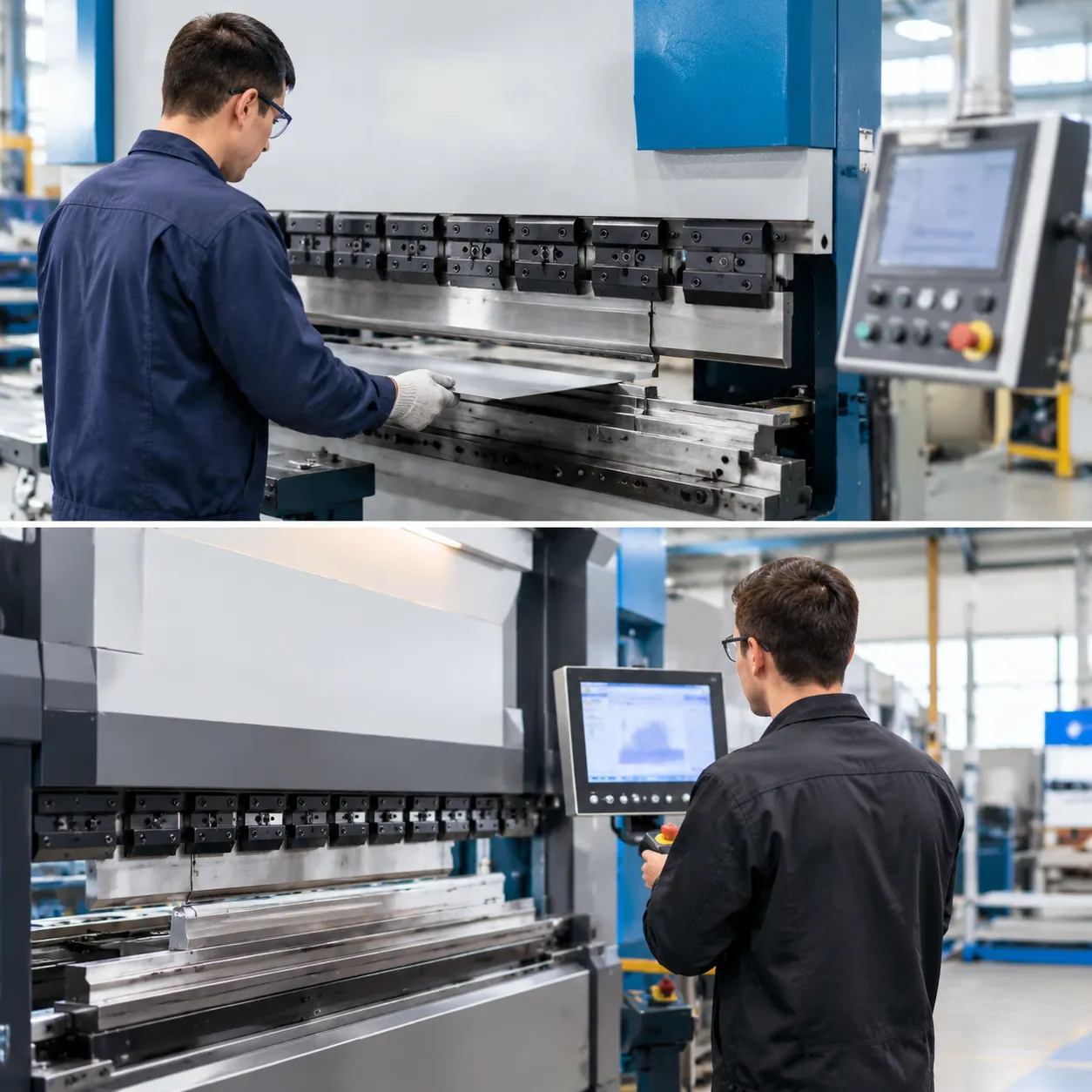
Navigating the difference between nc and cnc press brake models comes down to your shop's day-to-day part geometry, order velocity, and labor pool. We see fabricators struggle when they buy based on machine sticker price alone rather than part flow. Choosing between an entry-level torsion bar unit and an advanced electro-hydraulic platform requires weighing immediate capital outlay against part cycle times and scrap rates.
When a Conventional NC Press Brake Makes Economic Sense
A conventional NC press brake remains a viable workhorse under specific operating conditions:
-
- Single-Stage, Simple Geometries: If your production consists primarily of basic brackets, simple 90-degree channels, or flat enclosures with uniform sheet thicknesses, an NC machine delivers reliable output without unnecessary complexity.
- Long Production Runs: When your operators run thousands of the exact same part over multiple shifts, setup time becomes negligible on a per-part basis. Once mechanical cylinder depth stops are dialed in, the machine holds sufficient repeatability for non-critical assemblies.
- Generous Tolerance Thresholds: For structural applications, heavy plate framing, or agricultural equipment where bend tolerances of ±0.5 mm or higher are acceptable, mechanical torsion bar synchronization handles the workload reliably.
- Strict Capital Constraints: When cash flow demands the lowest entry price to get forming capacity onto the floor, an NC unit provides basic hydraulic tonnage at a fraction of the initial investment.
When an Electro-Hydraulic CNC Press Brake is Non-Negotiable
Upgrading to an electro-hydraulic servo press brake becomes essential as soon as component complexity and delivery schedules tighten:
-
- High-Mix, Low-Volume Fabrication: In custom contract manufacturing where jobs change several times per shift, offline programming and 2D/3D graphical simulation eliminate hours of manual tool positioning and trial bends.
- Multi-Bend Progressive Tooling: Complex enclosures requiring varied flange heights, acute pre-bends, and offset tooling require independent Y1, Y2 control paired with a multi-axis backgauge (X, R, Z1, Z2) to position parts in a single handling sequence.
- Strict Angle Repeatability Requirements: When downstream processes involve robotic welding, automated panel assembly, or precision aerospace integration, you need closed-loop optical linear scale feedback delivering an angle repeatability tolerance within ±0.01 mm.
- Long Bed Lengths Without Shimming: Any shop forming parts longer than 2.5 meters needs automated dynamic crowning compensation (V-axis) to counter machine bed deflection and prevent the canoe effect across the entire bend length.
To see how modern synchronized systems align with dynamic shop demands, explore our range of high-performance press brakes designed for rapid changeovers and tight-tolerance production.
Key Purchasing Criteria: Tolerance Limits, Run Sizes, and Part Complexity
When evaluating nc vs cnc press brake options for your operation, score your typical production runs against these benchmarks:
-
- Tolerance Windows: If your engineering prints specify bend angle tolerances under ±0.5 degrees and linear tolerances under ±0.2 mm, opt for CNC. The mechanical stop drift on basic NC machines makes maintaining these standards cost-prohibitive.
- Batch Sizing & Changeover Frequency: If you run fewer than 50 parts per batch, the setup speed of a CNC controller pays for itself. If your runs exceed 500 identical pieces and changeovers happen once a week, NC remains cost-effective.
- Part Geometry & Flange Variance: Complex parts with narrow flanges, tapered edges, or multi-step profiles demand automated backgauge retraction and dynamic R-axis height control. Simple, single-bend parts can be processed efficiently with standard two-axis stops.
- Operator Skill Availability: Veteran press brake operators who can calculate sheet metal bend allowance manually and feel material springback are increasingly rare. Modern CNC systems calculate bend deduction and crown settings automatically, letting newer operators produce precise parts immediately.
For a deeper dive into capital equipment evaluation and payback models, review our dedicated machinery buying guides to confirm the right tonnage, stroke length, and axis configuration for your facility.
Frequently Asked Questions: NC vs. CNC Press Brake
Can an NC press brake be converted into a CNC synchronized press brake?
Technically, you can retrofit an NC machine with an upgraded digital backgauge, but you cannot convert a mechanical torsion bar machine into a true electro-hydraulic CNC press brake economically. A genuine CNC machine relies on independent Y1 and Y2 proportional valves, optical linear scale feedback, and a dedicated hydraulic manifold. Re-engineering a torsion bar frame with independent hydraulic circuits and scale mounts costs almost as much as purchasing a factory-built electro-hydraulic servo press brake. When we evaluate shop upgrades, a full machine replacement consistently delivers better long-term reliability and lower overall downtime.
Why does an NC press brake lose bend angle uniformity on long parts?
Machine bed deflection is the primary culprit. When the ram exerts tonnage across a long workpiece, the center of the upper ram flexes upward while the lower bed sags downward, creating the common "canoe effect." Because an NC press brake uses fixed mechanical cylinder depth stops and lacks dynamic crowning compensation (V-axis), the punch penetrates deeper at the ends than in the middle. This variance leaves open angles in the center and sharp angles at the edges. Correcting this on an NC machine requires manual shimming or static wedge adjustments, whereas a CNC machine calculates and applies deflection compensation automatically in real time.
Is off-center or eccentric bending safe on a torsion bar machine?
We strongly advise against off-center bending on an NC torsion bar machine. Torsion bar synchronization relies on a solid mechanical shaft to force both hydraulic cylinders to travel together. When you bend heavy sheet metal on one side of the bed, the uneven load twists the shaft, strains the mechanical linkages, and causes premature wear on the hydraulic cylinder packings. In contrast, an electro-hydraulic CNC press brake handles off-center work safely because independent Y1 and Y2 hydraulic valves dynamically compensate for uneven loads using micrometer-level linear scale readings.
How much setup time do you save switching from NC to CNC?
In typical sheet metal fabrication runs, switching from an NC unit to a CNC press brake cuts setup time by 60% to 80%. An NC machine demands manual backgauge fine-tuning, physical test bends, and scrap adjustments to dial in angle repeatability tolerance. A CNC controller calculates bend sequences, flange deductions, and sheet metal bend allowance automatically from tooling profiles and material properties. For shops handling high-mix low-volume production or looking beyond traditional press brakes toward fully automated robotic panel bending cells, this software-driven automation eliminates test bend scrap entirely on day one.