Formula details
Product Details
Overview
Core Capabilities and Performance Metrics
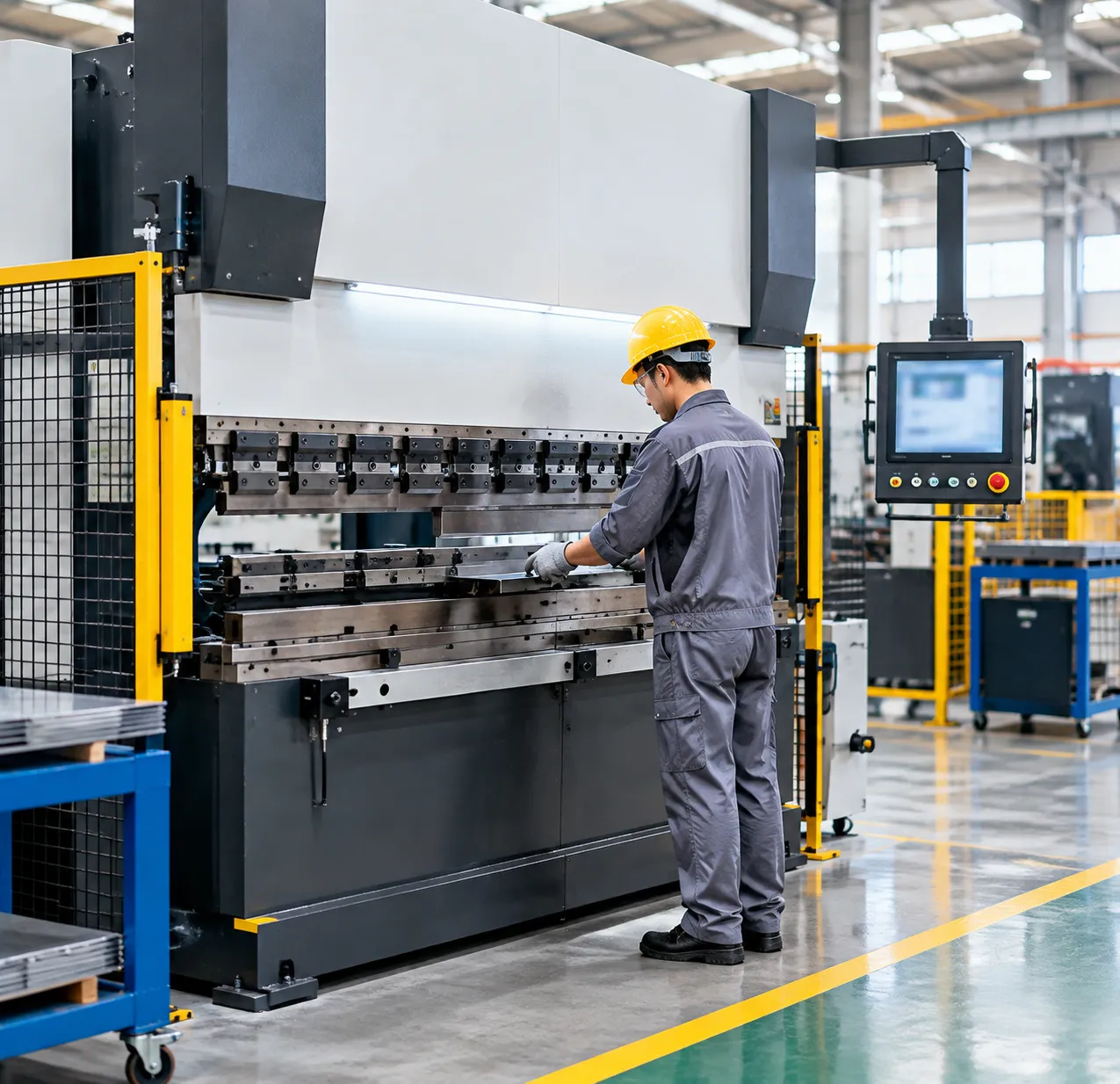
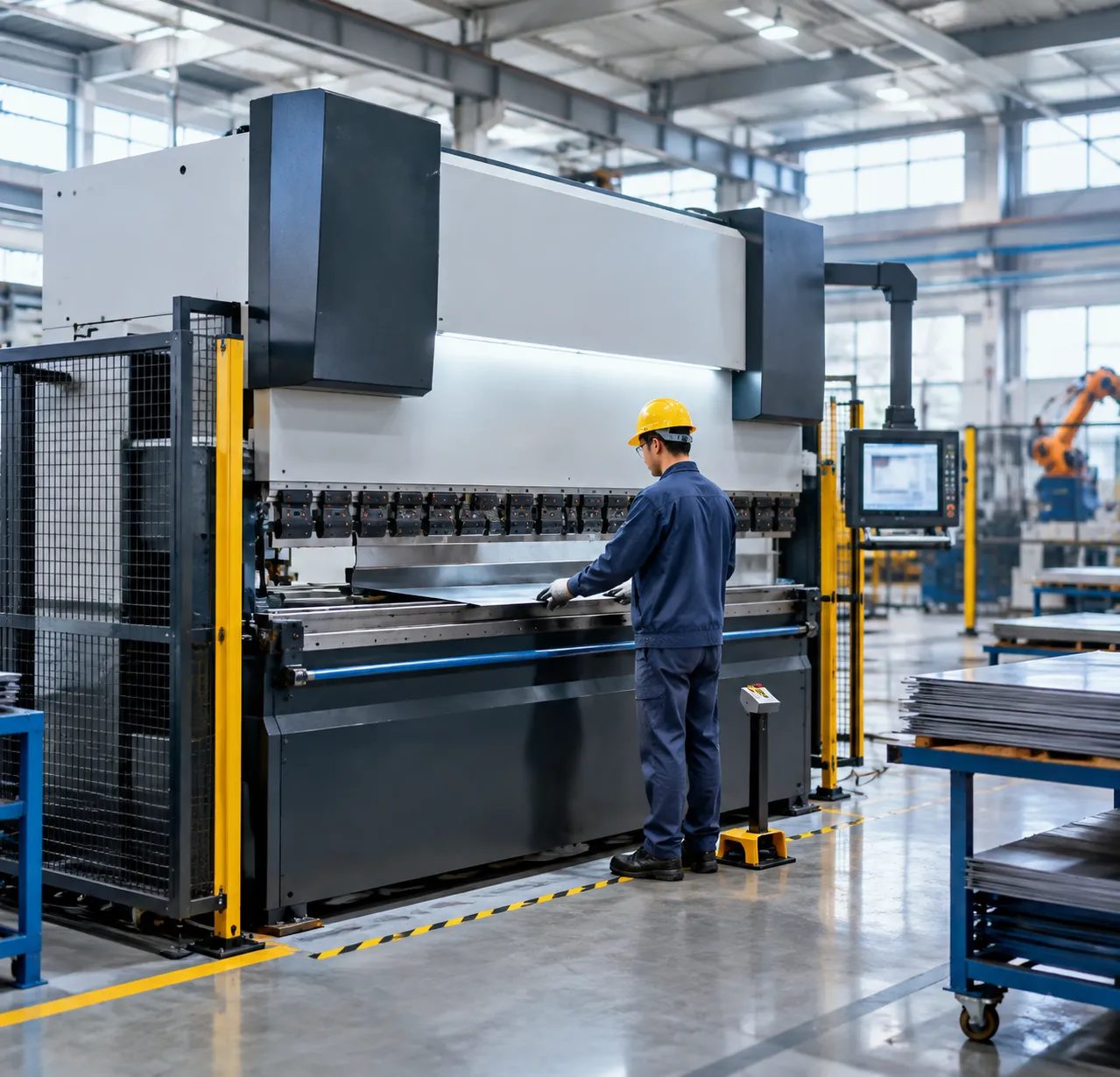
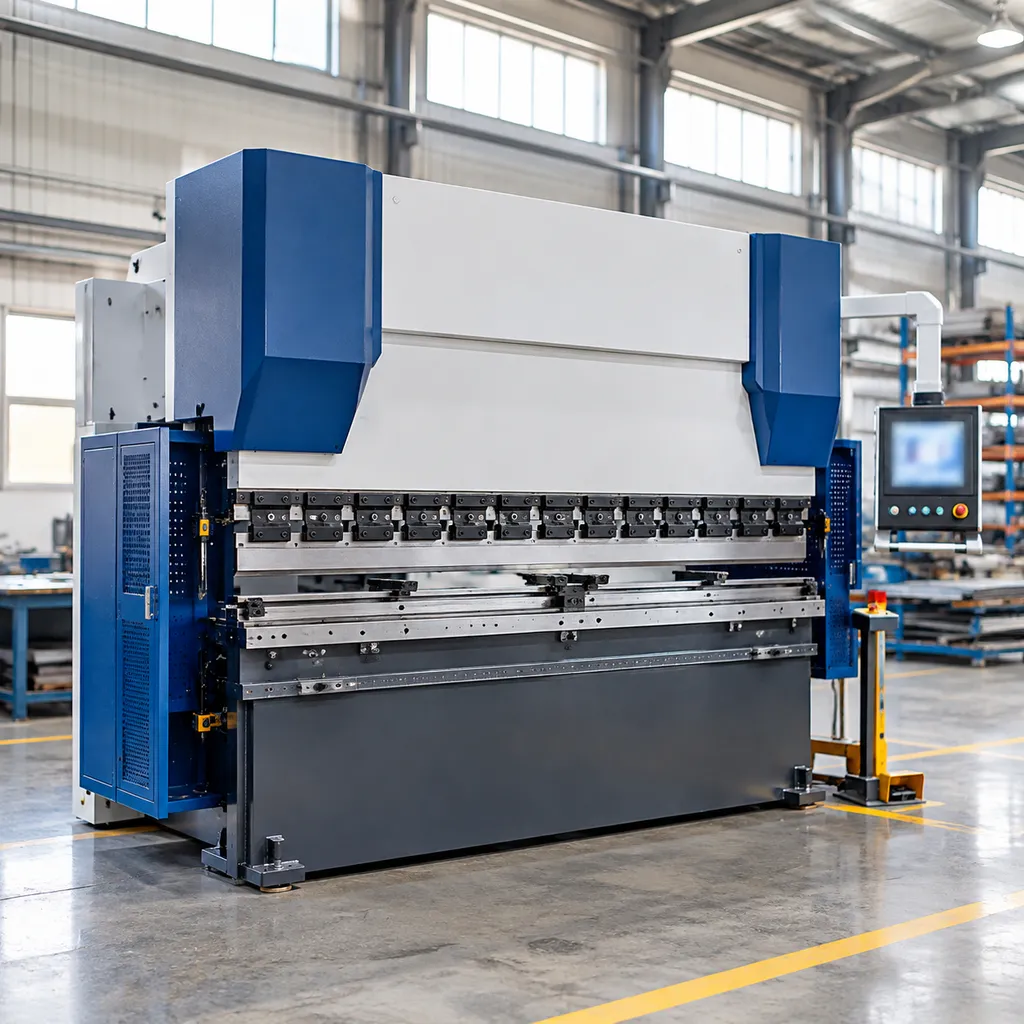
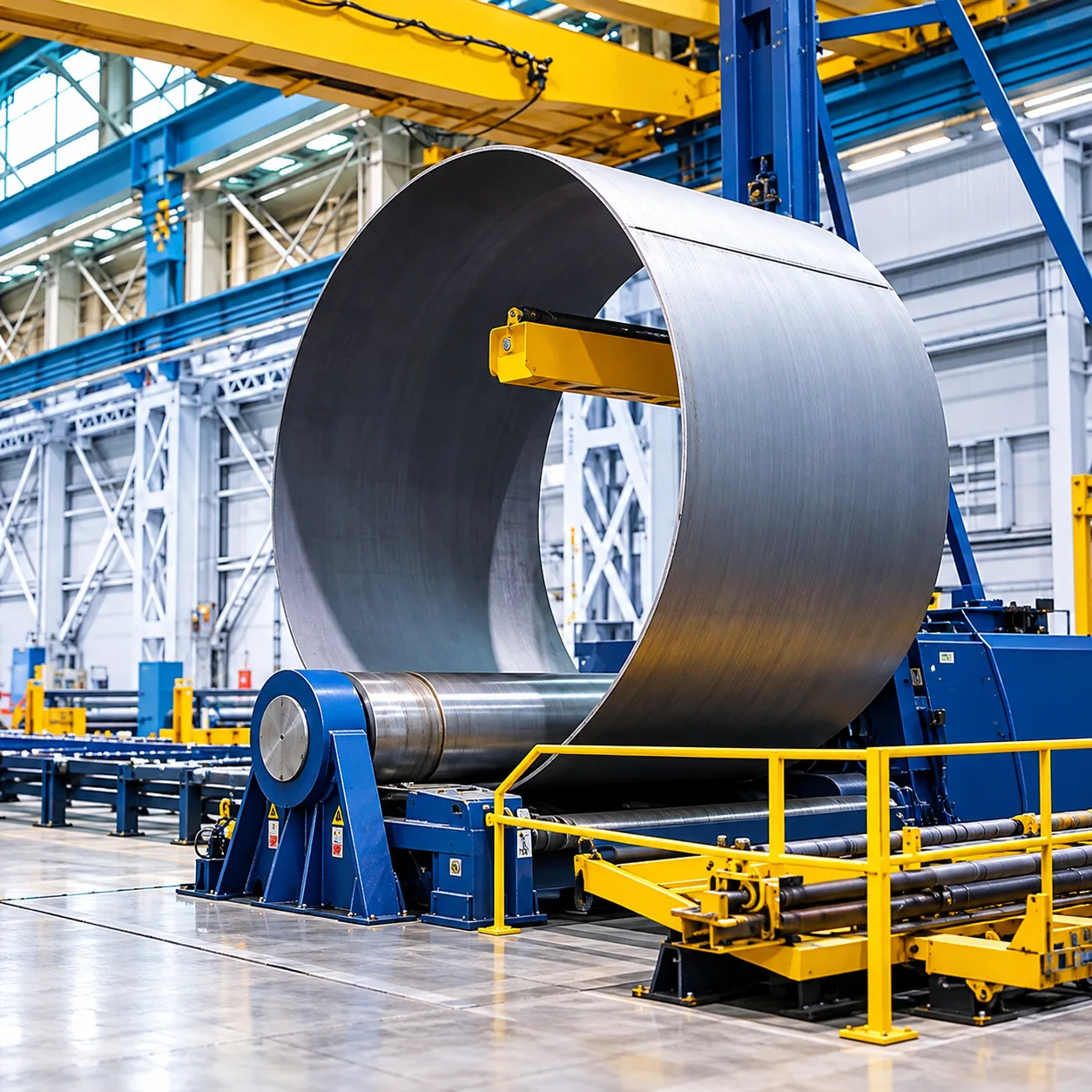
Our wind tower plate rolling machine is engineered to eliminate edge flat spots, plate slippage, and structural barrel distortion during heavy can production. Designed for multi-megawatt onshore and offshore wind turbine production lines, this heavy-duty system delivers the continuous forming tonnage required to shape high-yield structural steel into precision cylindrical and conical shells.
Maximum Cold Bending Thickness and Yield Strength Handling
Fabricating next-generation wind towers requires cold forming high-tensile steels without cracking or plastic deformation failure.
-
- Yield Strength Thresholds: Configured to cold-bend structural grades from standard S355 up to extra-high-yield S420, S460, and S500 steel.
- Cold Forming Thickness: Generates extreme hydraulic clamping and bending force to cold-roll plates up to 120 mm (4.72 in) thick, with hot-rolling options exceeding 160 mm.
- Torque Delivery: High-output hydraulic motors coupled to planetary gearboxes feed immense drive torque directly into the working rolls, preventing stall under full cold-forming loads.
Working Roll Length and Shell Diameter Envelope
Modern tower design demands wider plates to eliminate circumferential welds and optimize production cycles. Our machinery easily accommodates extra-wide, large-diameter steel plates:
-
- Roll Working Length: Standard lengths from 3,000 mm to 4,200 mm, accepting the widest commercial plate sizes to maximize single-can length.
- Maximum Shell Diameters: Expands beyond 8,000 mm (26.2 ft) for large offshore foundations and transition pieces.
- Minimum Shell Diameters: Tight-forming geometry allows bending down to 1.1 to 1.3 times the top roll diameter, making it capable of forming narrower top-tier tower cans on the same machine.
| Performance Parameter | Standard Range | Heavy Offshore Configuration |
|---|---|---|
| Max Cold Bending Thickness | 40 mm – 80 mm | Up to 120 mm (Yield Strength 355–460 MPa) |
| Working Roll Length | 3,000 mm – 3,500 mm | 4,000 mm – 4,200 mm |
| Shell Diameter Capacity | 1,500 mm – 5,500 mm | 2,000 mm – 8,500+ mm |
| Residual Flat End Length | ≤ 1.5x – 2x Plate Thickness | ≤ 1.5x – 1.8x Plate Thickness |
Pre-Bending Residual Flat Length Minimization
Unformed flat ends at the plate edges create major seam misalignment during downstream submerged arc welding (SAW). Our hydraulic 4-roll geometry solves this challenge at the source:
-
- Direct Pinch Clamping: The bottom central roll locks the leading and trailing edges against the top roll with continuous hydraulic tonnage, locking the material in place before bending begins.
- Minimal Unbent Edge: Residual flat zones are reduced to 1.5 to 2 times the nominal plate thickness, cutting down flat-end waste and eliminating secondary pre-bending press operations.
- Continuous Edge Curvature: Side rolls articulate upward along planetary swing guides to generate uniform curvature right to the very edge of the plate, guaranteeing perfect roundness and circular fit-up for longitudinal welding.
Heavy-Duty 4-Roll Machine Architecture
We build our frames using high-yield normalized steel weldments and heavy forged housings, eliminating structural flex under peak bending loads.
Independent Hydraulic Drives with Dynamic Speed Synchronization
To eliminate plate slippage and surface scuffing on structural steels, our heavy-duty plate rolling machines utilize independent drive systems:
-
- Direct-coupled hydraulic motors: Top and bottom rolls feature dedicated high-torque hydraulic motors paired with planetary gearboxes.
- Real-time peripheral speed matching: Digital closed-loop control dynamically synchronizes roll surface speeds during both pre-bending and continuous cylindrical rolling.
- Automatic anti-slip torque regulation: Clamping pressure automatically balances against rolling resistance to maintain positive traction without thinning the plate.
Planetary Roll Guide Mechanism for High Power Transfer
We implement a curved planetary swing-arm guide system for the side forming rolls rather than conventional linear slides:
-
- Direct force transmission: Side roll bending forces push directly toward the top roll center, delivering up to 95% mechanical power efficiency.
- Zero sliding friction: Eliminates gib wear, sticking, and play over millions of operating cycles.
- Tighter bending geometry: Allows side rolls to move deeper under the top roll for tighter initial pre-bending radii.
Heavy Forged Steel Frame Rigidity and Load Distribution
Wind tower sections demand uncompromising geometric stability. We ensure repeatable roundness through structural over-engineering:
| Structural Feature | Engineering Specification | Fabrication Benefit |
|---|---|---|
| Main Frame Material | Ultrasonic-tested Q355B/S355 structural steel | Maximum resistance against frame distortion |
| Stress Relief | Full thermal annealing post-welding | Eliminates residual weld stress to prevent long-term frame drift |
| Bearing Housings | Heavy forged alloy steel housings | Evenly distributes peak radial loads to the foundation |
| Drop-End Yoke | Hydraulic tilting design with rigid mechanical lock | Stable release mechanism during shell removal |
Dynamic Deflection Compensation and Crowning
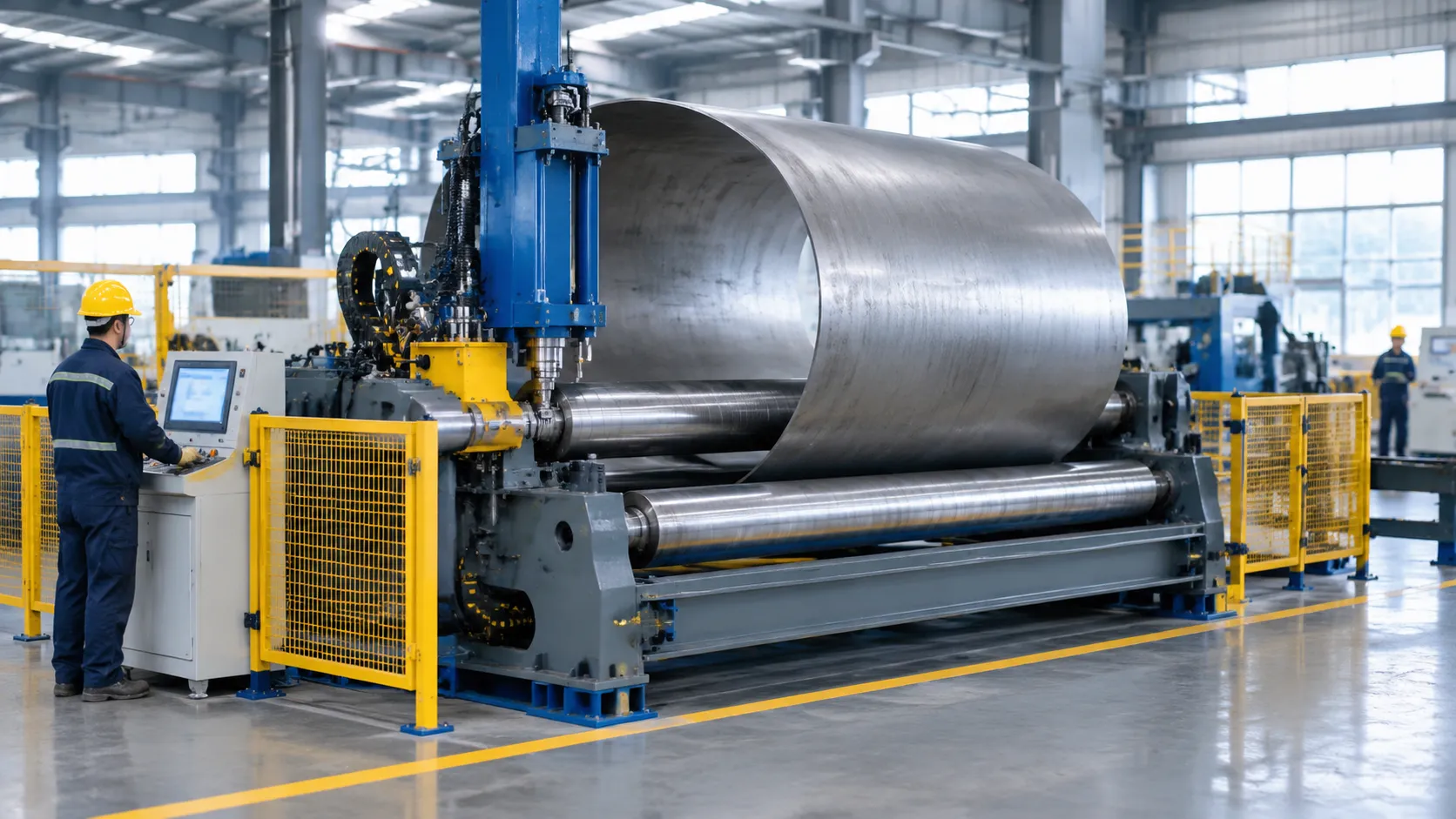
Roll deflection is the primary cause of out-of-round cans and uneven weld gaps in heavy-plate fabrication. When bending thick structural steel over long spans, the physical loads push the centers of the rolls apart, yielding an hourglass cross-section with uneven diameters along the shell. Our wind tower plate rolling machine integrates advanced dynamic deflection compensation to keep your cylinder profiles true from edge to edge.
Multi-Zone Hydraulic Counter-Crowning Systems
We engineer our roll architecture with both calculated mechanical crowning and active hydraulic compensation to manage extreme forming loads.
-
- Active Lower Roll Pre-Stressing: Multi-cylinder hydraulic support blocks sit directly beneath the bottom roll assembly. As rolling pressures rise, these proportional cylinders apply counteracting upward thrust along dedicated load zones.
- Proportional Force Distribution: Integrated pressure sensors measure bending resistance across the plate in real time. The system automatically balances hydraulic counter-thrust to mirror the deflection curve of the top roll.
- Broad Gauge Adaptability: Standard fixed-crown machines only deliver true cylinders at one specific plate thickness and yield strength. Our multi-zone hydraulic counter-crowning system dynamically adjusts, allowing you to run thin transitional cans and thick base shells on the same hydraulic plate rolling machine without roll changeouts.
Eliminating the Barrel Effect on Long Cylinders
When rolling cylinders that span 3,000 mm to 4,200 mm in width, uncompensated roll flex causes the classic "barrel effect"—where the outer ends pinch tight while the center remains under-bent.
-
- Uniform Center Curvature: Dynamic counter-deflection forces the center line of the plate into the exact radius formed at the roll ends.
- Flawless Edge Matching: Diameters match uniformly across the entire length of the rolled can, eliminating hourglassing and barrel tapers completely.
- Zero Secondary Rework: Operators bypass the time-consuming process of using hydraulic portal jacks or re-rolling passes to manually force center sections into tolerance.
Ensuring Seam Straightness for Downstream Submerged Arc Welding
Longitudinal seam alignment directly dictates cycle times in high-output wind energy fabrication lines. Inconsistent roll profiles create peaked seams or hour-glass gaps that stall automated welding workflows.
-
- Parallel Joint Gaps: By maintaining parallel contact across the entire roll face, our cylindrical shell rolling machine guarantees tight, parallel longitudinal seams with gap tolerances held within ±0.5 mm.
- Smooth SAW Tracker Engagement: Straight, uniform seams allow submerged arc welding (SAW) tractors and automated seam tracking sensors to track the joint without manual steering interventions, blow-throughs, or lack-of-fusion defects.
- Rapid Fit-Up Coupling: True cylindrical geometry means adjacent cans align flush on rotators with minimal root-gap variance, cutting roundness-calibration and fit-up time by up to 40%. Accurate preparation works hand in hand with precision plate cutting, where our high-performance sheet and tube laser cutting machines prepare weld-ready edges that roll tight and true on every pass.
High-Torque Pre-Bending and Conical Rolling
Bottom Roll High-Pressure Clamping
-
- Zero Plate Slippage: Dual hydraulic cylinders lock the bottom central roll against the top roll with continuous, regulated tonnage, pinching the heavy steel plate firmly.
- Consistent Yielding: Maintains positive drive traction during initial pre-bending passes, even on thick high-yield structural plates.
- Edge Accuracy: Clamping pressure prevents plate kick-back, keeping the plate parallel to roll axes for tight seam closure.
Direct Double-Edge Pre-Bending
-
- Single-Pass Setup: We engineer our heavy duty plate bending rolls to pre-bend both the leading and trailing plate edges without turning or flipping the plate.
- Minimized Residual Flats: Tight roll center distances reduce unbent flat ends down to 1.5 to 2 times plate thickness, slashing downstream seam calibration times.
- Cycle Time Reduction: Continuous forward-and-reverse feeding cycles complete pre-bending and circular rolling in one uninterrupted operation.
Tilting Rolls for Steep-Tapered Cone Cans
-
- Multi-Axis Independent Tilting: Both side bending rolls and the lower clamping roll tilt hydraulically to match steep conical geometries for wind tower transition sections.
- Electronic Tilt Synchronization: Linear transducers track individual roll tilt angles, ensuring symmetrical forming across variable cone radii.
- Adaptive Radius Control: Fully integrated into our CNC cone rolling machine software for automated multi-pass cone generation.
Hardened Thrust Roll Guide Shoe
Forming heavy cones generates extreme axial thrust forces that push plates off-center. We control this via heavy-duty mechanical stabilizers:
| Feature | Specification / Function |
|---|---|
| Material Build | Induction-hardened forged alloy steel contact surface |
| Axial Force Handling | Absorbs high side-thrust loads during heavy plate cone rolling |
| Plate Protection | Low-friction roller design eliminates edge scouring and surface gouging |
| Positioning | Manually or hydraulically adjustable to fit varying cone diameters |
Integrated Plate Handling and Auxiliary Support
Rolling large-diameter, thin-wall shells presents a constant risk of plate sag, ovality deformation, and dangerous overhead collapse. To maintain tight roundness tolerances and safeguard shop floor operators, our wind tower plate rolling machine integrates a synchronized material handling suite directly into the primary hydraulic circuit.
Hydraulic Overhead Gantry Support
Large cans inevitably deform under their own dead weight once the bend passes 180 degrees. Our vertical overhead plate support system eliminates this issue:
Anti-Collapse Stability: A hydraulic lifting crane supports diameters up to 8,000 mm, maintaining shell roundness throughout the final closing passes.
Proportional Flow Tracking: The overhead support moves in tandem with the plate rolling speed to prevent surface scratching or back-bending tension.
Quick-Release Unloading: Swings clear automatically when ejecting the closed can through the drop-end frame.
Hydraulic Side Supports for Lateral Alignment
To keep wide plates tracking straight and eliminate edge-spiraling during multi-pass forming:
Twin Articulated Arms: Our heavy-duty four-roll plate rolling machines use side-mounted, hydraulically driven guiding shoes that cradle the outer arc of the rolling plate.
Positive Guiding Force: Independent cylinders apply constant, measured lateral pressure to align the seam parallel to the roll axis before pre-bending.
Motorized Infeed Tables with Auto-Squaring
Proper geometry begins before the plate ever touches the rolls. We outfit our wind turbine tower fabrication equipment with automated feeding stations:
High-Capacity Staging Rolls: Motorized feed tables easily index high-tensile structural steel plates weighing up to 100 metric tons.
Auto-Squaring Pushers: Hydraulic squaring arms clamp and square the raw plate against the machine centerline, preventing feed skew and reducing setup cycles to under three minutes.
Smart CNC System and Automation for Wind Tower Plate Rolling
Multi-Axis Graphic Interface and Automated Bending Recipes
-
- Intuitive Touchscreen Operation: Operators input basic plate parameters—material yield strength, plate thickness, width, and target shell diameter—to generate optimized rolling paths automatically.
- Pre-Programmed Can and Cone Profiles: Store thousands of multi-radius and conical bending programs, reducing changeover times on variable-geometry sections.
- Full Integration: Connect directly to factory management software or wider automated sheet metal production lines for streamlined, batch-controlled tower production.
Real-Time Spring-Back Compensation
Varying tensile properties across structural steel batches often cause dimensional variances. Our control system calculates material resistance on the fly, applying dynamic spring-back compensation algorithms to adjust roll position during the cycle. This ensures finished cylinders match precise roundness tolerances on the very first pass.
High-Precision Roll Positioning
-
- Digital Optical Linear Scales: Dual absolute encoders mounted on each side of the machine monitor roll positioning down to 0.01 mm.
- Parallelism Control: Proportional hydraulic valves synchronize side and bottom roll positions in real time, preventing plate skewing during high-tonnage passes.
| CNC Control Feature | Technical Capability | Operational Benefit |
|---|---|---|
| Positioning Accuracy | ±0.01 mm via optical scales | Eliminates diameter mismatch during fit-up |
| Material Algorithms | Automatic spring-back calculation | Minimizes re-rolling passes and scrap rates |
| Cone Rolling Mode | Independent multi-axis axis tilting | Produces balanced, steep-angle tower transitions |
| System Diagnostics | Real-time I/O monitoring & predictive alerts | Prevents unexpected machine downtime |
Remote Diagnostics and Preventive Maintenance
-
- Cloud-Connected Support: Remote telemetry enables our technicians to troubleshoot software, update control profiles, and inspect system logs anywhere in the world.
- Predictive Maintenance Tracking: Automated tracking monitors hydraulic fluid levels, filter life, operating temperatures, and roll wear, alerting maintenance teams before component failure occurs.
Industrial Component Specifications Matrix
We build every wind tower plate rolling machine using tier-one global components to guarantee maximum uptime under continuous multi-shift production. Heavy structural bending demands uncompromising durability, which is why our heavy-duty industrial equipment integrates proven mechanical, hydraulic, and electrical hardware.
Core Component Breakdown
-
- 42CrMo Forged Alloy Rolls: Induction hardened up to HRC 50–55 with deep penetration to resist high-tonnage surface wear and prevent roll deflection under peak loads.
- Bosch Rexroth Proportional Hydraulics: Delivers sub-millimeter positioning response, micro-speed control under load, and dynamic pressure stabilization.
- Siemens S7 PLC & Industrial Touchscreen: Intuitive multi-axis control managing automated rolling cycles, real-time feedback, and system safety interlocks.
- SKF / Timken Heavy-Duty Bearings: Double-row spherical roller bearings permanently mounted in sealed housings to handle extreme radial and axial thrust loads.
| Subsystem | Standard Specification | Operational Advantage |
|---|---|---|
| Bending Rolls | 42CrMo forged alloy steel (Induction hardened) | High yield strength, zero surface cracking, long working life |
| Hydraulic Circuit | Bosch Rexroth proportional directional valves | Smooth roll positioning and precise pre-bending pressure |
| CNC & Automation | Siemens S7-1500 PLC + Industrial HMI | Easy multi-pass execution and automated recipe recall |
| Roll Support Bearings | SKF / Timken double-row spherical roller | Massive dynamic load rating with low rotational friction |
| Linear Tracking | Digital optical linear scales (0.01 mm resolution) | Absolute roll parallelism and repeatable cylinder tolerances |
Wind Energy Fabrication Applications of Our Wind Tower Plate Rolling Machine
Onshore Wind Tower Base, Mid, and Top Cans
Land-based wind towers demand fast cycle times and extreme roundness to ensure rapid seam welding on the shop floor.
Base Sections: We roll high-thickness steel plates (up to 50–80 mm) into rigid, wide-diameter base cans with minimal edge flats.
Mid & Top Cans: For thinner, larger-diameter upper cans, our overhead and side support systems prevent gravitational sag, keeping the cylinder perfectly circular during rolling.
High Throughput: Consistent pre-bending and rapid roll-forming cut cycle times down to minutes per can, feeding downstream fit-up lines continuously.
Offshore Foundation Monopiles and Jacket Legs
Offshore installations require massive structural components capable of withstanding extreme cyclic ocean loads.
Extra-Heavy Monopiles: Operating as a high-capacity monopile plate rolling machine, our heavy-duty units roll plate thicknesses exceeding 100 mm with high yield strength structural steel (such as S355 and S420/S460 grades).
Jacket Legs and Bracing: We deliver uniform cylindrical shells for multi-leg jacket structures, pairing seamlessly with automated tube processing solutions to streamline downstream welding and assembly.
Tight Seam Alignment: Precision roll positioning eliminates mismatch at the weld seam, slashing grinding and re-rolling downtime.
Conical Transition Pieces and Adapter Flanges
Tower geometry relies on tapered sections to transition load paths efficiently between varying diameters.
Steep-Taper Cones: Equipped with independent roll tilting and hardened thrust guide shoes, our machine operates as a dedicated CNC cone rolling machine, forming steep conical cans without plate slippage or edge distortion.
Transition Pieces (TPs): We roll heavy-wall conical sections that connect monopiles to tower bases, ensuring balanced material strain and accurate bevel alignment.
Flange Integration: Preserves edge geometry to ensure direct fit-up with forged connection flanges.
Floating Offshore Turbine Buoyancy Cans
Floating wind platforms demand ultra-large diameter shells with strict hydrodynamic and pressure requirements.
Buoyancy Column Shells: Our 4-roll architecture handles the massive diameters needed for semi-submersible columns, spar buoys, and tension-leg platforms (TLPs).
High-Yield Alloy Rolling: Dynamic crowning systems actively offset roll deflection, delivering flat-free edges and uniform diameters across every buoyancy can.
Watertight Integrity: Precise edge pre-bending ensures flawless fit-up for full-penetration submerged arc welding (SAW), safeguarding structural integrity in subsea environments.
Downstream Fit-Up and Production Line Integration
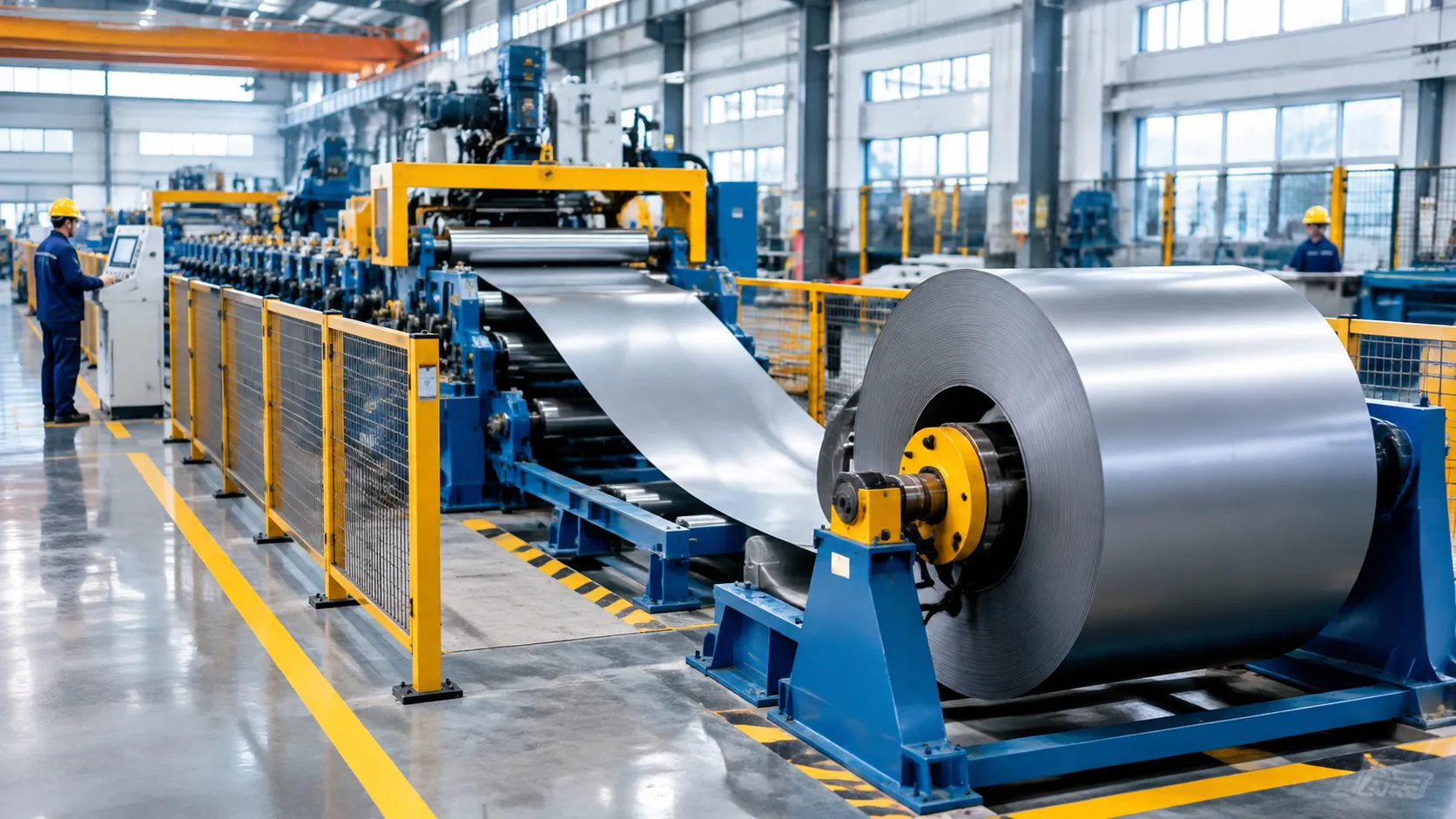
Direct Coupling with Fit-Up Turning Rolls and Rotators
Once the shell leaves the machine rolls, it transitions immediately into the alignment and tacking stages:
Automated Ejection to Transfer Cars: Heavy cans roll straight onto motorized hydraulic fit-up cars, eliminating overhead crane dependency for basic positioning.
Hydraulic Growing Lines: Our systems interface with fit-up turning rolls that independently adjust both ends of the can, matching root gaps and correcting high-low mismatches in minutes.
Powered Welding Rotators: Shells are seamlessly transferred to anti-drift motorized rotators designed to maintain exact axial alignment during continuous rotation.
Synchronization with Longitudinal and Circumferential SAW Units
Consistent edge geometry directly impacts weld cycle times. Our rolling tolerances feed clean, tight seams directly into your submerged arc welding (SAW) stations:
Longitudinal Seam Welding: Minimized edge flat spots allow immediate clamping and single-pass or multi-wire tandem SAW operations without pre-tack grinding.
Circumferential Multi-Can Joining: Accurate can roundness ensures that stacking sections together for circular seam welding requires minimal hydraulic roundness correction.
Laser Seam-Tracking Integration: The tight dimensional stability of our rolled cans ensures automated weld heads track joint geometry reliably without manual intervention.
Turnkey Edge Milling, Rolling, and Seam-Tracking Workflow
We build integrated setups that streamline the entire front-end of your wind tower production line:
| Stage | Process Function | Line Benefit |
|---|---|---|
| 1. Edge Milling | High-speed double-sided beveling (X, V, or U preps) | Delivers exact bevel angles and plate squaring before bending. |
| 2. Plate Rolling | Forming via our heavy-duty industrial plate processing equipment | Eliminates peaking and maintains zero-clearance seam alignment. |
| 3. Auto-Tacking | Laser-guided longitudinal seam alignment | Secures root pass instantly on the outfeed conveyor. |
| 4. SAW Station | Inside/outside automated tandem-wire submerged arc welding | Maximizes arc-on time and achieves 100% volumetric weld quality. |
This continuous mechanical flow eliminates plate sitting idle between processes, protecting your cycle times and lowering handling labor per tower section.
Wind Tower Plate Rolling Machine: Frequently Asked Questions
How does the machine prevent the barrel effect on thick plates?
When bending heavy plates across wide working rolls, mechanical roll deflection naturally concentrates pressure at the plate edges, causing the center of the cylinder to remain under-bent—an issue known as the barrel effect. Our wind tower plate rolling machine eliminates this issue through two synchronized methods:
-
- Engineered Roll Crowning: We machine the working rolls with a precise, parabolic crown profile tailored to specific plate thickness and yield strength ranges.
- Dynamic Hydraulic Counter-Crowning: For variable workloads, our systems integrate multi-zone hydraulic counter-crowning backup blocks beneath the lower roll. Real-time pressure sensors automatically counteract top-roll deflection during heavy loads, keeping the contact pressure perfectly linear across the entire seam to guarantee straight joint fit-up for downstream submerged arc welding.
What is the minimum diameter achievable relative to top roll diameter?
Achievable diameters depend on plate thickness, material yield point, and edge pre-bending demands:
-
- Standard Rolling: On our 4 roll plate bending machine configurations, the minimum rolling diameter typically reaches 1.1 to 1.2 times the top roll diameter for plates within standard capacity.
- Pre-Bending Operations: Because pre-bending requires maximum clamping pressure right at the edge of the plate, the minimum achievable pre-bend diameter ranges between 1.3 and 1.4 times the top roll diameter.
- Interchangeable Top Rolls: For facilities fabricating both compact top tower cans and large base sections, we supply quick-change smaller top rolls to reach tighter diameters without sacrificing frame rigidity.
How does the CNC handle varying yield strength in high-grade structural steel?
Structural steels like S355, S420, and S460 often exhibit lot-to-lot yield variations of up to 15%, which directly alters plate spring-back. Our CNC system manages these discrepancies dynamically:
-
- Initial Pinch Sensing: During the first clamping and pre-bending cycle, proportional hydraulic load sensors detect the exact resistance of the plate.
- Real-Time Spring-Back Calculation: The industrial CNC cross-references the actual pressure profile with our database of material bending recipes, calculating the exact elastic deflection.
- Automated Axis Correction: The digital optical linear scales automatically adjust the side-roll positioning by fractions of a millimeter to match the target radius on the first pass, cutting out manual gauge checks and re-rolling steps.
Can the machine roll cones and cylinders on the same setup?
Yes. Our heavy duty plate bending rolls handle cylindrical cans and steep conical transition pieces without retooling:
| Feature | Engineering Mechanism | Production Benefit |
|---|---|---|
| Independent Roll Tilting | Bottom and side rolls tilt hydraulically via independent dual-cylinder circuits | Maintains proper angular contact for variable cone tapers |
| Hardened Thrust Shoe | Heavy-duty guide shoe mounted to the frame equipped with hardened bearings | Absorbs intense axial sliding forces generated during cone formation |
| Differential Surface Speed | Independent planetary drives synchronize differing inner and outer cone radius travel speeds | Prevents surface scoring, slipping, and uneven wall thinning |
What auxiliary support is required for thin-wall large-diameter cans?
When rolling tower cans exceeding 4,000 mm in diameter with thin-to-medium wall thicknesses (such as upper tower sections), plate deadweight causes severe ovality, top-shell sagging, and catastrophic buckle-collapse during rolling. We stabilize the material using an integrated support package:
-
- Hydraulic Overhead Gantry Support: An overhead vertical support arm guides the plate as it rolls upward, carrying the shell's top deadweight and keeping the cylinder round before tack welding.
- Hydraulic Side Pushers: Dual side-centering arms support the plate's leading and trailing edges, guiding the material into the bending rolls at a true 90-degree angle and eliminating tail-end droop.
- Motorized Infeed Staging Tables: Heavy-duty entry tables square the heavy plate automatically, minimizing operator intervention and ensuring strict longitudinal seam alignment.