Formula details
Product Details
Overview
SS Plate Rolling Machine Engineering for Stainless Steel
Fabricating austenitic, duplex, and super duplex stainless steels presents mechanical challenges that standard carbon steel benders cannot handle. Stainless steel plate cold-forming demands substantially higher bending forces, causes rapid work hardening, generates intense springback, and risks surface iron contamination.
Core Engineering Challenges & Our Solutions
| Engineering Challenge | Our Solution |
|---|---|
| High Yield Strength & Springback | 1.5×–2.0× hydraulic tonnage capacity, CNC radius control, and adaptive over-bending cycles |
| Surface Contamination / Marring | 42CrMo forged rolls, hardened to HRC 55–60 and precision-ground to a mirror finish (Ra ≤ 0.4 μm) |
| Centerline Deflection | Pre-calculated parabolic camber and dynamic hydraulic lower-roll backup supports |
Handling Higher Yield Strength and Springback in Stainless Plate Forming
Grades such as 304, 316L, 2205 Duplex, and 2507 Super Duplex exhibit yield strengths ranging from 205 MPa to over 550 MPa, accompanied by rapid strain hardening during deformation. Rolling these materials requires rigid structural sizing and intelligent force control:
-
- Oversized Hydraulic Power Units: We equip our stainless steel sheet bending roll systems with higher operating hydraulic pressures (up to 28–32 MPa) and heavy-duty planetary drives, delivering the torque required to deform high-yield alloys without stalling.
- Massive Welded Machine Frames: All side frames, linear guides, and swing arms are fabricated from high-tensile Q355B steel plates, thermal stress-relieved in-house to absorb extreme peak loads without frame flexing.
- Adaptive Springback Compensation: Our CNC stainless plate curving machine software accounts for alloy-specific elastic recovery, automatically programming progressive multi-pass curvature and controlled over-bending radii to achieve true target diameters on the first run.
Eliminating Carbon Contamination with Mirror-Polished Rolls
In sanitary, pharmaceutical, and offshore pressure vessel manufacturing, any microscopic transfer of free iron particles from the bending rolls into the stainless plate destroys the material's passive chromium oxide layer, initiating localized pitting and crevice corrosion.
| Roll Specification | Standard Carbon Steel Roller | Our SS Plate Rolling Machine |
|---|---|---|
| Material Base | 45# / 1045 Carbon Steel | Forged 42CrMo / 4140 Alloy Steel |
| Heat Treatment | Surface quenching (shallow) | Deep Induction Hardening (HRC 55–60, depth 4–8 mm) |
| Surface Finish | Standard Machined (Ra 1.6–3.2 μm) | Precision Ground & Mirror Polished (Ra ≤ 0.4 μm) |
| Surface Protection | Bare Metal / Oil | Optional Hard Chrome Plating / PU Sleeves |
| Cross-Contamination | High Risk of Iron Transfer | Zero Iron Pickup / Preserves Passivation |
Our deep-quenched roll surface stops foreign particulate entrapment and prevents mechanical marring on standard 2B, No. 4, and mirror-finished stainless steel sheets.
Synchronized Crowning Systems to Stop Roll Deflection on Wide Sheets
When rolling wide, heavy-gauge stainless plates, the massive upward forces exerted by the side and bottom rolls cause the central span of the top roll to deflect upward. Without mechanical correction, this produces a "barrel-shaped" cylinder where the center diameter is larger than the two ends, ruining seam alignment for longitudinal welding.
UNCOMPENSATED DEFLECTION (BARREL DEFECT)
[ Roll Center Bends Upward ] --> Center: Under-bent (Flat / Wide)
====____/==== --> Ends: Properly bent (Tight)
OUR SYNCHRONIZED CROWNING SOLUTION
[ Pre-Cambered Top Roll + Hydraulic Lower Support ] --> Uniform Contact Pressure
========================== --> Result: True Parallel Cylinder Across Full Width
-
- Parabolic Roll Crowning: We machine a calculated continuous crown directly into the barrel of the main rolls, counteracting standard deflection profiles under specific load zones.
- Hydraulic Active Anti-Deflection Support: For wide plate benders (over 3,000 mm sheet width), we integrate multi-point hydraulic support rollers beneath the lower roll. These hydraulic cylinders apply continuous, proportional upward pressure to keep the contact line straight under changing plate thicknesses.
- Proportional Parallelism Monitoring: High-resolution linear encoders monitor both ends of the rolls continuously, adjusting electro-hydraulic proportional valves within ±0.05 mm to prevent angular deviation across the entire bending cycle.
Types of SS Plate Rolling Machines for Sale
SS Plate Rolling Machine Types
| 4-Roll Hydraulic | 3-Roll Variable Axis | CNC Multi-Axis Automated |
|---|---|---|
| • Single-pass speed | • Thick & heavy wall plates | • Springback algorithms |
| • Minimum flat ends | • Tight conical transitions | • High-volume precision |
| • Continuous pinch hold | • Independent roll geometry | • Automated calibration |
Hydraulic 4-Roll Plate Benders for Fast Single-Pass Rolling and Pre-Bending
Our hydraulic 4 roll plate benders offer high efficiency for thin-to-medium gauge stainless steel cylinders:
-
- Instant Plate Clamping: The bottom pinch roll secures the sheet against the top roll, preventing slipping when forming polished 304 or 316L sheets.
- Precise Pre-Bending: Side rolls square the plate and pre-bend leading and trailing edges without removing the sheet from the machine.
- Fast Single-Pass Cycles: Complete roll-bending in one continuous rotation reduces work hardening on austenitic stainless steels.
Hydraulic 3-Roll Variable Axis Benders for Heavy Plates and Conical Shapes
For high-yield structural shells, heavy-wall reactors, and complex cones, our heavy duty plate rolling machines provide flexible forming power:
-
- Adjustable Geometry: The lower rolls move horizontally while the top roll moves vertically, allowing you to narrow the roll centers for tight-radius pre-bending on high-strength Duplex grades.
- Cone Forming Power: Independent tilting of all three rolls delivers maximum torque for steep-angle conical transitions and reducers.
- Thick Plate Capacity: Extended roll-opening clearance accepts thick, hot-rolled stainless plates without gouging the surfaces.
CNC Multi-Axis Automated Rolling Centers with Springback Compensation
To tackle high material springback and maintain tight tolerances across large batches, our automated CNC systems streamline the entire forming cycle:
-
- Dynamic Springback Algorithms: Built-in calculation models automatically adjust side roll positions to counter the natural elasticity of stainless grades.
- Multi-Radius Forming: Run complex oval, polycentric, and multi-radius profiles without manual intervention.
- Direct Integration: Seamless interface with overhead hydraulic cranes and motorized feeding systems for single-operator production.
Key Mechanical Features of Our SS Plate Rolling Machine
Tight Pre-Bending Geometry (Flat Ends Down to 1.5× Thickness)
Stainless steel requires high clamping force to prevent slipping during the initial bend. Our optimized roller geometry holds the sheet tight right to the tangent point:
Minimal unbent flat edges: Reduces remaining flat ends to 1.5–2× plate thickness, virtually eliminating the need for pre-crimping or post-roll trimming.
Direct edge forming: The side rolls move along tight planetary or linear guides, delivering maximum leverage directly to the plate edge.
Ideal for high-spec work: Saves labor hours when forming shells for ASME vessels and sanitary food tanks.
For high-speed, single-pass edge bending, explore our four-roll plate rolling machines engineered for tight-tolerance cylindrical runs.
Induction-Hardened 42CrMo Forged Alloy Rolls
Carbon transfer causes rust spots on stainless steel. To prevent cross-contamination and roll surface pitting:
Forged 42CrMo steel: Rolls are precision forged, heat-treated, and induction-hardened to HRC 55–60.
Mirror-polished finish: Roll bodies are ground and polished smooth to protect standard mill finishes, 2B sheets, and mirror-grade plates from gouges and tooling marks.
Deep hardening layer: Deep case-hardening depth resists the heavy abrasive wear typical of high-tensile stainless grades.
Hydraulic Drop End for Fast Shell Removal
Unloading completed cylinders must be quick and safe:
Push-button tilt release: The hydraulic drop-end housing swings down smoothly from the operator console.
Top roll balance system: A rear balancing cylinder tilts the top roll up immediately, clearing the finished cylinder for fast overhead or side crane removal.
Rigid locking mechanism: Heavy-duty mechanical locks secure the drop end back into position with zero play for the next rolling cycle.
Dual Proportional Valve Parallelism (±0.05 mm Accuracy)
Uneven roll positioning causes barrel-shaped or conical defects on long stainless sheets. We eliminate roll skewing with precision hydraulic controls:
Digital axis synchronization: High-resolution digital linear encoders continuously monitor both ends of the lateral rolls.
Real-time proportional correction: Dual independent proportional valves adjust oil flow instantly, holding parallel alignment within ±0.05 mm.
Independent tilt for cones: The same system lets operators deliberately tilt side rolls at precise angles to form true conical reducers without manual guesswork.
Hydraulic Overload and Torsion Safety Systems
Forming high-yield materials like 304, 316L, and Duplex stainless steel puts extreme strain on the mechanical frame. Our built-in protection package prevents equipment damage:
Pressure relief valves: Hydraulic circuits instantly release excess pressure if a plate exceeds cold-forming limits.
Torsional overload trip: Drive motors and planetary gearboxes disengage under extreme peak resistance to protect drive shafts from shearing.
Emergency safety stops: Full-perimeter safety trip wires and console emergency stops ensure immediate machine shutdown during unexpected sheet movement.
| Mechanical Feature | Technical Specification | Operational Benefit |
|---|---|---|
| Roll Material | 42CrMo Forged Alloy Steel | Prevents roll bending under heavy loads |
| Surface Hardness | HRC 55–60 (Induction Hardened) | Stops carbon pickup and surface abrasion |
| Parallelism Tolerance | ±0.05 mm via Encoders | Guarantees straight, un-tapered shells |
| Minimum Flat End | 1.5× – 2× Plate Thickness | Cuts down manual cutting and post-grinding |
| Unloading Mechanism | Hydraulic Drop End & Top Roll Tilt | Speeds up cycle times on production lines |
| Safety Integration | Dual-Circuit Hydraulic Relief | Protects machine frame from yield shocks |
If your production calls for custom roll lengths, special crowning profiles, or integrated material handling, check out our tailored sheet metal bending solutions designed for global stainless steel fabricators.
SS Plate Rolling Machine Technical Specifications Matrix
Stainless Steel Plate Bending Machine Specifications
| Model Series | Useful Plate Width (mm) | Rolling Thickness (304/316L) | Pre-Bending (304/316L) | Top Roll Diameter (mm) | Rolling Speed (m/min) | Main Motor Power (kW) |
|---|---|---|---|---|---|---|
| SS-4R 12/2000 | 2,000 | 12 mm | 10 mm | 240 | 1.5 – 6.0 | 11 |
| SS-4R 20/2500 | 2,500 | 20 mm | 16 mm | 340 | 1.5 – 5.5 | 18.5 |
| SS-4R 30/3000 | 3,000 | 30 mm | 25 mm | 440 | 1.5 – 5.0 | 30 |
| SS-4R 45/3000 | 3,000 | 45 mm | 36 mm | 540 | 1.2 – 4.5 | 45 |
| SS-4R 70/3000 | 3,000 | 70 mm | 55 mm | 680 | 1.0 – 4.0 | 75 |
Note: Custom roll lengths from 1,000 mm to 6,000 mm and heavier rolling capacities are manufactured to project requirements.
Thickness and Pre-Bending Capacities for 304 and 316L
Stainless steel has a 30% to 50% higher cold yield strength than structural carbon steel. When forming austenitic grades (304, 304L, 316L, 321) and Duplex alloys:
-
- Sizing Ratio: We calculate machine frames and hydraulics based on 1.4x to 1.6x the tonnage required for equivalent mild steel plate.
- Pre-Bending Force: Side and bottom pinch rolls apply direct vertical hydraulic clamping to minimize flat ends down to 1.5x plate thickness.
- Work Hardening Absorption: Hydraulic pressure tracks real-time sheet resistance, preventing plate stall during multi-pass forming on high-capacity cylinders for energy and pressure vessels.
Roll Diameters and Minimum Rolling Radius Ratios
Roll geometry dictates the smallest shell inside diameter (ID) achievable on an industrial sheet metal roller:
-
- Minimum Shell Diameter: Standard top rolls produce cylinders as tight as 1.1x to 1.3x top roll diameter at 50% max plate thickness.
- Tight Radius Applications: Down to 1.4x top roll diameter at full pre-bending capacity.
- Interchangeable Top Mandrels: For tight-diameter stainless tubes, we supply modular top rolls down to smaller custom diameters with lower tonnage limits.
Drive Power, Working Pressure, and Rolling Speeds
-
- Hydraulic Working Pressure: Standard system pressure runs at 260 to 280 bar (26–28 MPa), backed by independent pressure manifolds for pinch, side roll tilt, and drop-end actuation.
- Drive System: Independent hydraulic motors paired with planetary gearboxes drive the top and bottom rolls directly, eliminating belt slip and mechanical lash.
- Speed Regulation: Dual-speed or step-less variable speed control (1.0 to 6.0 m/min) allows slow, high-torque pre-bending and rapid high-speed rounding.
Industrial Applications for Stainless Steel Plate Bending Rolls
Our SS plate rolling machine lineup is built to handle the high yield strength, springback, and strict surface cleanliness required across critical processing industries. As an experienced ss plate rolling machine manufacturer, we engineer each system to form uniform cylindrical and conical components while eliminating surface scuffing and iron contamination.
ASME Pressure Vessels, Reactor Shells, and LNG Cryogenic Tanks
Fabricating thick-gauge stainless vessels requires extreme bending power and precise roll geometry to prevent ovality.
Heavy-Wall Shells: Our heavy duty plate rolling machine models cold-roll 304, 316L, and Duplex grades up to multi-inch thicknesses for pressurized reactors and distillation towers.
Cryogenic Containment: Delivers exact edge pre-bending to eliminate seam peaking on LNG tanks, ensuring clean fit-up for automated longitudinal submerged arc welding.
Tolerances: Tight electronic roll synchronization holds diameter tolerances within ±1mm across wide plates.
Sanitary Food, Dairy, and Pharmaceutical Storage Tanks
Sanitary vessel fabrication demands absolute surface integrity without gouging or carbon pickup.
Zero Contamination: Induction-hardened, mirror-polished rolls prevent microscopic surface embedding on bright annealed and 2B finished sheets.
Thin-Wall Cylinders: High-speed four-roll systems roll large-diameter wine, brewery, and dairy storage silos without sheet distortion or work-hardening flat spots.
Minimal Post-Processing: Smooth roll contact eliminates the need for expensive secondary pickling, grinding, or re-polishing.
Chemical Piping, Scrubbers, and Heavy-Wall Heat Exchanger Shells
Handling corrosive acids and aggressive gases requires high-alloy integrity throughout the roll forming process.
Welded Pipe and Ducting: Rolls tight-radius stainless steel pipes, exhaust stacks, and wet scrubber casings with tight edge-to-edge alignment.
Heat Exchanger Shells: Maintains cylindrical concentricity across long rolling lengths to ensure fast baffle and tube bundle insertion.
Line Integration: Easily paired with handling tables and downstream equipment in automated sheet metal production lines for continuous vessel production.
Conical Reducers, Duct Transitions, and Architectural Cones
Forming non-cylindrical stainless components requires dedicated geometry control to avoid skewing.
Cone Rolling Attachments: Angular side roll tilting with hardened guide rolls accurately bends concentric and eccentric conical reducers.
Exhaust and Duct Transitions: Smoothly shapes heavy industrial flues, hopper transitions, and vent cones.
Architectural Structures: Delivers clean curvature on structural cones and decorative stainless cladding without tool marks or surface marring.
Custom Options and Auxiliary Tooling for SS Plate Benders
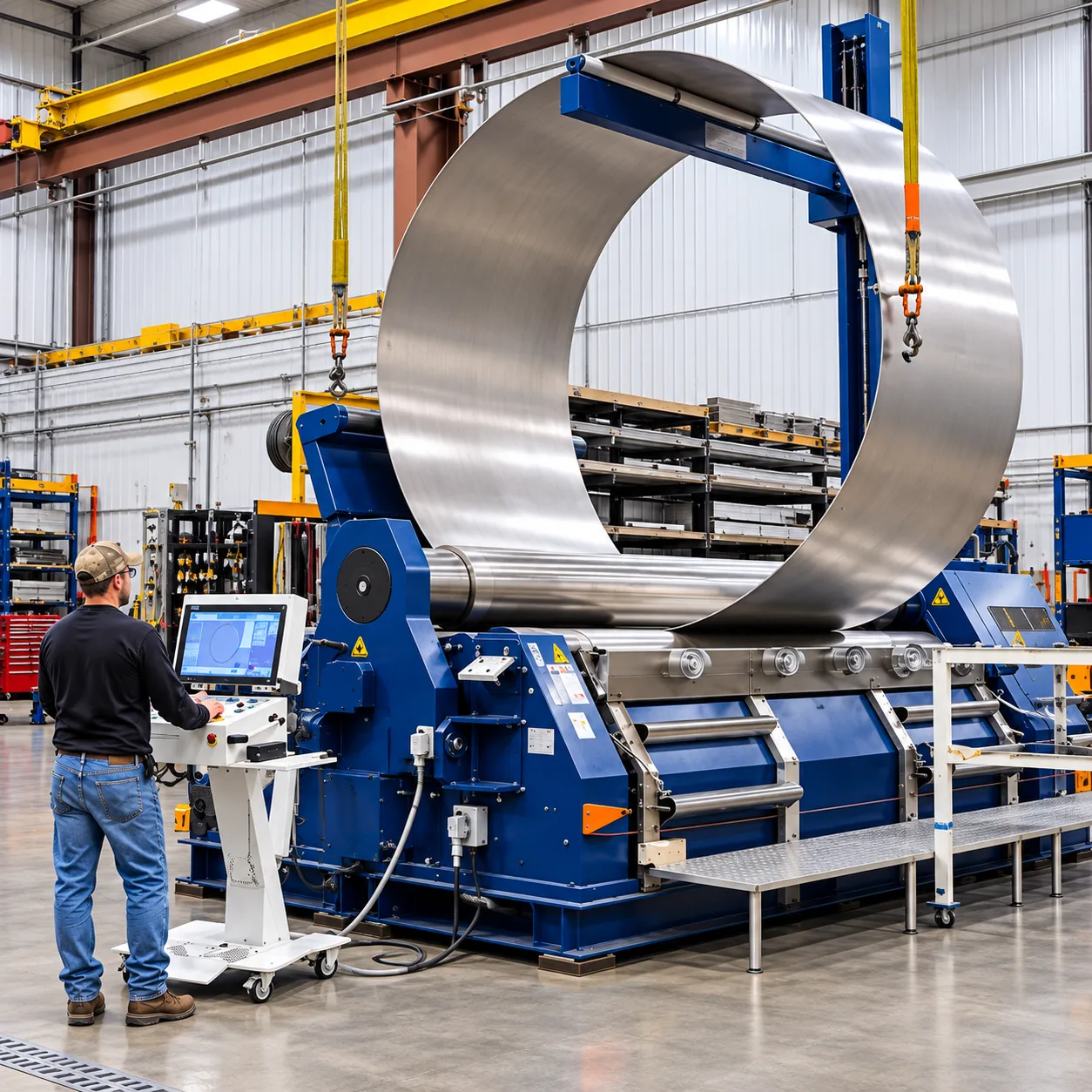
Standard roll setups rarely cover every stainless steel job shop requirement. When handling thin-wall shells, oversized vessels, or mirror-finished plates, our ss plate rolling machine factory engineers auxiliary systems that prevent deformation, stop cross-contamination, and speed up cycle times.
Top Hydraulic Support Cranes for Large-Diameter Thin-Wall Cylinders
Thin-gauge stainless steel lacks the structural stiffness to hold its own shape once rolled past 180 degrees. Without overhead stabilization, large-diameter cylinders collapse under their own weight, causing ovality, pinching, and welded seam misalignment.
-
- Proportional Hydraulic Lifting: Matches roll speed automatically during the curving cycle.
- Non-Marking Contact Pads: Polyurethane or nylon saddle pads eliminate surface scoring on 304 and 316L sheets.
- Diameter Capacity: Stabilizes shells from 1,000 mm up to 6,000 mm in diameter.
- Direct CNC Integration: Controlled directly through the main touch-screen console for single-operator runs.
Side Support Systems to Prevent Sheet Sagging and Maintain Alignment
Long leading and trailing plate sections droop as they enter the pinch rolls, creating uneven edge lead-ins, diagonal drift, and conical distortion. Our hydraulic side supports keep wide stainless plates dead-level throughout infeed and pre-bending.
-
- Dual-Axis Articulation: Supports both horizontal guiding and vertical elevation.
- Squaring Alignment: Centers the sheet against the clamping rolls before the initial pre-pinch.
- High Payload Ratings: Handles plate thicknesses up to 50 mm without hydraulic pressure drops.
Interchangeable Top Rolls for Small-Diameter Stainless Sleeves
Rolling small-diameter cylinders requires a smaller top roll, but smaller rolls suffer higher deflection under maximum load. We provide interchangeable 42CrMo top roll packages to give your hydraulic 4 roll plate bender broader working flexibility.
-
- Rapid Changeover Design: The hydraulic drop end and quick-release roll housing allow roll swaps in under 45 minutes.
- Precision Pre-Cambered Profiles: Each interchangeable shaft features dedicated crowning to offset deflection at specific diameter ranges.
- Custom OD Sizing: Allows bending down to tight 1.1x to 1.3x top roll diameter ratios for specialty pipe liners, exhaust components, and industrial pump sleeves.
Motorized Infeed Tables with Polyurethane Rollers for Scratch Prevention
Direct metal-to-metal contact during loading ruins sanitary 2B or polished architectural finishes and embeds free carbon particles into the sheet. For plates prepared on high-precision sheet metal laser cutting machines, maintaining surface integrity through the forming phase is critical.
-
- Coated Roller Beds: High-density polyurethane rollers eliminate iron contamination and scratches.
- Motorized Drive Integration: Variable-speed drive feeds heavy sheets smoothly into the bending rolls without manual pushing.
- Hydraulic Lateral Alignment Guides: Pneumatic or hydraulic side pushers square the plate against the roll axis to ensure parallel seam alignment for automated longitudinal welding.
Auxiliary Tooling & Custom Options Overview
| Tooling System | Primary Function | Ideal Application | Key Production Benefit |
|---|---|---|---|
| Overhead Hydraulic Crane | Prevents large shell collapse | Thin-wall storage tanks, ducting (2–8 mm) | Eliminates overhead crane use; holds ±1.0 mm roundness |
| Hydraulic Side Guides | Prevents plate sag on infeed | Wide stainless plates (>2,500 mm length) | Stops diagonal skewing and edge misalignment |
| Interchangeable Top Roll | Reduces minimum roll diameter | Exhaust sleeves, pipe fittings, bushings | Doubles machine versatility for small IDs |
| Motorized Poly Infeed Table | Scratch-free automated feeding | Food, dairy, and pharma sanitary vessels | Protects Ra finish and prevents carbon pickup |
| Cone Bending Attachment | Angled roll tilt and guide rolls | Reducers, hoppers, conical transitions | Delivers precise conical forming without sheet slipping |
Why Choose Our SS Plate Rolling Machine Factory in China
As a dedicated SS plate rolling machine manufacturer, we eliminate third-party markups and quality compromises by managing every stage of production under one roof. Our modern SS plate rolling machine factory in China builds heavy-duty bending systems engineered specifically to handle the high yield strength, springback, and surface sensitivity of stainless steel alloys.
In-House CNC Machining, Quenching, and Ultrasonic Testing
We maintain complete control over the metallurgical and structural integrity of every ss plate rolling machine we build:
-
- Heavy-Duty Machining: Machine frames, drop ends, and side frames are processed on large CNC floor-type boring and milling centers to guarantee strict mechanical parallelism.
- Deep Induction Quenching: Our rolls are forged from premium 42CrMo alloy steel, normalized, and heat-treated in vertical quenching furnaces to achieve a surface hardness of HRC 55–60.
- Ultrasonic NDT Inspection: Every forged roll undergoes 100% ultrasonic flaw detection to ensure zero internal voids, micro-cracks, or structural inclusions before machining.
- Micro-Finish Polishing: Roll surfaces are ground and mirror-polished to prevent carbon pickup and surface marring on high-grade stainless plates.
Certified Global Manufacturing Standards
Our manufacturing processes comply with strict international quality and safety benchmarks. We integrate world-class hydraulic and electronic components—including Siemens motors, Schneider electrics, and Rexroth proportional valves—to ensure seamless integration and long-term reliability.
| Factory Standard Feature | Our Production Standard | Standard Market Alternative |
|---|---|---|
| Certifications | CE, ISO9001:2015, UL Compliance | Basic ISO only / uncertified |
| Roll Material & Hardness | Forged 42CrMo / HRC 55–60 | 45# Carbon Steel / HRC 40–45 |
| Roll Surface Finish | Mirror-polished Ra ≤ 0.4 µm | Standard ground Ra 1.6–3.2 µm |
| Hydraulic System | Dual proportional valve control | Basic manual or single solenoid valves |
| Parallelism Accuracy | Electronic synchronization (±0.05 mm) | Mechanical torsion bar (±0.5 mm) |
For detailed selection criteria and machinery specifications, explore our comprehensive machinery buying guides covering advanced forming technologies.
100% Full-Load Pre-Delivery Test Rolling
We never ship equipment based on dry runs alone. Before any ss plate rolling machine for sale leaves our facility, we conduct full-load bending tests on customer-specified 304, 316L, or duplex stainless steel plates:
-
- Capacity Verification: We load the machine to 100% of its rated thickness and yield strength to verify hydraulic system stability and motor draw.
- Pre-Bending Inspection: We measure residual flat ends to confirm that the pre-bending geometry achieves tight tolerances within 1.5 to 2 times the plate thickness.
- Roundness and Crowning Check: We inspect rolled shells with precision laser trackers to verify that anti-deflection crowning keeps the cylinder body straight without barrel or hourglass distortion.
- Video & Inspection Documentation: Customers receive full video proof, hydraulic pressure data logs, and comprehensive dimensional inspection reports prior to crating.
Global Shipping and On-Site Service from an SS Plate Rolling Machine Manufacturer
Export-Grade Vacuum Packing and Moisture-Barrier Skid Loading
Ocean freight exposes heavy equipment to salt air, humidity, and constant vibration. We protect every ss plate rolling machine before it leaves our facility:
-
- Corrosion Protection: Mirror-finished rolls and exposed alloy surfaces are coated with industrial anti-corrosion grease and wrapped in multi-layer VCI (Vapor Corrosion Inhibitor) film.
- Vacuum Sealing: Complete hydraulic assemblies and electrical cabinets are vacuum-sealed inside thick foil barriers with desiccant packs to prevent moisture buildup.
- Heavy-Duty Steel Base Mounting: The machine frame is bolted directly to heavy steel channel skids, eliminating flex during lifting and transit.
- Reinforced Container Lashing: For standard containers or flat racks, we use high-tensile steel strapping and cross-bracing to lock the equipment securely in place.
On-Site Hydraulic Calibration, Leveling, and Operator Training
Proper installation is critical for achieving exact tolerances on stainless steel. Our engineers provide full on-site global service and technical support to get your machine dialed in quickly:
-
- Precision Foundation Leveling: Alignment of the machine frame to prevent uneven load distribution across the hydraulic cylinders.
- Hydraulic System Tuning: Calibration of digital proportional valves to ensure side roll parallelism remains within ±0.05 mm under full rolling pressure.
- CNC Program Setup: Loading material profiles and testing springback compensation values using your specific stainless plate grades.
- Hands-On Operator Training: Practical instruction covering plate alignment, pre-bending setups, drop-end operation, and scratch-free handling techniques.
Warranty Coverage, 24/7 Remote Diagnostics, and Rapid Spare Parts Dispatch
Every ss plate rolling machine for sale includes responsive post-installation support to protect your daily production schedule:
-
- Comprehensive Equipment Warranty: Full coverage on structural components, forged rolls, hydraulic manifolds, and CNC hardware.
- 24/7 Remote Diagnostics: Real-time PLC system access via secure Ethernet gateways allows our technicians to troubleshoot programming issues, adjust pressure curves, and resolve sensor faults instantly.
- Global Spare Parts Inventory: Critical wear items—such as high-pressure seals, linear encoders, proportional valves, and electrical relays—are kept in stock for rapid international air dispatch.
SS Plate Rolling Machine FAQs
How does rolling stainless steel differ from standard carbon steel?
Stainless steel has a significantly higher yield strength, work-hardens rapidly during deformation, and exhibits greater springback. Rolling austenitic grades like 304 or 316 requires roughly 40% to 60% more bending force than mild steel of identical thickness. As an experienced ss plate rolling machine manufacturer, we design our hydraulic drive systems with oversized pistons and rigid machine frames to handle these high-load forming forces without stalling or flexing.
How do polished rolls prevent iron cross-contamination on 316L plates?
Standard carbon steel rolls transfer free iron particles directly into stainless sheets under high clamping pressure. Once exposed to moisture, these embedded particles oxidize and cause severe pitting corrosion. Our ss plate rolling machine factory equips every stainless-dedicated machine with induction-hardened, mirror-polished 42CrMo alloy rolls. This smooth, non-porous finish stops carbon migration, protecting the passive oxide layer required for sanitary and chemical-grade vessels.
What is the smallest cylinder diameter we can roll on these machines?
The minimum rolling diameter depends on the top roll diameter, plate thickness, and material yield point:
Standard configurations: Roll tight shells down to 1.1 to 1.3 times the top roll diameter.
Interchangeable top rolls: Enable specialized rolling of ultra-small diameter cylinders and thick-wall sleeves.
Edge quality: Pre-cutting sheet edges cleanly with high-precision laser cutting machines prior to rolling ensures minimum flat spots during pre-bending.
Can your machines handle Duplex and Super Duplex stainless steel grades?
Yes. Grades such as 2205 Duplex and 2507 Super Duplex feature extreme tensile properties that demand rigid torque delivery. We calculate machine sizing specifically for high-yield materials, integrating high-torque hydraulic motors, reinforced planetary gearboxes, and dual-axis proportional hydraulics to form tough alloys reliably without structural deflection.
What is the average lead time for custom vs standard plate rollers?
-
- Standard models: As a direct SS plate rolling machine supplier, we maintain pre-machined frames and components to ship standard 3-roll and 4-roll machines within 20 to 30 days.
- Custom CNC configurations: Tailored roll lengths, interchangeable rolls, overhead cranes, and side support systems require 45 to 60 days, which includes full-load test rolling at our ss plate rolling machine China production facility before dispatch.
How does the automatic crowning system keep cylinders straight?
Wide stainless plates exert immense resistance that naturally deflects the center of the bending rolls, leading to unwanted "barrel" or "canoe" shapes. Our machines use hydraulic anti-deflection crowning built directly into the lower roll supports. This system applies real-time upward counter-pressure matching the material's resistance, keeping the roll contact line perfectly level and producing true, straight cylinders from edge to edge. Every ss plate rolling machine for sale from our lineup is calibrated to maintain parallel tolerance within ±0.05 mm across the entire working length.