
Precision Sheet Metal Forming &
Intelligent CNC Bending Machinery
Backed by decades of engineering expertise, Haden delivers turnkey bending solutions alongside advanced sheet metal laser cutting machines—from 30T–1000T CNC press brakes and automatic panel benders to integrated robotic cells—tailored for exceptional repeatability and flexible production.
Real-time closed-loop laser angle measurement and dynamic crowning compensation.
High-tonnage stability across carbon steel, stainless steel, and aluminum alloys.
Rapid automated tool clamping and changer options to minimize setup downtime.
Production-proven installations operating across industrial sites worldwide.
Core Bending Equipment & Technology Matrix
Haden designs and builds four dedicated industrial bending equipment platforms alongside our wider portfolio of fabrication products to solve demanding precision, throughput, and structural forming challenges. From multi-axis electro-hydraulic press brakes and high-efficiency all-electric servo machines to universal automatic panel benders and turnkey robotic cells, our modular systems deliver tight angular tolerances, rapid tool changeovers, and continuous manufacturing reliability across global job shops and OEM production facilities.
CNC Hydraulic Press Brakes
Closed-loop electro-hydraulic synchronization with dual proportional servo valves, engineered for deep channel bending, high-strength alloy forming, and multi-machine tandem operations.
Technical Specifications
Servo Electric Press Brakes
Direct dual-servomotor belt-drive system delivering instantaneous dynamic response, zero hydraulic maintenance, and up to 50% power reduction on high-takt precision manufacturing lines.
Technical Specifications
Automatic Panel Benders
Universal segmented folding blades perform rapid upward and downward bending cycles without tooling changeovers, maximizing throughput on enclosures, architectural skins, and chassis trays.
Technical Specifications
Robotic Bending Cells
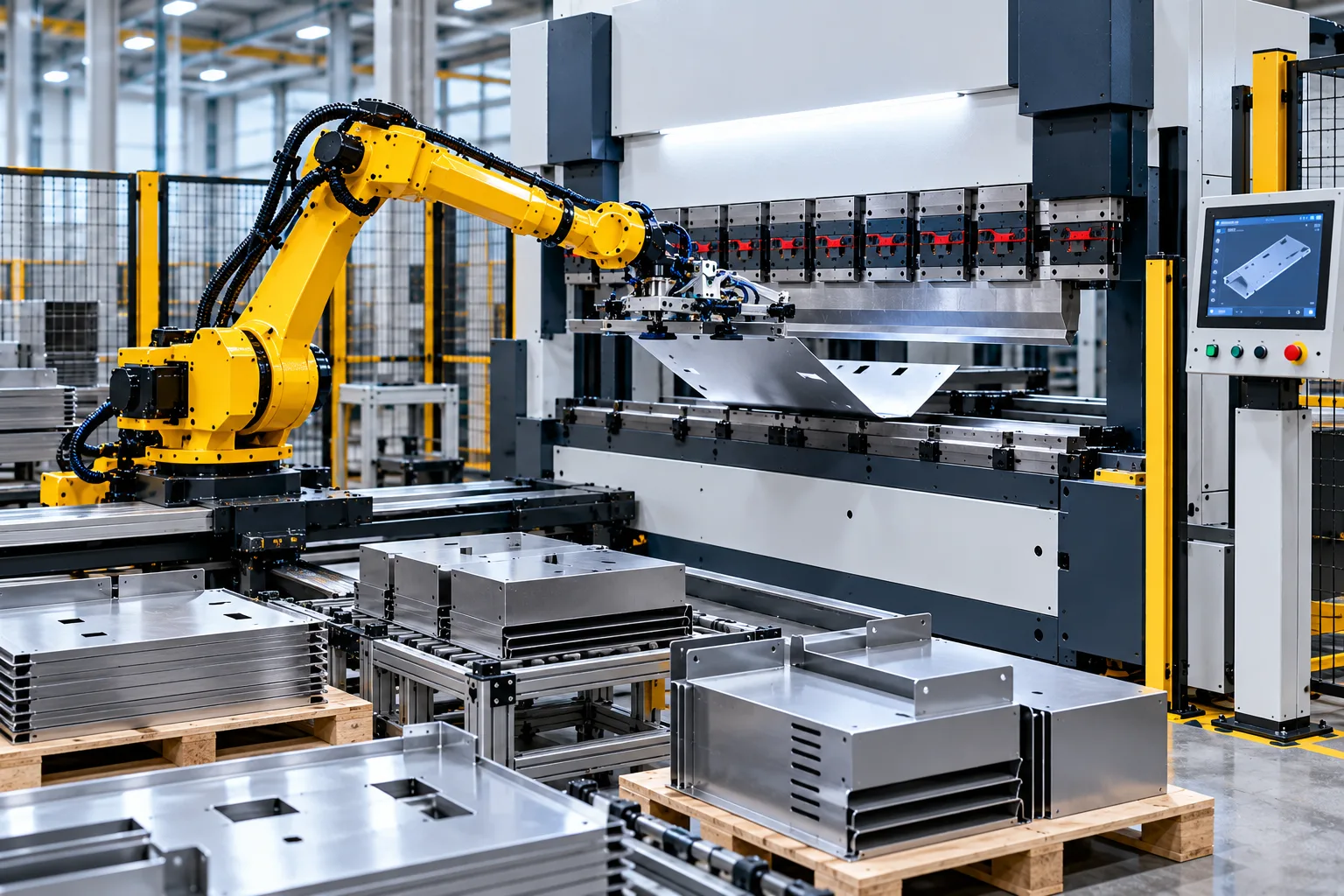
Fully automated manufacturing cells combining multi-axis articulated robots, dynamic sheet-following software, optical alignment tables, and automatic regripping for continuous lights-out fabrication.
Technical Specifications
Kinematic Architecture & Workpiece Envelope Comparison
Determining the correct sheet metal bending solution requires balancing part envelope geometry, lot sizes, raw plate yield strengths, and required changeover frequencies. Whether operating standalone or integrated downstream from high-speed laser cutting machines, Haden manufactures both specialized press brakes and automated multilateral panel benders with modular hydraulic, direct-servo, and robotic configurations, allowing fabrication engineers to match machinery kinematics directly to their factory takt times and dimensional tolerance budgets.
| Equipment Family | Primary Kinematics | Standard Thickness Range | Setup / Changeover Time | Typical Target Workpieces | Angular Accuracy |
|---|---|---|---|---|---|
| CNC Hydraulic Press Brake | Dual Proportional Hydraulic Valves (Y1/Y2) | 1.0mm – 25.0mm (30T to 1000T+) | Hydraulic Quick-Clamping (~2–5 min) | Structural chassis, heavy brackets, deep side channels, thick plates | ±0.2° (with Dynamic CNC Crowning) |
| All-Electric Servo Press Brake | Direct Dual-Servo Motors & Heavy-Duty Belts | 0.5mm – 4.0mm (35T to 125T) | Precision Segmented Tooling (~1–3 min) | Electronics housings, medical device enclosures, thin brackets | ±0.15° (High-Speed Direct Servo) |
| Automatic Panel Bender | Universal Bidirectional Folding Blades & Rotator | 0.5mm – 3.2mm (Cold Rolled / Stainless / Aluminum) | 0 Seconds (Universal Automatic Setup) | 4-sided electrical enclosures, elevator doors, HVAC casings, trays | ±0.2° (Real-Time Thickness Probing) |
| Robotic Bending Cell | 6-Axis Articulated Robot + Synchronized Ram Interlock | Tailored to Configured Press Brake Capacity | Automated ATC Tool Changing (15–60 sec) | High-volume repetitive components, large panels, lights-out shifts | ±0.2° (Continuous Automated Repeatability) |
Multi-Axis Backgauge Kinematics
Configure multi-axis backgauge architectures spanning X, R, Z1, Z2, X1, and X2 axes. High-rigidity ground ball screws and digital AC brushless servos maintain ±0.01mm repeatability during complex multi-station tapered bending and asymmetric flange positioning.
Closed-Loop Optical Scale Feedback
Sub-micron linear optical encoders mounted to independent C-frames monitor ram positioning in real time. Dynamic electro-hydraulic or servo feedback actively compensates for side-frame deflection under off-center loading, ensuring straight, parallel bend lines across the bed.
3D CAD/CAM & Collision Avoidance
Seamlessly import STEP, IGES, and DXF part files prepared on sheet metal laser cutting machines directly into Haden CNC control interfaces. Intelligent offline simulation software automatically generates optimized bend sequences, selects segmented punch-and-die sets, and detects potential tooling collisions before physical execution.
Press Brake vs. Panel Bender: Strategic Sheet Metal Bending Selection Guide
Choosing between a synchronized CNC press brake and an intelligent multilateral panel bender determines your facility's long-term production throughput, part accuracy, tooling overhead, and shop floor labor allocation. While both technologies execute precise linear bends, their forming mechanics, kinematics, and optimal part envelopes solve distinct fabrication challenges.
Modern sheet metal manufacturers rarely rely on a single process, often integrating upstream laser cutting machines with high-efficiency downstream forming systems. By evaluating component geometry, material thickness, batch variability, and cycle-time constraints, plant managers and manufacturing engineers can pinpoint the appropriate machine configuration—or deploy a balanced hybrid cell.
Compare Operational Dimensions by Production Profile
| Technical Metric |
Intelligent Multilateral Panel Bender
Automated Folding
|
CNC Synchronized Press Brake
Linear Punch & Die
|
|---|---|---|
| Workpiece Geometry Suitability | 4-Sided Closed Panels, Trays & Enclosures Exceptional for electrical control cabinets, HVAC covers, architectural facade cassettes, shelving, doors, and wide flat blanks with peripheral bends. | Deep Cavities, Narrow Channels & Heavy Brackets Deep throat depths and large daylight openings allow forming of narrow U-channels, complex multi-break geometric profiles, and closed square tubes. |
| Kinematic Forming Motion | Universal Oscillating Blades The sheet is clamped flat by universal blankholder tools while upper and lower bending blades oscillate up and down to form positive and negative bends. | Linear Ram Stroke & V-Die Penetration Electro-hydraulic or electric servo drives press an upper punch straight into a bottom V-die to achieve air bending, bottoming, or coining. |
| Material Thickness Envelope | 0.5 mm to 3.2 mm (26 ga to 10 ga) Engineered for light-to-medium gauge carbon steel, stainless steel, and ductile aluminum alloys. | 0.5 mm to 25.0+ mm (Broad Capacity) Complete capability ranging from thin sheet metal up to heavy structural steel and thick structural profiles. |
| Bending Force & Tonnage Delivery | Localized Clamping & Dynamic Wiping Bending force is applied progressively along the edge through servo-driven folding arms. | 30 Tons to 1,000+ Tons Concentrated Load Concentrated hydraulic or servo-mechanical pressing tonnage across the bed length, paired with CNC crowning. |
| Tooling Setup & Changeover Time | Universal Segmented Tooling Universal blankholder tooling automatically adjusts to part dimensions via CNC actuators, supporting flexible high-mix production. | Manual or Automated Tool Change Different jobs can require upper punch and lower V-die changes, while automatic tool changing can reduce setup requirements. |
| 4-Sided Pan / Box Production | Automated Part Repositioning Integrated manipulators can rotate and position blanks automatically while completing multiple edges in sequence. | Sequential Bend Positioning Conventional press-brake production requires positioning and reorientation of the sheet between bend sequences. |
| Operator Skill Dependency | Automated Programming Support CAD/CAM software can generate folding sequences and blade adjustments while reducing manual setup. | Process Knowledge Required Press-brake operation involves bend sequencing, tooling selection, springback compensation, and backgauge setup. |
| Ergonomics & Large Sheet Handling | Horizontal Sheet Support The sheet remains supported horizontally on brush or transfer tables during forming. | Manual or Sheet-Follower Assisted Larger workpieces may require operator support or CNC sheet-following equipment as the sheet rotates. |
When to Deploy CNC Press Brakes
CNC press brakes remain a flexible forming platform for custom fabricators, heavy equipment manufacturers, and structural job shops. Their open-frame architecture accommodates broad geometric variation, deeper sections, and higher forming loads.
- ✓ Heavier Plate Forming: Applications extending beyond typical panel-bender thickness ranges.
- ✓ Deep Cavities & Closed Channels: U-channels, narrow return flanges, and deeper box sections.
- ✓ Specialized Forming Profiles: Radius tooling, hemming, offsets and segmented tooling.
- ✓ Tandem & Long-Part Bending: Configurations for long structural workpieces.
When to Deploy Automatic Panel Benders
Automatic panel benders are designed for repeatable thin-gauge panel, enclosure, tray and box forming where automated blank manipulation and reduced tooling intervention can improve production flow.
- ✓ 4-Sided Boxes, Trays & Enclosures: Electrical cabinets, HVAC panels, server racks and furniture.
- ✓ High-Mix Production: Automated adjustment supports changing panel dimensions.
- ✓ Cosmetic Sheet Metal: Suitable for applications where surface handling is important.
- ✓ Automated Part Handling: CNC manipulation reduces repeated manual repositioning.
Building a Balanced Hybrid Fabrication Strategy
Press brakes and panel benders can be deployed together when a production mix includes both thin-gauge enclosure work and heavier or geometrically complex formed components.
Route thin-gauge exterior panels, access doors and cabinet covers prepared on sheet metal laser cutting machines to automatic panel bending when the geometry fits the process.
Route heavier mounting rails, internal structural brackets, narrow channels and specialized profiles to the CNC press brake with the required tooling configuration.
Coordinate formed exterior panels and structural components with downstream welding, riveting, assembly and material-handling processes as part of the overall production-line design.
Need Part-Specific Machine Selection?
Share your material, thickness, part dimensions and forming requirements with Haden's application engineering team for a project-specific bending configuration review.
Precision Control, Laser Angle Measurement & Dynamic Crowning
Eliminate angular variance, canoe deflection, and material springback across high-mix sheet metal fabrication with Haden's closed-loop CNC compensation and intelligent metrology systems.
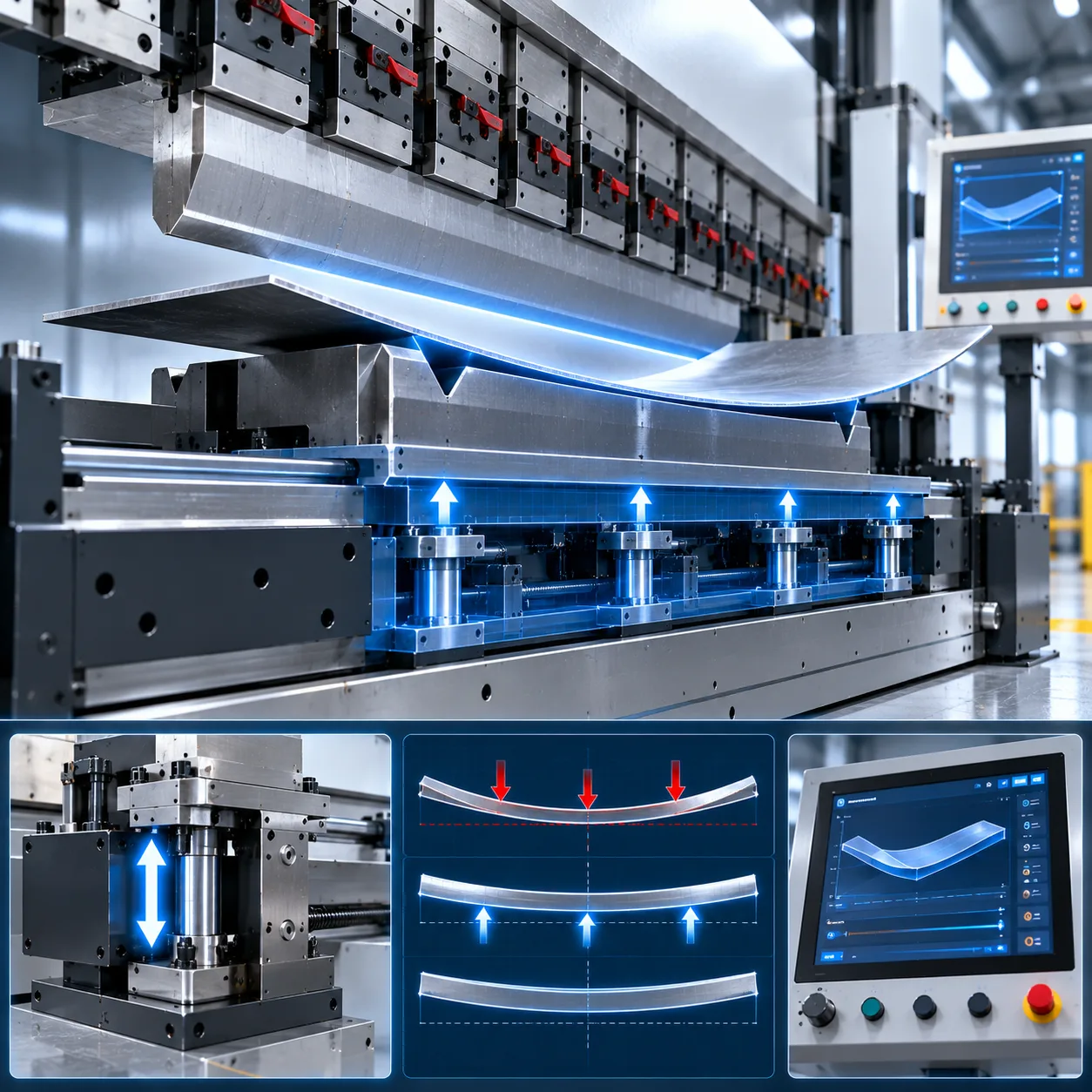
Dynamic CNC Mechanical & Hydraulic Crowning
The CNC controller dynamically computes bed deflection curves in real time based on material yield strength, sheet thickness, V-die opening, and bend length.
- •Deflection Neutralization: Continuously eliminates center "canoe" angle deviation
- •Material-Adaptive: Auto-adjusts for carbon steel, stainless, and aluminum
- •Linear Straightness: Maintains uniform angle profiles along the full bed length
High-resolution CNC mechanical wedges execute micro-adjustments in milliseconds to compensate for machine frame elasticity.
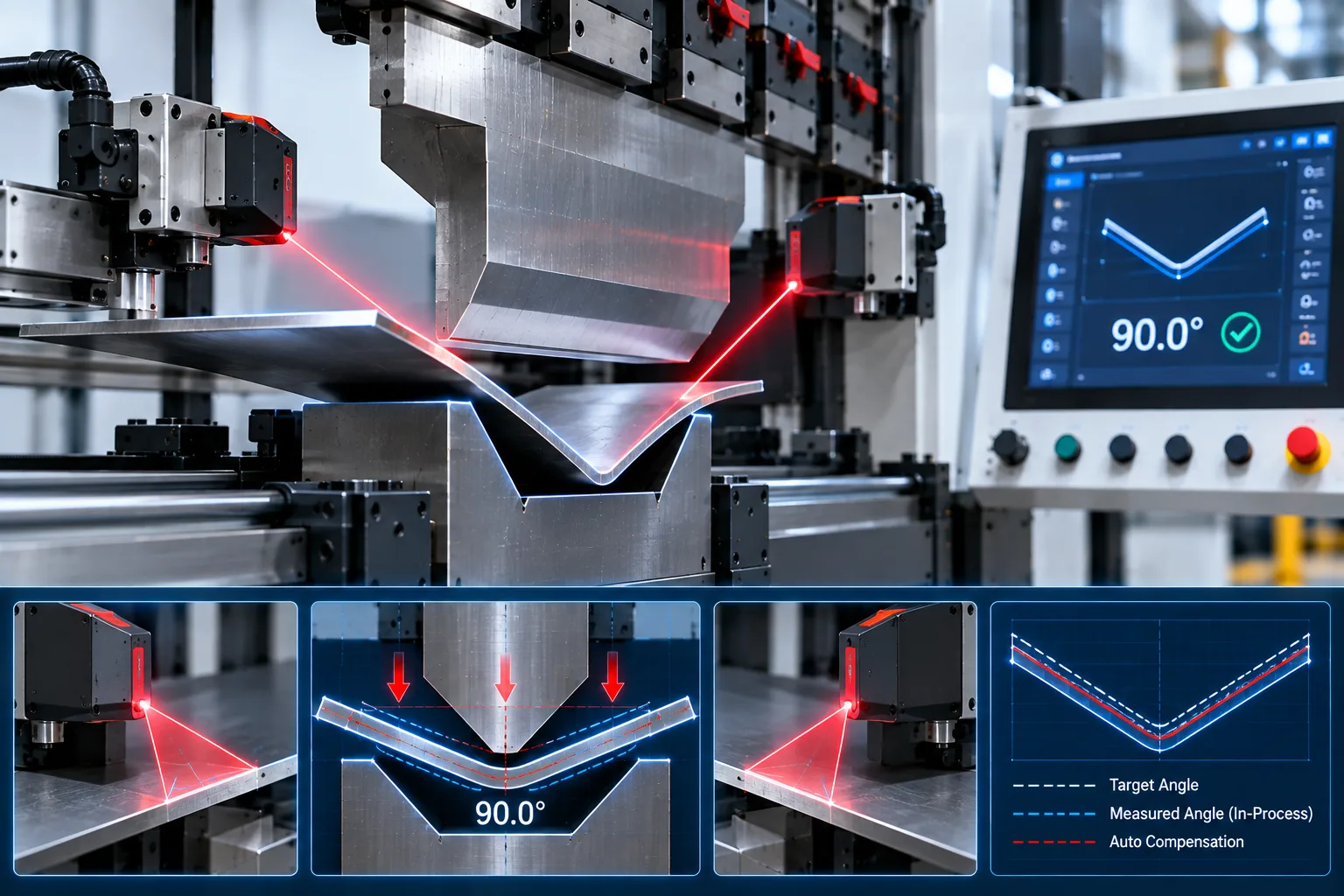
Real-Time In-Process Laser Angle Measurement
Dual optical laser sensors track sheet deformation in real time during ram descent, detecting springback and executing instant micro-repress corrections in a single stroke.
- •First-Piece Qualification: Delivers finished bend accuracy stabilized within ±0.2°
- •Adaptive Springback Control: Offsets batch-to-batch sheet hardness variations
- •Zero Trial Bends: Drastically cuts setup scrap on blanks produced by high-precision sheet metal laser cutting machines and prepainted alloys
Dual-axis high-speed optical transceivers capture angle changes up to 1,000 times per second for continuous closed-loop depth adjustment.
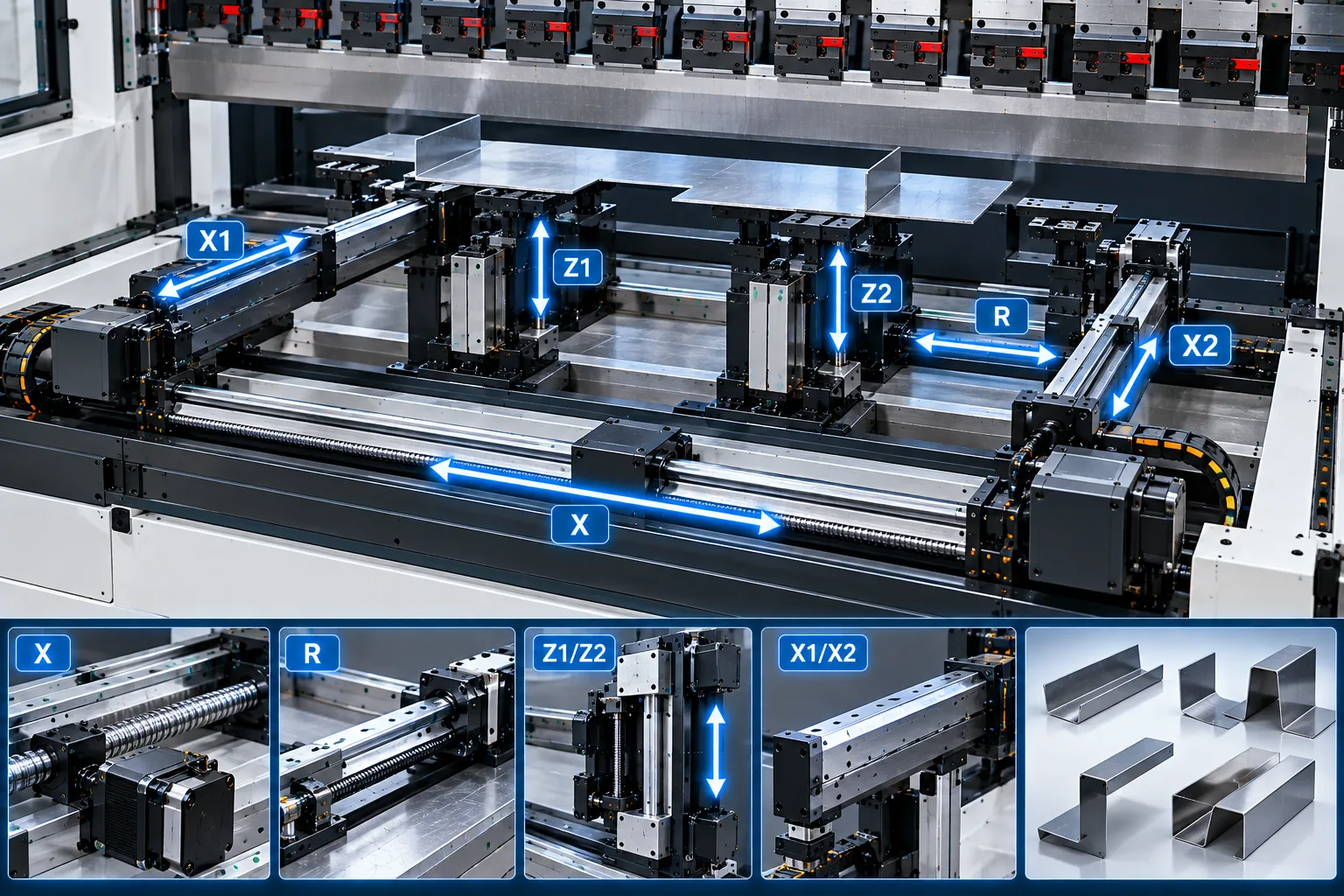
Multi-Axis High-Speed Backgauge Precision Positioning
High-rigidity ground ball screws and AC servo drives coordinate X/R/Z1/Z2/X1/X2 axes simultaneously for complex stepped, tapered, and asymmetric workpieces.
- •Sub-Millimeter Repeatability: Precision linear guides guarantee ±0.01 mm repeatability
- •Complex Flange Referencing: Independent finger stops handle conical and angled contours
- •High-Speed Indexing: Rapid multi-axis positioning slashes cycle times between bends
Hardened contact fingers with optional integrated optical sheet sensors prevent misalignments before stroke execution.
Integrated Closed-Loop Precision Architecture
Haden unifies dynamic mechanical crowning, real-time laser feedback, and multi-axis backgauge synchronization into an intelligent CNC forming architecture. Operating in microsecond communication loops, these systems continuously compensate for rolling direction variance, material grain irregularities, and frame elasticity to satisfy rigorous ISO 13715 and ASME Y14.5 GD&T requirements.
High-Precision Industrial Applications
- • Electrical enclosures and server racks requiring tight hemming and seamless seam alignment
- • Aerospace brackets and structural channels with strict angularity and profile callouts
- • Architectural facades and elevator door panels demanding clean, scratch-free straightness
Process Stability & Yield Benchmarks
- • Process capability: Cpk > 1.67 maintained across multi-coil production batches fed from automated coil-fed laser cutting machines
- • First-pass yield: 99.2%+ on complex, multi-station sequential bending sequences
- • Tool life preservation: Balanced load distribution extends punch and die service life by 35%
Precision Forming Capability Benchmark
| Performance Parameter | Conventional Press Brake | Haden Closed-Loop Precision System |
|---|---|---|
| Bend Angle Tolerance | ±0.5° to ±1.5° (operator-dependent) | ±0.2° (laser closed-loop compensation) |
| Backgauge Repeat Accuracy | ±0.05 mm to ±0.10 mm | ±0.01 mm (high-speed multi-axis servo) |
| Springback Correction | Manual test bends & static CNC offsets | Real-time adaptive in-stroke micro-repress |
| Dynamic Bed Crowning | Manual shimming or fixed hydraulic curve | CNC multi-wedge mechanical / proportional hydraulic |
| First-Part Production Yield | 88% – 93% (subject to setup trial pieces) | 99.2%+ (first piece directly to tolerance) |
International Standards & Quality Conformance
- ✓ ISO 13715 & ISO 2768-mK: Full compliance with international linear and angular tolerance standards
- ✓ DIN 6935: Verified sheet metal bending allowance formulas and minimum flange dimension rules
- ✓ AIAG MSA & SPC: Capable of statistical process control tracking for precision contract manufacturing
- ✓ IATF 16949 / AS9100 Ready: Documented process capability and repeatability for Tier-1 supply chains
Core Hardware & Metrology Infrastructure
- • Closed-Loop Optical Scales: High-precision linear glass scales mounted on independent side C-frames
- • Proportional Servo Valve Blocks: High-frequency dual-cylinder synchronization with micro-step precision
- • Non-Contact Laser Scanners: Ambient-light-filtered laser optics for accurate reflective surface tracking
- • Stress-Relieved Machine Bed: Heavy annealed steel frame construction prevents thermal and mechanical drift
Haden's Engineering Precision Guarantee
Every Haden press brake and automated bending solution pairs effortlessly with our high-performance laser cutting machines, integrating world-class closed-loop linear scales, CNC crowning mechanisms, and high-response servo valve groups. Rigorous factory laser interferometry and multi-point tonnage verification ensure each machine achieves turnkey accuracy on your shop floor from day one.
In-process laser-verified angular tolerance
Servo backgauge multi-axis repeatability
First-pass yield on complex multi-flange parts
Automated Bending Lines & Robotic Sheet Metal Cells
Scale seamlessly from standalone CNC press brakes and upstream laser cutting machines to fully autonomous robotic bending cells. Haden delivers integrated turnkey engineering across raw sheet de-stacking, precision forming, automated part flipping, and high-density palletizing.
Robot-Assisted Bending & Dynamic Ram Synchronization
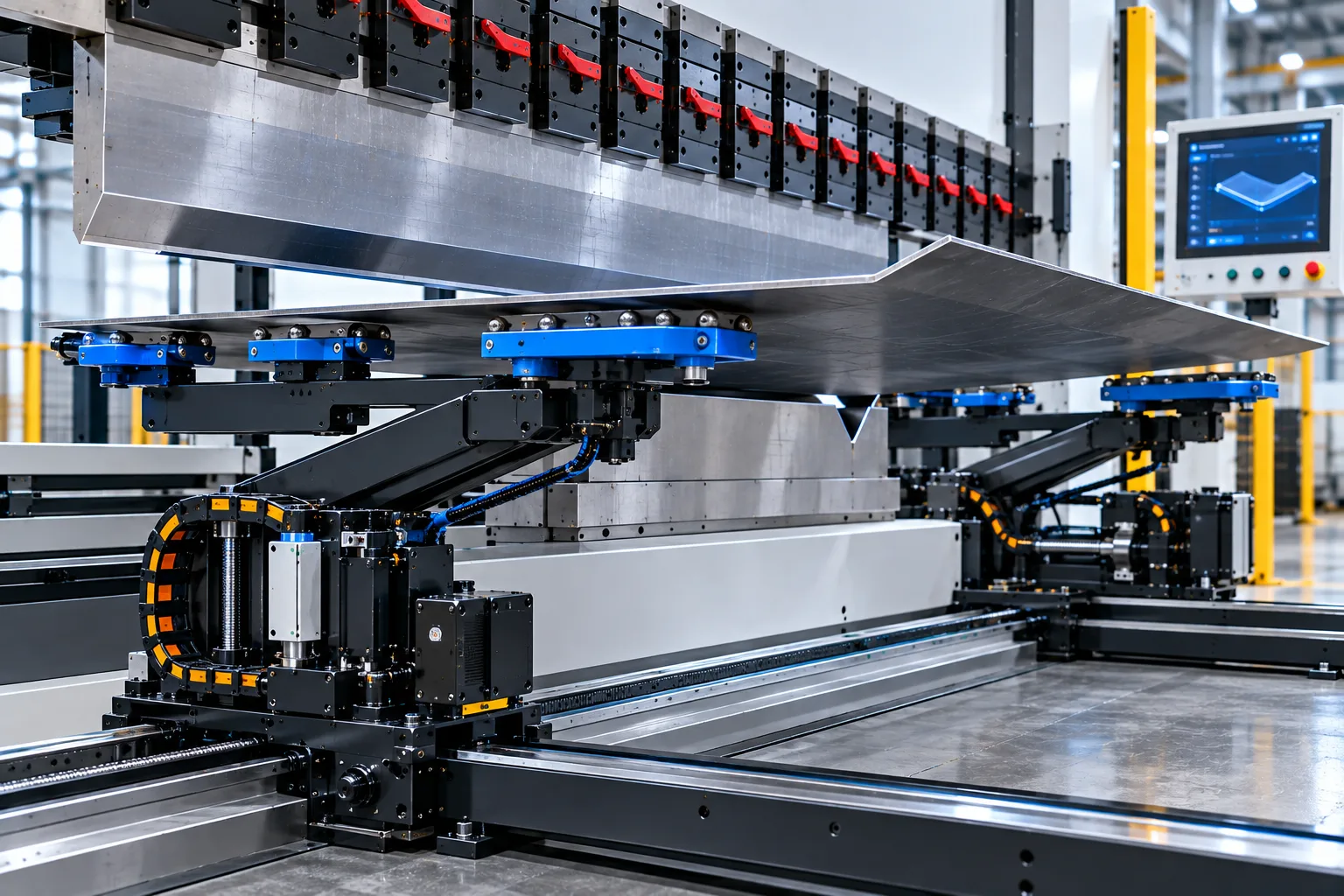
Industrial articulated robots equipped with hybrid vacuum suction and magnetic grippers track sheet kinematics with microsecond precision during stroke execution. This active synchronization eliminates sheet sag, prevents secondary reverse-bend distortion, and handles flat blanks produced by sheet metal laser cutting machines without operator strain on large panels.
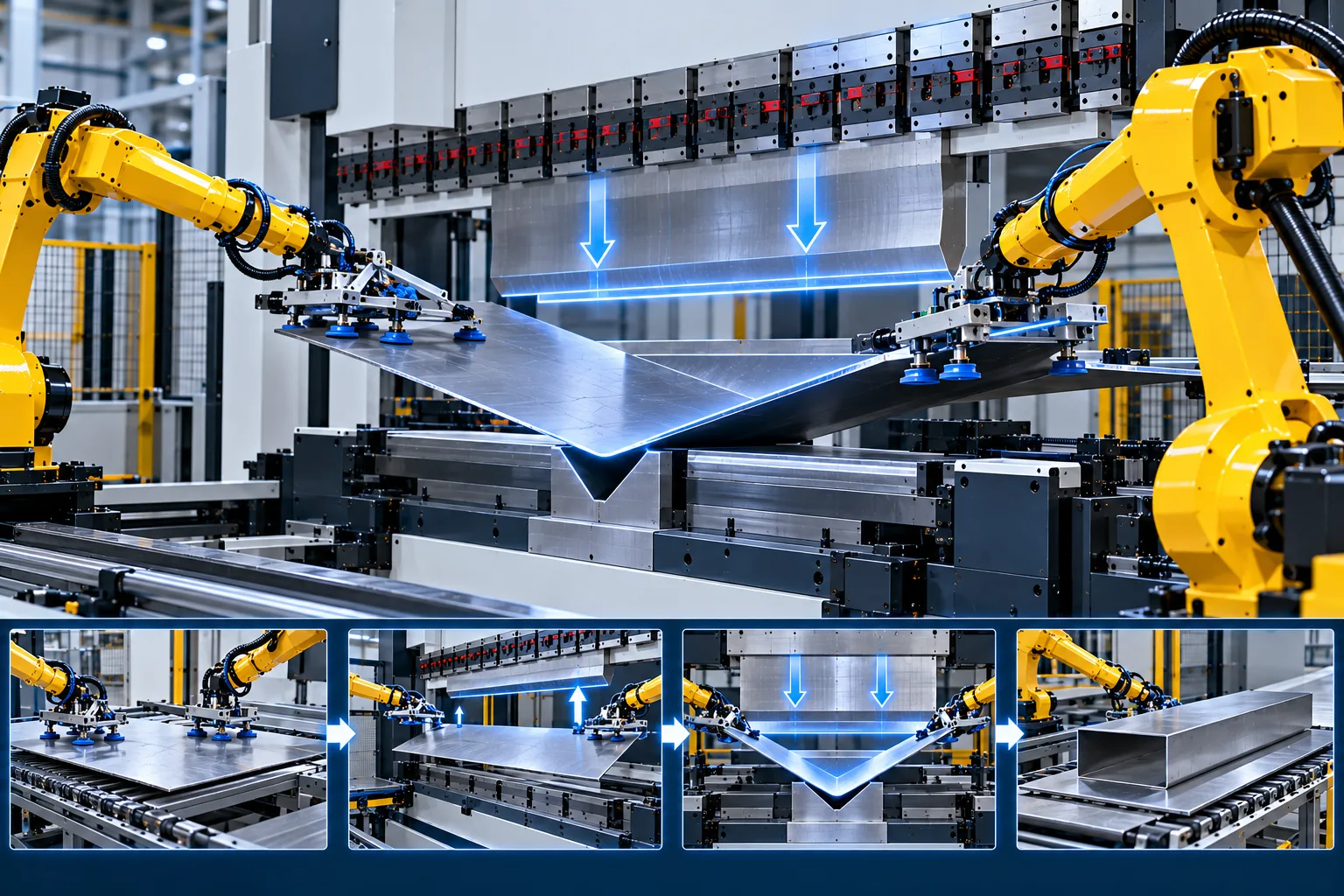
Heavy Plate CNC Sheet Follower Systems
Our dual-axis front and rear heavy-duty CNC sheet followers dynamically support heavy plates throughout the bending cycle. Replacing 2 to 3 manual assistants, Haden sheet followers eliminate workplace pinch hazards while preventing reverse-angle bending scratches on surface-critical components.
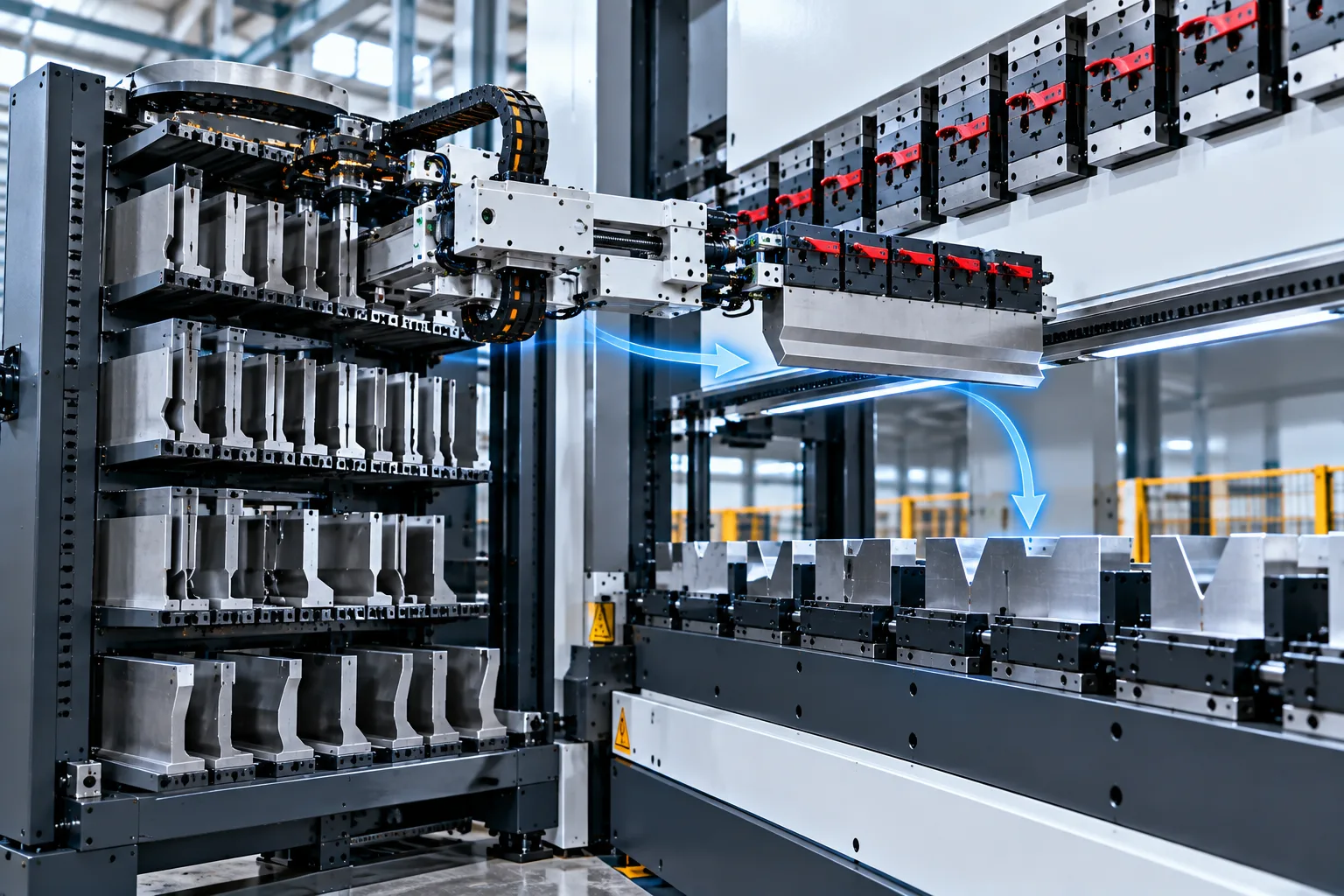
Intelligent Automatic Tool Changer (ATC)
Eliminate setup bottlenecks with rapid tool storage magazines. High-precision manipulators swap segmented upper punches and multi-V bottom dies within 15 to 60 seconds, enabling fully autonomous, continuous production across complex batch sequences without manual intervention.
Integrated Robotic Bending & Production Line Automation
Haden integrates robotic bending cells with offline programming, collision checking, angle-control systems, material handling, and factory production interfaces for automated sheet metal workflows connected with sheet and tube laser cutting machines .
Share your part geometry, material range, production volume, and automation requirements for a project-specific line review.
Discuss Your Automation ProjectExplore Engineering Capabilities →Industry-Specific Bending & Forming Scenarios
Compare forming challenges, production requirements, and recommended bending configurations across major sheet metal manufacturing sectors.
Electrical Cabinet Bending & Server Enclosures
Industrial control panels, modular server racks, and NEMA/IP-rated electrical enclosures require precision multi-bend geometries, complex return flanges, and tight gasket channel tolerances. Precision flange execution ensures reliable door latching, IP66 environmental sealing, and rapid downstream welding assembly.
Key Manufacturing Challenges
- — Forming complex internal returns and narrow profiles without tool collision
- — Maintaining strict sealing channel linearity and dimensional tolerances within ±0.2 mm
- — Integrating multi-step crushed hems and hinge offsets in high-mix batches
- — Eliminating scratch defects on pre-galvanized, powder-coated, or zinc-plated steel
Recommended Equipment Combination
Haden automatic panel benders for rapid 4-sided box forming paired with servo-electric press brakes for deep-channel internal returns and custom bracketry.
HVAC Panel Forming & Ventilation Duct Casings
Air handling unit (AHU) housings, acoustic duct panels, and modular chiller casings demand rapid forming across large, thin-gauge sheet blanks prepared by high-precision sheet metal laser cutting machines . Maintaining panel flatness across 2-meter to 4-meter spans without oil canning or handling distortion is critical for high-volume commercial HVAC production schedules.
Key Manufacturing Challenges
- — Preventing secondary reverse-bend bowing and sag on large 0.8 mm–2.0 mm sheets
- — Ensuring rapid cycle times on dual-flange and acoustic panel wrapper contours
- — Eliminating multi-operator manual panel support to reduce labor fatigue and risk
- — Preserving protective zinc coatings during repetitive high-speed air bending
Recommended Equipment Combination
Extended-bed CNC hydraulic press brakes equipped with synchronized sheet support systems, alongside automatic panel benders for automated tray and cover fabrication.
Elevator Sheet Metal Bending & Architectural Facades
Elevator door leaves, cab wall cassettes, and architectural exterior curtain wall panels demand zero-defect cosmetic quality on extra-long decorative stainless steel and aluminum sheets. Tight angular consistency and sharp edge geometry—frequently integrated after V-grooving—are critical for architectural fabrication.
Key Manufacturing Challenges
- — Forming 3-meter to 6-meter decorative sheets with consistent angular straightness
- — Minimizing die witness marks, contact scratches, and scuffs on decorative finishes
- — Producing sharp outside corners on pre-grooved architectural panels
- — Compensating for material variation across long brushed stainless blanks
Recommended Equipment Combination
CNC press brake configurations combined with V-grooving machines for architectural panels requiring controlled corner geometry and cosmetic surface protection.
Commercial Kitchenware & Food Processing Equipment
Fabricating commercial refrigeration housings, prep tables, dishwashing systems, and food-grade stainless counters requires controlled stainless-steel forming, consistent hems, accurate corners, and careful protection of finished surfaces.
Key Manufacturing Challenges
- — Forming 304/316 stainless steel while controlling cracking and springback
- — Producing tightly formed safety edges and consistent hems
- — Minimizing tool-transfer marks and surface scuffing
- — Maintaining corner squareness for downstream welding and assembly
Recommended Equipment Combination
Precision servo-electric press brakes with appropriate hemming tooling and CNC backgauging for repeatable stainless-steel fabrication.
Heavy Machinery, Crane Booms & Vehicle Chassis
Agricultural implements, construction equipment booms, trailer side rails, and commercial vehicle chassis members combine tubular sections prepared on tube laser cutting machines with high-strength plate. These applications require careful evaluation of material strength, springback, machine tonnage, tooling, and deflection control.
Key Manufacturing Challenges
- — Managing high forming loads on high-strength alloy plate
- — Compensating for substantial springback in high-yield-strength materials
- — Maintaining straightness across long structural channels
- — Matching tooling geometry and machine rigidity to demanding forming loads
Recommended Equipment Combination
Heavy-duty CNC hydraulic press brakes configured around the required material strength, working length, tooling, crowning, and part-handling requirements.
Targeting a Custom Sheet Metal Bending Application?
Share your material, thickness, part geometry, production volume, and forming requirements. Haden application engineers can help evaluate the appropriate press brake, panel bending, V-grooving, or automated forming configuration.
Precision Sheet Metal Bending Tooling & Custom Forming Dies
Demanding forming profiles require specialized tool geometries, tightly controlled metallurgical properties, and dedicated solutions to eliminate machine interference. Haden manufactures heavy-duty custom tooling for high-performance press brakes, precision hemming dies, and scratch-free forming systems designed to resolve tight dimensional constraints while maintaining repeatable angular tolerances.
Whether forming precision blanks prepared on sheet metal laser cutting machines, deep box return flanges, or non-marking cosmetic profiles, our tooling systems integrate directly with standard CNC crowning systems and rapid-clamping beams across carbon steel, stainless steel, and structural aluminum alloys.
Industrial-Grade 42CrMo Alloy Steel with Deep Induction Hardening
Tool longevity and edge retention depend on core alloy purity and controlled thermal processing. Haden precision press brake tooling is forged from vacuum-degassed 42CrMo high-tensile alloy steel and treated with multi-frequency CNC induction hardening. Critical working tips, punch radii, and V-die contact shoulders are hardened to 56–60 HRC up to a depth of 3–5 mm, preventing premature deformation, shoulder galling, and tonnage fatigue under continuous heavy-gauge production.
| Specification | Haden Standard Series | Engineered Custom Series |
|---|---|---|
| Base Material | 42CrMo / SCM440 Quenched & Tempered | Premium Tool Steels (Cr12MoV / D2 / 1.2379) |
| Working Surface Hardness | 54–58 HRC (Working Radii) | 58–62 HRC (Full Profile Deep Induction) |
| Grinding Accuracy | ±0.01 mm Match Ground Alignment | ±0.005 mm Precision Mirror Ground |
| Mounting Compatibility | European Standard / Promecam Style | Wila / Trumpf Style & Custom Hydraulic Tangs |
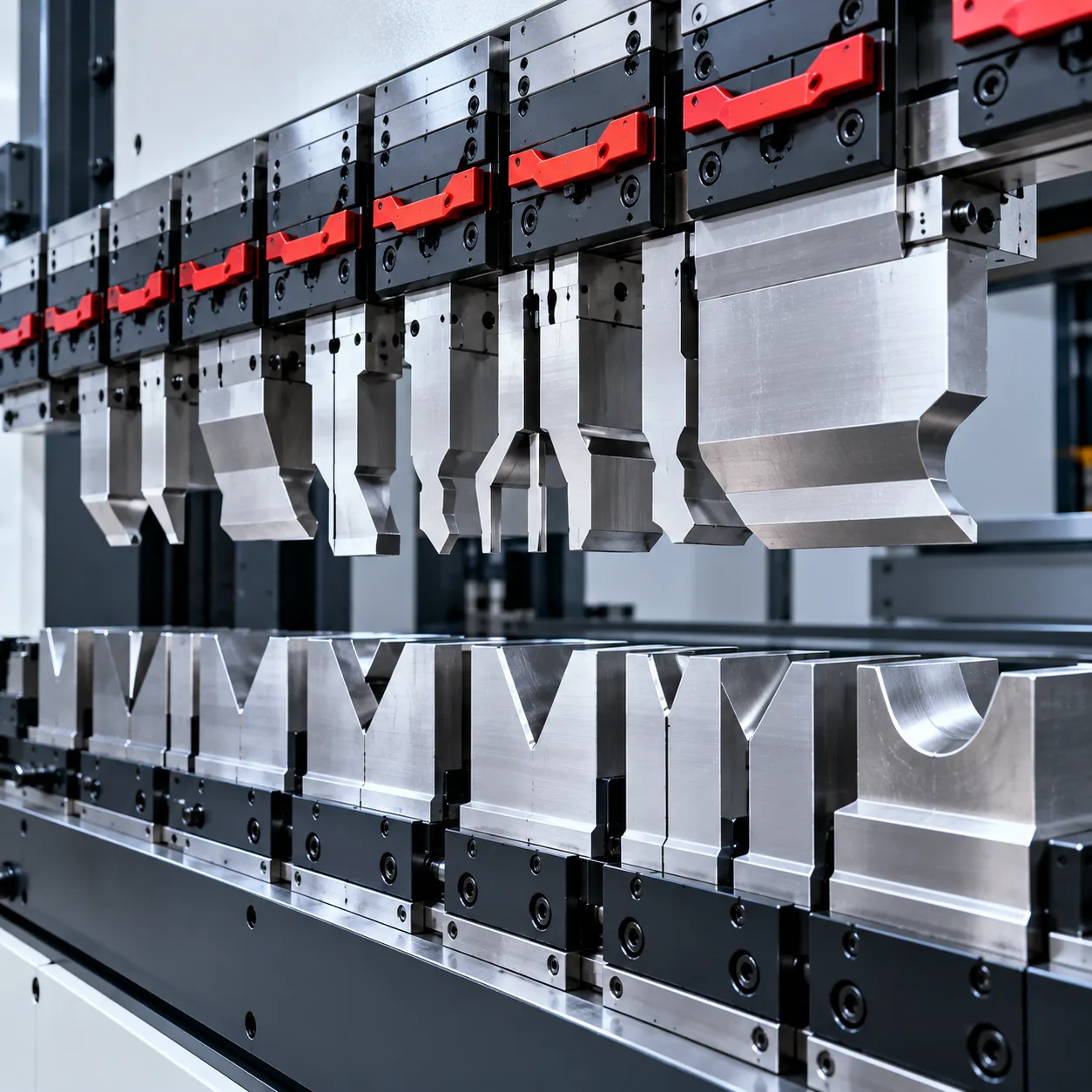
CNC match-ground segmented punch and die profiles engineered for rapid setup and modular reconfiguration.
Specialized Tooling Technologies for Complex Part Geometries
Standard V-dies often struggle with tight return flanges, cosmetic surfaces, or progressive hems. Haden engineers tailored tooling solutions designed around your specific geometric constraints and surface quality standards.
Standard & Hardened Segmented Tooling Systems
Engineered for modular flexibility, our precision-matched segmented tool sets allow operators to rapidly configure specific bending lengths for boxes, trays, and electrical cabinets without custom machining delays.
- • Modular Segmentation: Standard kits configured with section widths from 10 mm ear pieces to 500 mm solid blocks.
- • Quick-Clamping Tangs: Safety-click pins for effortless vertical tool insertion and pneumatic self-seating.
- • Relieved Horn Segments: Left and right end horns allow unhindered clearance on deep 4-sided enclosure return bends.
Single-Stroke Combination Hemming & Flattening Dies
Eliminate secondary manual flipping and dual-station setups with spring-assisted, hydraulic, or pneumatic combination hemming lower dies that execute the pre-bend and final hem in a single machine stroke.
- • Two-Stage Forming Cycle: Acute 30° pre-bend followed by dynamic table collapse for immediate flat or teardrop hemming.
- • Adjustable Hem Gap: CNC-programmable flattening clearance accommodates open water-tight seams or crushed flat edges.
- • Spring & Air Assist: High-cycle spring or pneumatic return mechanisms engineered for high-speed automated duty cycles.
Scratch-Free Bending & Surface Protection Tooling
Eliminate die-shoulder witness marks, tooling friction lines, and expensive secondary polishing on mirror-finish stainless steel, pre-painted sheets, and architectural aluminum panels.
- • Rolla-V Pivoting Rotor Dies: Hardened precision wing inserts rotate with the sheet, substituting sliding contact with pure rolling motion.
- • Polyurethane Die Inserts: Replaceable elastomeric synthetic pads provide non-marking zero-clearance radius support.
- • Heavy-Duty Die Barrier Films: High-tensile urethane protective films designed to withstand severe air-bending tonnages.
V-Grooving Pre-Bending Synergy for Ultra-Sharp Architectural Radii
Architectural facades, elevator interior panels, and luxury stainless steel casework often demand sharp outer corners that traditional air bending cannot achieve without edge cracking or large radii. By combining Haden high-speed CNC V-grooving machines with matched press brake forming, a precision V-shaped relief channel is machined along the fold line prior to bending.
This integrated synergy enables subsequent forming to achieve a tight outer radius approaching R ≈ material thickness, generating razor-sharp exterior corners, minimal springback variation, and significantly reduced required bending tonnage.
V-Groove Forming Advantages
- ✓ Zero-Radius Sharp Corners: Flawless external joint appearance matching solid extrusion profiles.
- ✓ Ultra-Narrow Return Flanges: Form short leg lengths that fall below standard minimum V-die thresholds.
- ✓ Tonnage Reduction: Decreases forming force by up to 60%, lowering tool wear and machine stress.
Specialty Tooling Profiles & Custom Forming Geometry Matrix
Haden develops customized punch and die configurations tailored to your exact 2D/3D part profiles and clearance envelopes.
Deep Gooseneck Punches
Relieved throat depths up to 250 mm engineered to form deep channels, U-profiles, and narrow return legs without ram interference.
Adjustable & Multi-V Dies
CNC-programmable or shim-adjustable V-die openings from 6 mm to 400 mm for rapid gauge changeovers on heavy plate production.
Offset & Z-Bending Tooling
Forms two opposite bends in a single press stroke to maintain parallel web alignment and eliminate secondary handling steps.
Louver & Card-Guide Dies
Custom progressive ventilation louver sets, stiffening rib punches, and card guides formed directly on the press brake.
1:1 Custom Tooling Profile Prototyping per 3D CAD Part Prints
Uncertain if your complex part geometry will collide with the upper ram, backgauge fingers, or lower bed? Haden’s application engineers deliver end-to-end technical verification. We perform comprehensive 3D sheet metal unfolding simulations, bend-line stress analyses, and physical prototype testing to validate custom punch and die profiles before cutting production steel.
Industrial Bending Case Studies & Sheet Metal ROI
Haden has helped global manufacturers optimize tens of thousands of sheet metal forming operations alongside high-performance laser-cutting machines. Explore empirical production data, rapid payback benchmarks, and verified engineering transformations across premier fabrication facilities worldwide.
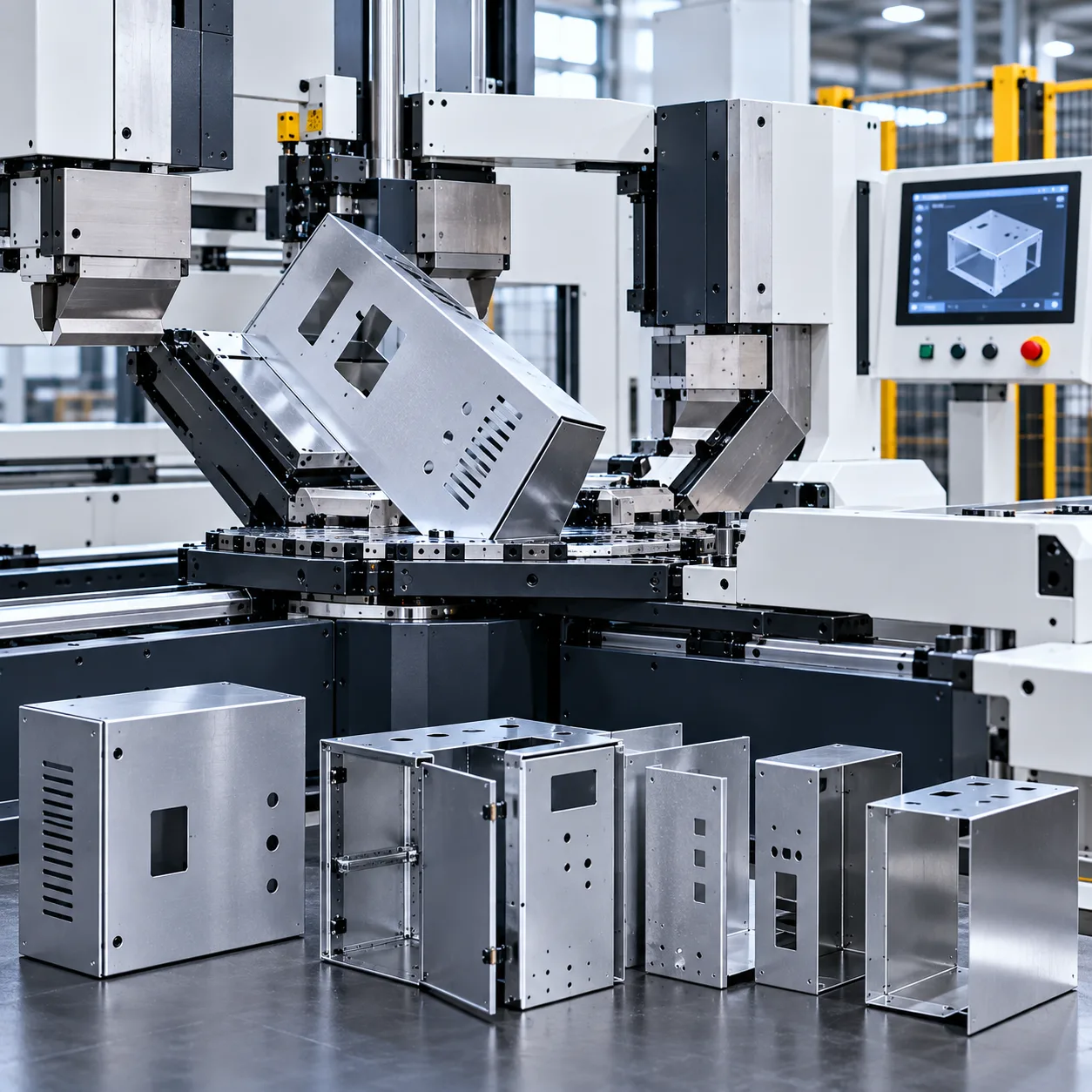 Electrical Enclosures • Europe
Multilateral Panel Bender for Control Cabinets
Production Bottleneck
Frequent manual tool setups caused severe cycle delays and inconsistent flange accuracy across high-mix server rack and enclosure batches.
Engineered Solution
Integrated an intelligent multilateral panel bending center featuring universal automated tooling and dynamic material thickness compensation, synchronizing directly with upstream sheet metal laser cutting machines.
Empirical Results
 Commercial HVAC • North America
Robotic Electro-Hydraulic Press Brake Cell
Production Bottleneck
Severe skilled-labor shortages limited operations to a single shift, while manual handling yielded an unacceptable 2.8% angular defect rate.
Engineered Solution
Turnkey electro-hydraulic CNC press brake cell engineered with heavy-payload robotic material tracking and closed-loop laser angle measurement, designed to complement high-output coil-fed laser cutting machines.
Empirical Results
 Elevator Fabrication • Southeast Asia
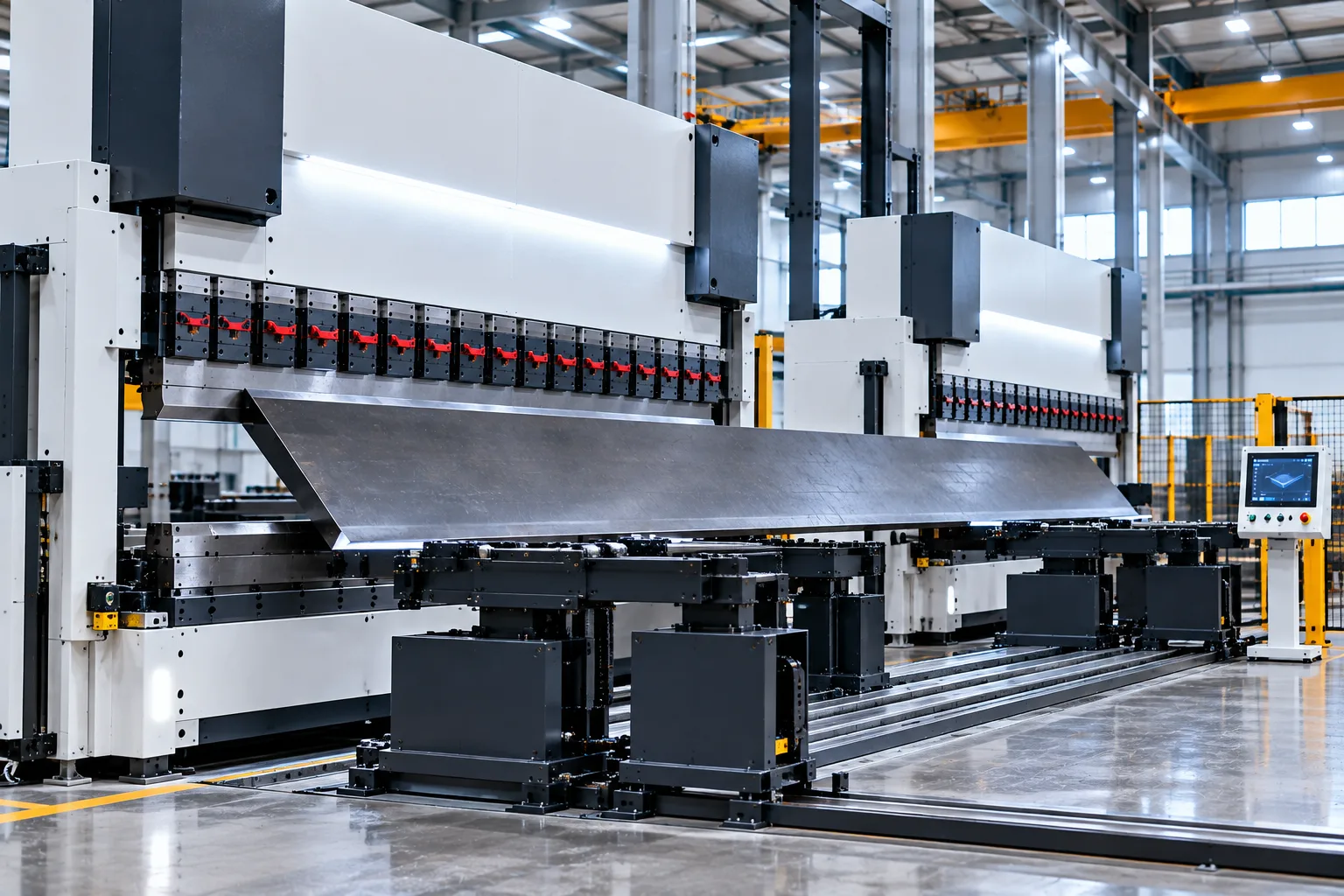
Dual Tandem Heavy Plate Bending System
Production Bottleneck
Severe longitudinal straightness deviations on 4-meter stainless elevator door leaves led to high rework costs and failed safety audits.
Engineered Solution
Synchronized tandem press brakes with CNC dynamic hydraulic crowning compensation and scratch-free polyurethane forming tooling.
Empirical Results
10,000+
Bending Operations Optimized Worldwide
< 14 Mos
Average Equipment Payback Period
99.8%
Operational Forming Reliability
50+
Countries with Active Field Installations
Sheet Metal Bending FAQ: Process Engineering & Tonnage Calculations
Authoritative engineering answers covering air bending force formulas, minimum flange geometry, closed-loop springback compensation, and production cell integration.
Standard empirical formula to determine required press brake tonnage based on sheet thickness, bend length, and bottom die V-opening width.
Calculates minimum return flange dimensions to prevent blank slippage into lower die shoulder radiuses during precision forming.
Real-time laser angle tracking measures material yield variation and executes micron-level corrective re-pressing in the same stroke.
How do you accurately calculate the required tonnage for sheet metal bending?
How do you accurately calculate the required tonnage for sheet metal bending?
Bending tonnage calculation depends on material sheet thickness (S), tensile strength (σb), bending length (L), and lower die V-groove opening (V). For standard air bending of mild structural steel (450 MPa), use the industry baseline formula:
When fabricating stainless steel alloys (such as AISI 304 or 316), required forming force increases by approximately 40% to 50% due to elevated work-hardening rates. For structural aluminum alloys, tonnage requirements typically drop by 40% to 50% compared to mild steel.
- Recommended V-Width: 6× to 8× material thickness for sheets under 3 mm; 8× to 10× for plates 3 mm to 6 mm.
- Automated Calculation: Haden CNC controllers store comprehensive parametric material libraries, automatically calculating required tonnage, dynamic crowning deflection curves, and backgauge retraction sequences upon CAD import of profiles cut by sheet metal laser cutting machines.
What is the minimum allowable flange length in sheet metal bending?
What is the minimum allowable flange length in sheet metal bending?
In conventional press brake air bending, minimum flange length (bmin) is constrained by lower die shoulder contact. If the return flange is shorter than the minimum support threshold, the workpiece drops into the V-groove before reaching target depth, causing angular errors and edge distortion.
For example, using an 8 mm V-die on 1.0 mm mild steel, the safe minimum return flange is approximately 5.6 mm. To produce ultra-narrow flanges without part distortion, Haden offers two specialized forming paths:
- Rotary / Wing-Bend Tooling: Support flanges as narrow as 2.5× sheet thickness without groove drop-in.
- Automatic Panel Benders: Universal oscillating folding blades form exterior flanges as short as 1.5 mm to 3.0 mm with zero die changeovers.
How is angular springback controlled in high-strength steels and heavy plates?
How is angular springback controlled in high-strength steels and heavy plates?
High-yield materials like Hardox, structural steels (Strenx, Domex), and tempered aluminum alloys exhibit significant elastic recovery post-release, occasionally producing angular deviations of 5° to 12°.
Haden integrates a multi-tier closed-loop control architecture to neutralize raw material tensile variations:
- Real-Time Laser Angle Measurement: Non-contact optical sensors measure real-time sheet deflection, calculate elastic springback upon partial decompression, and execute a precise micro-repress in the same stroke to guarantee ±0.2° tolerances.
- Dynamic CNC Crowning: High-precision mechanical wedge crowning systems compensate for bed and ram deflection, ensuring consistent bend angles across the full machine bed length.
- Pre-Bending V-Grooving Synergy: Planing narrow V-grooves along bend lines on heavy plates lowers required tonnage by up to 60%, virtually eliminating elastic springback and outer-bend cracking.
What is the programming workflow for robotic bending automation cells?
What is the programming workflow for robotic bending automation cells?
Haden robotic bending cells integrate seamlessly alongside high-speed laser cutting machines and utilize advanced 3D offline simulation software, fully decoupling program generation from physical machine time and eliminating manual teach-pendant bottlenecks.
The standard four-step digital workflow enables rapid changeovers:
- 3D CAD Model Import: Direct ingestion of STEP, IGES, or SAT component files into the offline CAM suite.
- Automated Tooling & Sequencing: The software selects punch and die layouts, calculates backgauge positions, and automatically determines collision-free bending sequences.
- Robot Trajectory & Gripper Synthesis: The simulation engine calculates regripping cycles, synchronous sheet follower trajectories, and collision checks against tooling and side frames.
- Direct NC Code Deployment: Production programs are pushed to machine and robot controllers via Ethernet, reducing new component setup times to under 15 minutes.
What are standard equipment lead times and overseas commissioning policies?
What are standard equipment lead times and overseas commissioning policies?
Haden maintains strict production milestones and comprehensive turnkey commissioning support for international manufacturing facilities.
How do you prevent die marking on mirror-finish stainless and prepainted panels?
How do you prevent die marking on mirror-finish stainless and prepainted panels?
Fabricating architectural cladding, commercial food equipment, and electrical enclosures requires zero cosmetic marring. Sliding friction across standard hardened V-die shoulders is the primary cause of score marks and surface galling.
Haden provides three engineered anti-scratch solutions:
- Polyurethane Protective Films: Heavy-duty urethane elastomer strips (0.4 mm to 2.0 mm thickness) layered over lower dies isolate sensitive sheet surfaces from metallic contact.
- Roller-Bearing Lower Dies: Hardened rolling inserts turn with the blank during the downward stroke, replacing sliding abrasion with smooth rolling friction.
- Panel Bending Folding Blades: Oscillating universal folding blades apply non-sliding bending torque from the outside, completely eliminating die witness lines on coated and prepainted stock.
Air Bending Engineering Matrix: Die Openings & Tonnage by Material Gauge
Reference baseline parameters for structural mild steel (σb = 450 MPa). Actual tonnage requirements scale proportionally for stainless steel, high-strength alloy, and structural aluminum grades.
| Sheet Thickness (S) | Recommended V-Width (V) | Min. Inside Radius (r) | Min. Flange Length (b_min) | Tonnage per Meter (Mild Steel) | Tonnage per Meter (Stainless 304) |
|---|---|---|---|---|---|
| 0.8 mm (22 Ga) | 6.0 mm | 1.0 mm | 4.2 mm | 70 kN/m (7.1 T/m) | 105 kN/m (10.7 T/m) |
| 1.5 mm (16 Ga) | 10.0 mm | 1.6 mm | 7.0 mm | 145 kN/m (14.8 T/m) | 218 kN/m (22.2 T/m) |
| 3.0 mm (11 Ga) | 24.0 mm | 3.8 mm | 16.8 mm | 245 kN/m (25.0 T/m) | 368 kN/m (37.5 T/m) |
| 6.0 mm (1/4 in) | 50.0 mm | 8.0 mm | 35.0 mm | 470 kN/m (47.9 T/m) | 705 kN/m (71.9 T/m) |
| 10.0 mm (3/8 in) | 80.0 mm | 13.0 mm | 56.0 mm | 810 kN/m (82.6 T/m) | 1,215 kN/m (123.9 T/m) |
Find the Right Bending Solution for Your Parts
Share your material, thickness, part geometry, and production requirements. Haden application engineers can help evaluate the appropriate machine configuration, tooling approach, bending sequence, and automation options for your application.
Request a Bending Solution
Tell us what you need to bend. Basic information is enough to start — drawings can be added if available.