
Industrial Leveling Machines for Precision Sheet & Plate Flattening
Haden precision leveling machines are engineered to correct coil set, residual stress, and flatness deviations in sheet and plate before cutting, forming, welding, and downstream fabrication. Configurable leveling architectures, precision roller systems, and CNC-controlled adjustment support applications from thin sheet to heavy plate processing. Integrate leveling with downstream sheet metal laser cutting machines for a more consistent production workflow.
Available specifications and processing ranges vary by machine model and material.
Precision Leveling Machinery Engineered for Plates, Coils, and Automated Lines
Eliminating residual internal stress and geometric distortion requires purpose-built machine rigidity matched to material yield strengths and feeding formats. Haden manufactures high-performance leveling products engineered for discrete laser blanks, high-speed press lines, and continuous coil processing. By delivering uniform plastic-elastic counter-bending across the workpiece cross-section, our levelers guarantee absolute flatness, eliminate springback, and safeguard downstream automated fabrication.
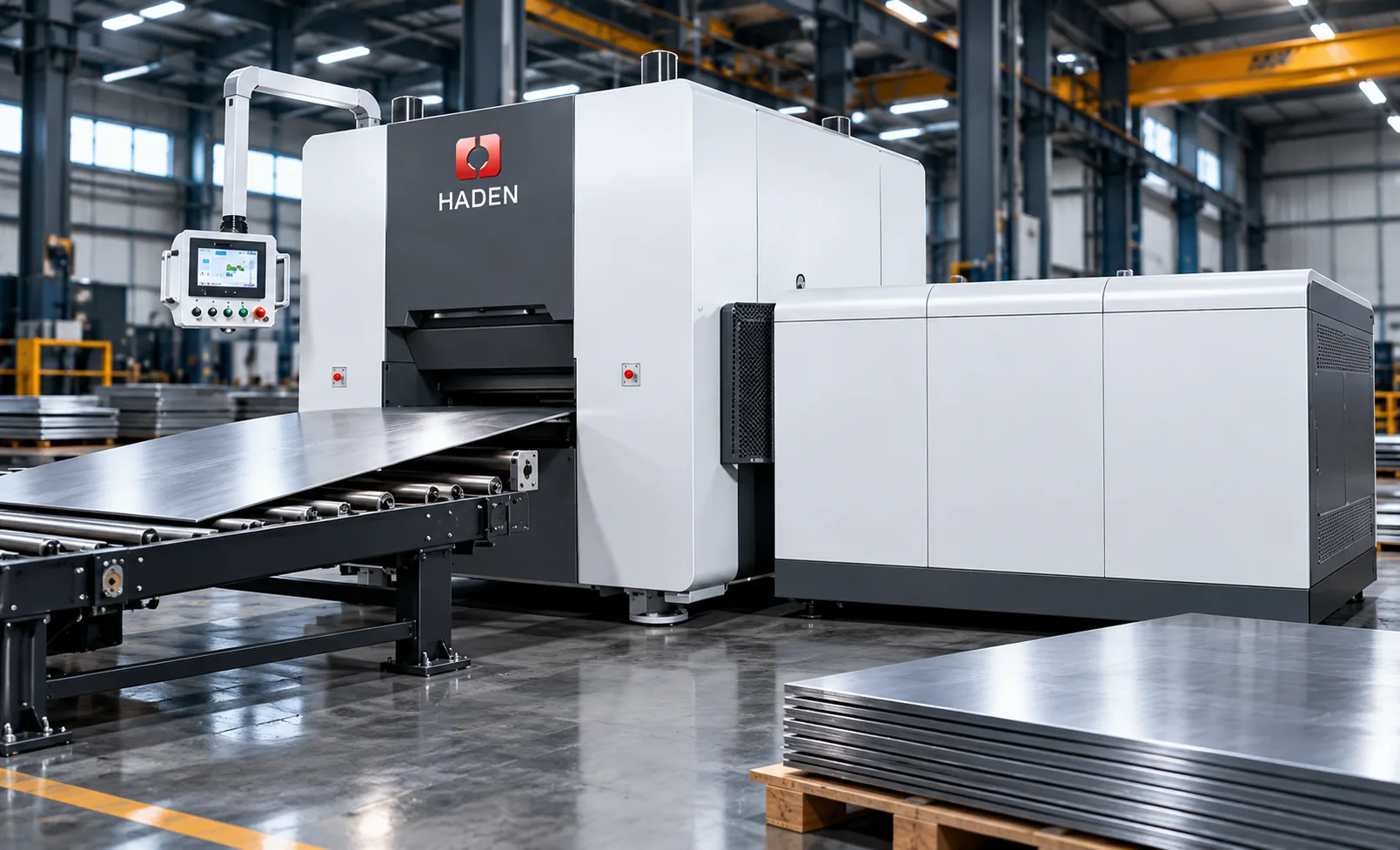
Plate Leveling Machines
Engineered for standalone sheet leveling, heavy structural plates, punched panels, and parts produced on thermal laser cutting machines or plasma cutters. Neutralizes localized thermal stresses and edge warping to prevent laser collision and secondary bending inaccuracies.
Key Engineering Parameters
- Thickness Envelope: 0.5 mm to 30.0 mm
- Max Plate Width: Up to 3,000 mm
- Roll Configuration: 17 to 23 Precision Rolls
- Frame Architecture: Stress-Relieved Box Gantry
- Control System: CNC Hydraulic Servo Gap
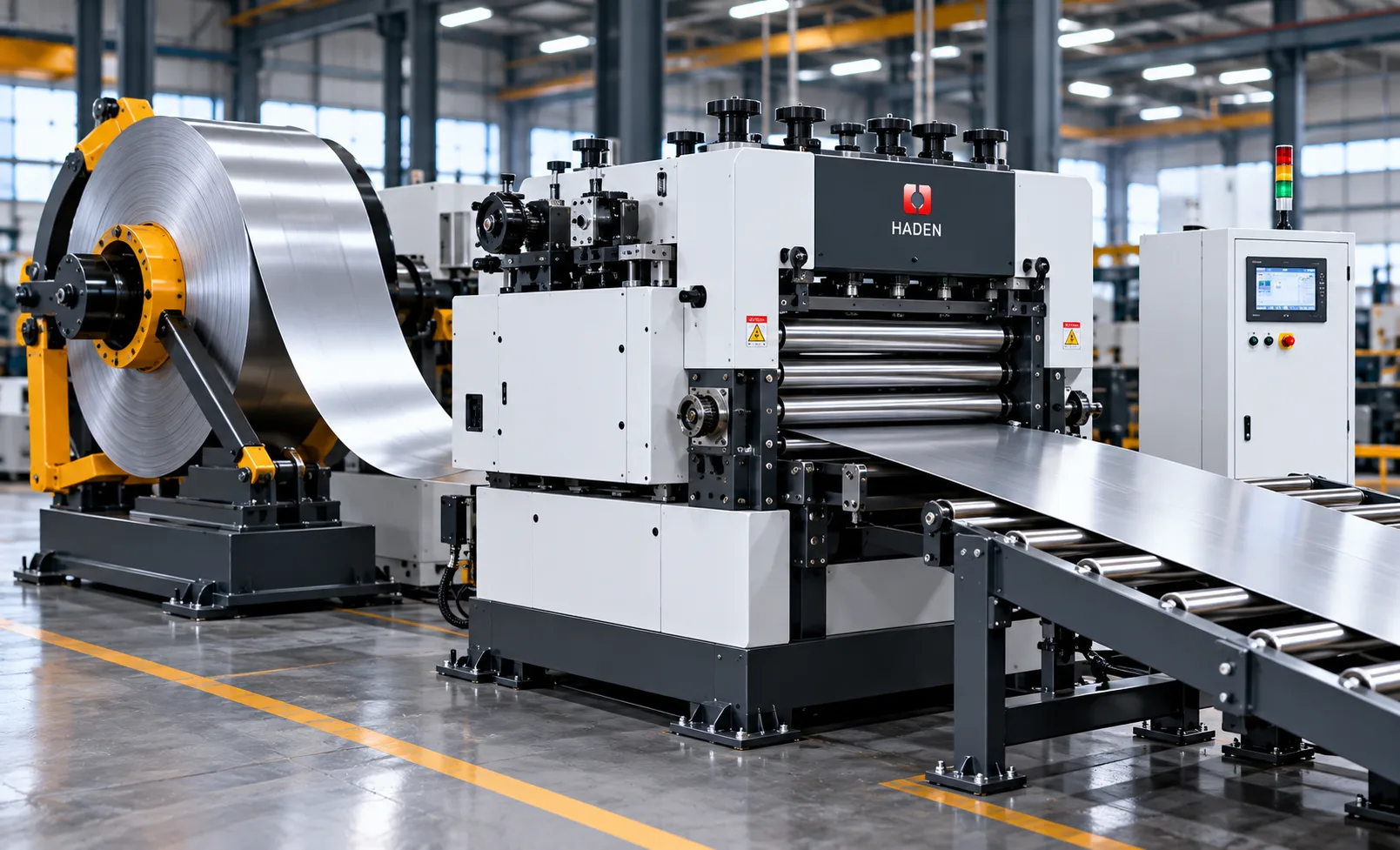
Coil Leveling Machines
Designed for high-speed continuous uncoiling and stamping press feed lines. Completely eliminates coil set, crossbow, and strip camber across cold-rolled steels, surface-sensitive stainless steels, and automotive aluminum coils.
Key Engineering Parameters
- Thickness Envelope: 0.2 mm to 16.0 mm
- Strip Width: 200 mm to 2,200 mm
- Cassette Design: 4-High & 6-High Quick-Change
- Line Synchronization: Encoder Loop & Speed Match
- Surface Protection: Zero-Mark Hard Chrome Rolls
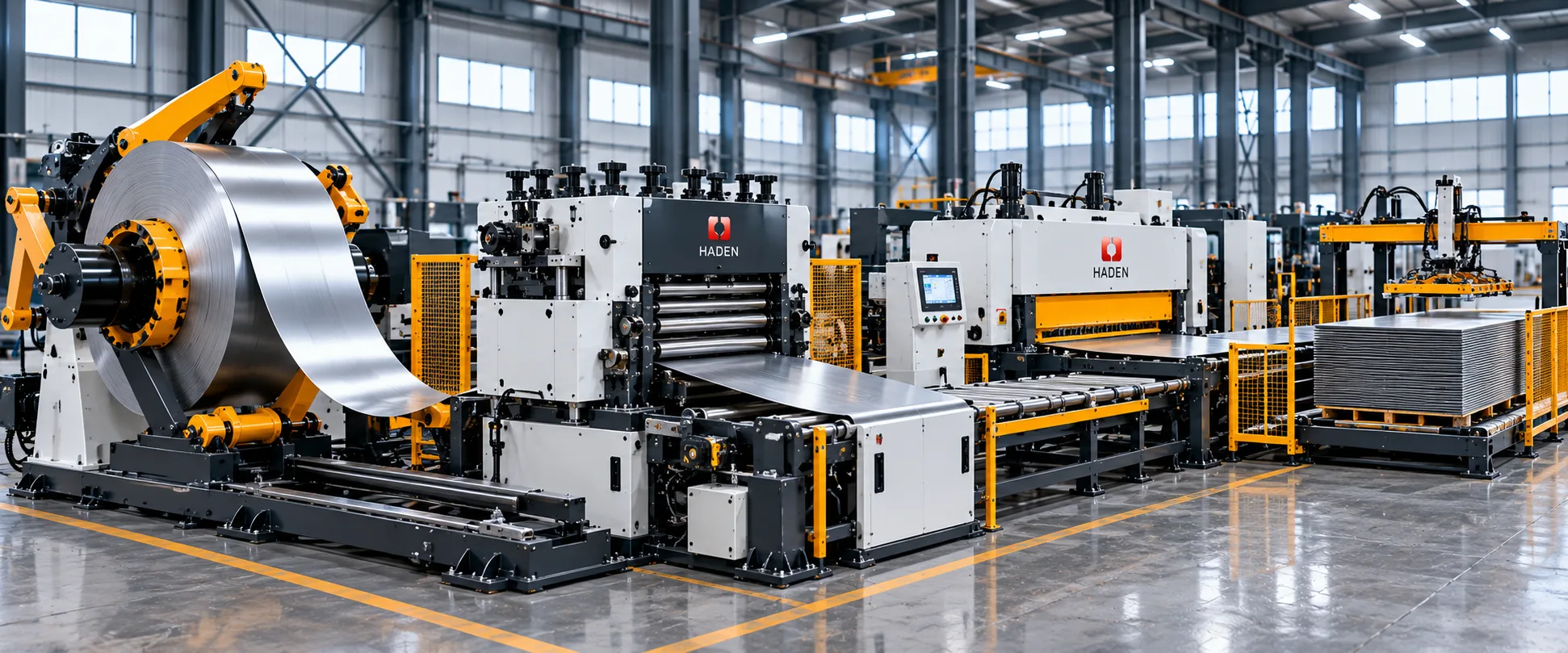
Cut-to-Length Lines
High-output processing lines integrating heavy decoiling, multi-roll precision leveling, closed-loop servo feeding, high-speed shearing, and automated sheet stacking for metal service centers and fabrication plants.
Key Engineering Parameters
- Max Line Speed: Up to 80 m/min
- Length Tolerance: ±0.2 mm Servo Precision
- Coil Capacity: Up to 35 Metric Tons
- Shear Technology: Hydraulic / Rotary / Flying Shear
- Stacking System: Pneumatic / Drop / Magnetic Stacker
Product Line Comparison Matrix & Operational Capabilities
Evaluate machine formats across material yield thresholds, primary stress defect correction, cassette configurations, and target downstream fabrication stages.
| Leveling Category | Operational Mode | Defect Elimination | Thickness Envelope | Cassette Structure | Downstream Processes |
|---|---|---|---|---|---|
| Plate Leveling Machines | Standalone single blanks and thick structural plates | Thermal warp, cut-edge stress, oil canning, angular camber | 0.5 mm – 30.0 mm | 4-High (Heavy Plate) / 6-High (Fine Sheet) | CNC laser cutting, robotic welding, precision press braking |
| Coil Leveling Machines | Continuous in-line coil decoiling and press feeding | Coil set, crossbow, center buckle, wavy edges | 0.2 mm – 16.0 mm | 6-High with intermediate pressure-dispersing rolls | Progressive stamping, roll forming, deep drawing blanks |
| Cut-to-Length Lines | Fully automated coil-to-sheet continuous processing | Coil curvature, longitudinal stress variance, edge wave | 0.5 mm – 25.0 mm | Interchangeable multi-cassette motorized systems | Steel toll processing, architectural cladding, OEM distribution |
How Multi-Roll Technology Eliminates Internal Stress and Material Memory
Sheet metal develops severe residual stresses during steel mill rolling, coil coiling, and localized thermal cutting. When released during punching or downstream fabrication on sheet metal laser cutting machines, these locked stresses cause edge lifting, oil canning, and severe dimensional springback. Haden multi-roll leveling machines utilize alternating cyclic elastic-plastic bending to homogenize internal grain boundaries and equalize cross-sectional tension.
By subjecting the raw stock to deep plastic deformation at the machine entry—straining outer material fibers beyond yield strength by up to 80%—followed by progressively decaying counter-bends toward the exit rolls, our systems reset material memory. Finished workpieces achieve strict DIN EN 10029 Class S flatness standards and maintain complete dimensional stability through robotic welding, bending, and powder coating.
Standard 4-High Roll Assembly
Direct heavy-duty backup roll support delivering exceptional structural stiffness for carbon steel plates and heavy structural fabrication.
Precision 6-High Cassette
Intermediate load-distributing rolls that completely eliminate backup roll shadowing on mirror stainless steel, aluminum, and painted surfaces.
Need Equipment Sizing for Your Material Envelope?
Selecting the ideal roll diameter, center pitch, and total drive torque depends directly on your material yield strength and cross-sectional thickness. Haden application engineers run detailed finite element calculations to verify machine capacity for your specific production mix.
- Sample test leveling with laser flatness coordinate reports
- Integration engineering for automated press feeds and CTL lines
- DIN EN 10029 Class S tolerance verification on high-tensile steels
The Physics of Roller Leveling: Elastic-Plastic Deformation and Residual Stress Relief
Industrial precision leveling machines transform raw, distorted metal stock into dimensionally stable, flat sheets. By subjecting workpieces to a calculated series of alternating cyclic bends, Haden leveling technology systematically erases mechanical memory, neutralizes trapped internal residual stress, and delivers precision sheet metal flattening that resists springback during secondary operations on industrial laser cutting machines, stamping presses, or press brakes.
Roll Cassette Mechanics
4-High Cassette Mode: Heavy-duty backup rollers interface directly with work rolls. Designed for standard structural carbon steels, hot-rolled pickled plates, and heavy fabrication where core plastification takes precedence over delicate surface aesthetics.
Dual servo gap actuators ensure absolute micrometer-level symmetry.
Deep inlet deformation breaks fiber tension across core cross-sections.
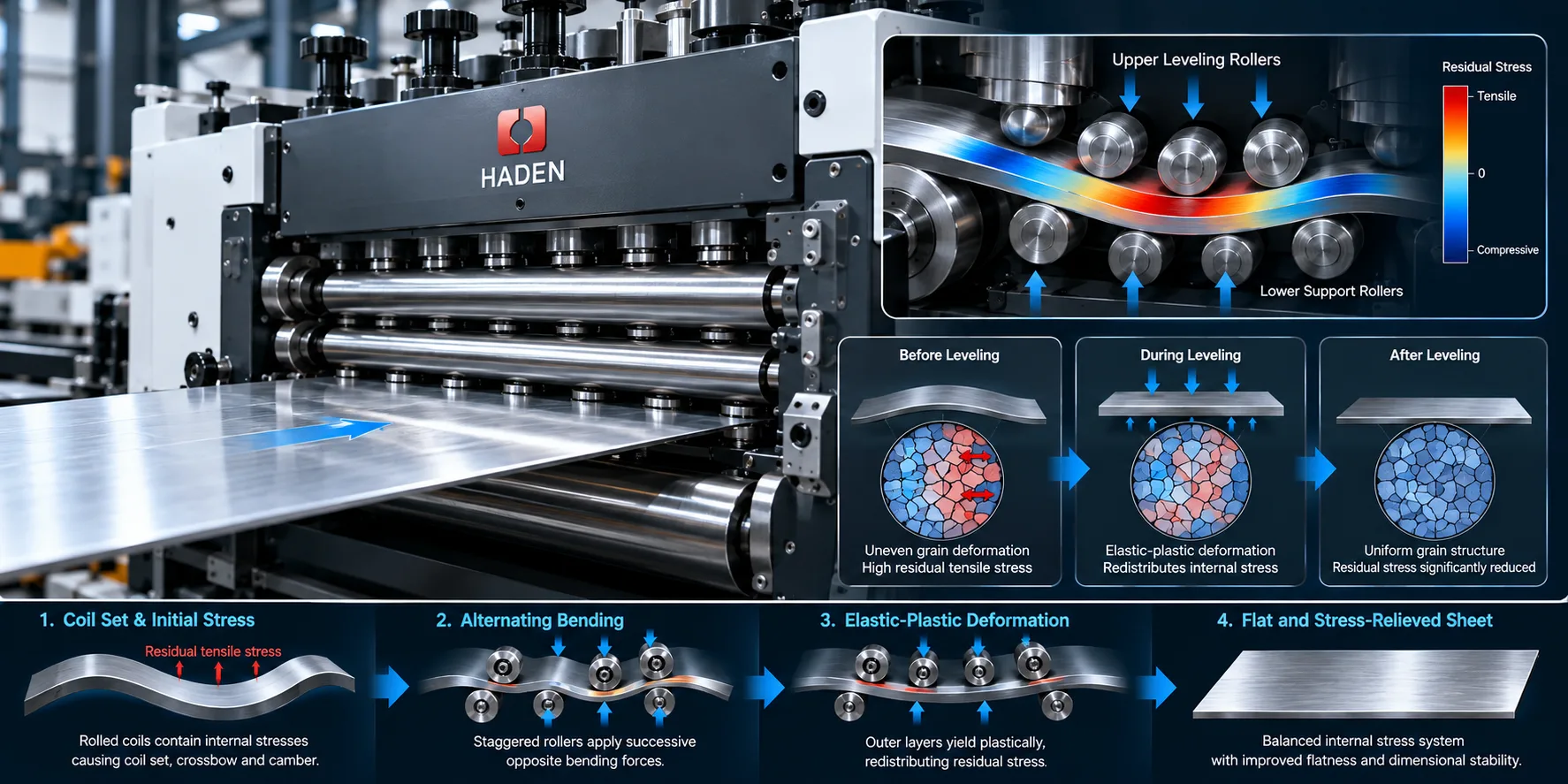
Alternating Bending Mechanics & Yield Dynamics
The roller leveling principle relies on subjecting metal sheets to a series of controlled, decreasing cyclic alternating bends. When unworked sheets enter the leveler, uneven internal stresses create common shape defects such as coil set, crossbow, center buckle, and edge waves that can compromise precision on sheet metal laser cutting machines.
Inlet Zone Maximum Plastic Strain
The initial work rolls intermesh deeply, inducing cyclic plastic elongation that exceeds material yield strength by 70% to 80%. This rigorous deformation homogenizes internal tension and eliminates previous curvature memory.
Intermediate Decaying Counter-Bends
As the metal travels through sequential staggered rolls, roll intermesh progressively diminishes. Each reverse bend reduces plastic strain amplitude, transitioning the core fibers toward elastic boundaries.
Outlet Zone Springback Neutralization
The final exit rolls deliver pure elastic springback cancellation. Workpiece outer fibers and neutral axes reach complete stress equilibrium, discharging a dead-flat sheet compliant with international tolerances.
Haden utilizes finite element method optimized ultra-rigid frames and hardened rolls to ensure alternating bending forces are distributed evenly across the entire plate cross-section without structural frame deflection under severe hydraulic down-thrust loads.
Cassette Architecture Comparison: 4-High vs. 6-High
Selecting the appropriate roll cassette architecture is critical for balancing mechanical leveling capacity against strict surface cosmetic requirements.
| Feature | 4-High Leveling Cassette | 6-High Leveling Cassette |
|---|---|---|
| Roll Stacking | Work Rolls + Backup Rolls | Work Rolls + Intermediate Rolls + Backup Rolls |
| Surface Protection | Standard (potential backup roll shadow) | Superior (zero line marking or striping) |
| Target Materials | Carbon steels, structural plates, HRPO | Mirror stainless, aluminum alloys, polished copper |
| Load Capacity | Extreme high-tonnage rigidity | High-precision torque distribution |
| Primary Advantage | Maximum deep plastic deformation | Pristine optical surface integrity |
Intelligent CNC Servo Gap Control
Modern high-yield materials demand exact positioning. Haden levelers integrate dual-mode electro-hydraulic micro-adjustment drives providing 0.01 mm positioning accuracy. The built-in CNC expert system correlates material yield strength, sheet width, and measured thickness to automatically compute optimal roll intermesh geometries.
- ✓ Adaptive material database
- ✓ Hydraulic overload fast-release
- ✓ Dynamic roll crown micro-thrust
- ✓ Closed-loop encoder feedback
Verify Leveling Requirements for Your Material
Share your material grade, thickness, width, incoming flatness condition, and target tolerance. Haden application engineers can evaluate suitable roll configuration, leveling capacity, and machine setup for your production requirements, including continuous lines integrated with coil-fed laser cutting machines .
Leveling Machine Sizing Guide: Roll Diameter, Pitch & Yield Strength Matching
Selecting the correct roller leveling machine requires an exact mathematical match between sheet thickness, yield strength, roll diameter, and intermesh pitch. Inadequate roll sizing prevents full elastic-plastic deformation, leaving internal residual stresses that cause post-cutting warping, while oversized rolls cannot achieve the tight alternating bending radii needed for thin, high-yield alloys. Haden engineers calibrate roll geometry, cassette stiffness, and servo drive dynamics to achieve 70% to 80% plastic strain penetration across target alloy profiles.
Thickness Sizing Framework by Material Envelope
Select a thickness classification below to inspect roll diameter parameters, cassette configurations, and down-thrust tonnage requirements.
Small Roll Diameters for Sharp Alternating Plastic Curvature
Thin metal strip, punched blanks, and cut parts from sheet-metal laser-cutting machines require compact roll diameters from Ø25 mm to Ø50 mm combined with tight center-to-center pitch. Because thin gauges exhibit minimal section modulus, larger roll diameters cannot create the tight wrap angle necessary to overcome material yield strength. This high-density roll configuration eradicates coil set, crossbow, and localized edge wave without generating secondary fluting or roller shadow marks.
Intermediate roll rows isolate driven work rolls from backup bearings, preventing shadow stripes on polished stainless, copper, and cosmetic aluminum.
A multi-stage alternating curvature envelope yields gradual stress decay, securing flat geometry with near-zero elastic springback.
Target Downstream Applications
- Precision server enclosures and electronic chassis
- EV battery cell busbars, terminal tabs, and cooling plates
- Automotive stamped brackets, clutch discs, and interior trims
- Fine-blanked components and perforated filter screens
Engineering Sizing Specifications
Material Yield Strength vs. Leveling Force Sizing Matrix
The plastic bending moment required to eliminate plate distortion scales directly with yield strength (Re / Rp0.2) and the square of thickness. Use this engineering matrix to evaluate hydraulic down-thrust multipliers, roll architecture recommendations, and model series matches across diverse industrial materials.
| Material Category | Typical Commercial Grades | Yield Strength (Re / Rp0.2) | Relative Plastic Resistance | Required Down-Thrust Factor | Recommended Roll Architecture | Haden Series Match |
|---|---|---|---|---|---|---|
| Low-Carbon Mild Steel | Q235B, SS400, ASTM A36, S235JR | 235 – 275 MPa | Baseline (1.0×) | Standard Hydraulic Load | 4-High (17–19 Rolls) | HDL-Std Series |
| Austenitic & Ferritic Stainless | AISI 304, 304L, 316L, 430 | 290 – 350 MPa | Moderate-High (1.4× – 1.6×) | +40% Increased Tonnage | 6-High Non-Marking (21–23 Rolls) | HDL-Pro 6H Series |
| High-Strength Structural Steel | Q690D, Strenx 700, S690QL | 690 – 780 MPa | High (2.5× – 2.8×) | +150% High-Tonnage Down-Thrust | 4-High Reinforced Box Frame | HDL-Xtreme Series |
| Ultra-High Strength & Wear Plate | Hardox 450, Strenx 960, Armox 500 | 960 – 1,300 MPa | Extreme (3.8× – 4.5×) | +280% Multi-Cylinder Hydraulic Lock | 4-High Heavy Forged (HRC 65) | HDL-ArmorMax Series |
| Aluminum Alloys (Medium/High Yield) | 5052-H32, 6061-T6, 7075-T6 | 180 – 505 MPa | Low Modulus, High Springback | Micro-Servo Gap Regulation | 6-High Polished Mirror Rolls | HDL-Aero 6H Series |
| Copper, Brass & Titanium Alloys | C11000 ETP, C26000, Ti-6Al-4V | 200 – 880 MPa | Variable Strain Hardening | Torque-Regulated Closed Loop | 6-High Multi-Backup Array | HDL-Titan Series |
How Haden Engineers Calculate Exact Machine Parameters
Leveling machine selection cannot rely on nominal thickness values alone. Our engineering sizing process models elastic-plastic stress gradients, roll bending limits, and structural deflection using true material stress-strain curves.
Plastic Section Modulus & Curvature Radius
We calculate the critical bending radius needed to plasticize 70% to 80% of the cross-section, ensuring residual stress eradication without material surface cracking.
Roll Diameter & Pitch Envelope Optimization
Work roll diameter and intermesh pitch are matched to maximize plastic strain across thin gauges while providing high torsional rigidity for heavy-gauge runs.
Separating Force & Frame Deflection Analysis
Finite element modeling calculates maximum separating reactions, ensuring structural frame deflection remains strictly below 0.02 mm/m under peak operational loads.
Drive Torque & Process Line Synchronization
Main motor ratings, distribution gearboxes, and cardan drive shafts are sized to deliver continuous plastic deformation torque during both continuous feeding for coil-fed laser-cutting machines and discrete plate operations.
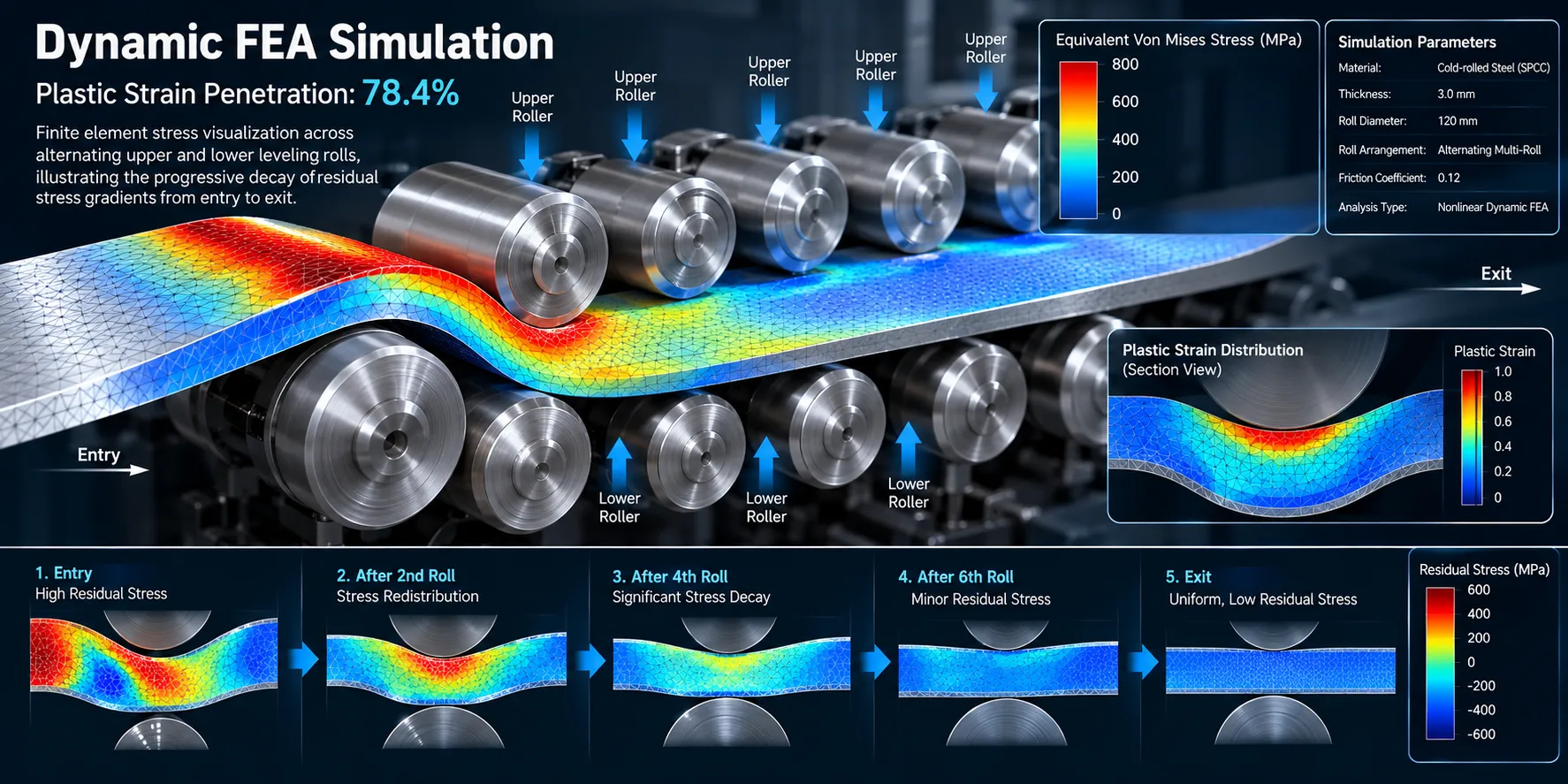
Finite element stress visualization across alternating upper and lower leveling rolls, illustrating the progressive decay of residual stress gradients from entry to exit.
Tolerances down to ≤0.1 mm/m
Induction-hardened tool steel
Need a Leveling Machine Configuration for Your Material?
Share your material grade, tensile strength, thickness, width, plate dimensions, and target flatness requirements. Haden application engineers can evaluate the suitable leveling capacity, roll configuration, and machine setup for your sheet or plate processing application.
Eliminating Residual Stress Across Critical Manufacturing Sectors
High-throughput sheet metal fabrication relies fundamentally on material flatness and homogeneous internal stress distribution across advanced laser cutting machines and downstream processing lines. Unrelieved residual stress from primary rolling mills or thermal cutting operations triggers severe springback, edge camber, and automated processing disruptions. Precision industrial roller levelers eliminate these production roadblocks through controlled, multi-roll alternating plastic-elastic deformation.
Haden leveling systems serve automotive Tier-1 suppliers, contract laser cutting centers, electrical enclosure manufacturers, and heavy engineering plants worldwide. Engineered to meet and exceed strict DIN EN 10029 Class S flatness criteria, our leveling equipment turns distorted raw coils, heavy plate stock, and stamped blanks into dimensionally stable, stress-relieved workpieces optimized for automated downstream processing.
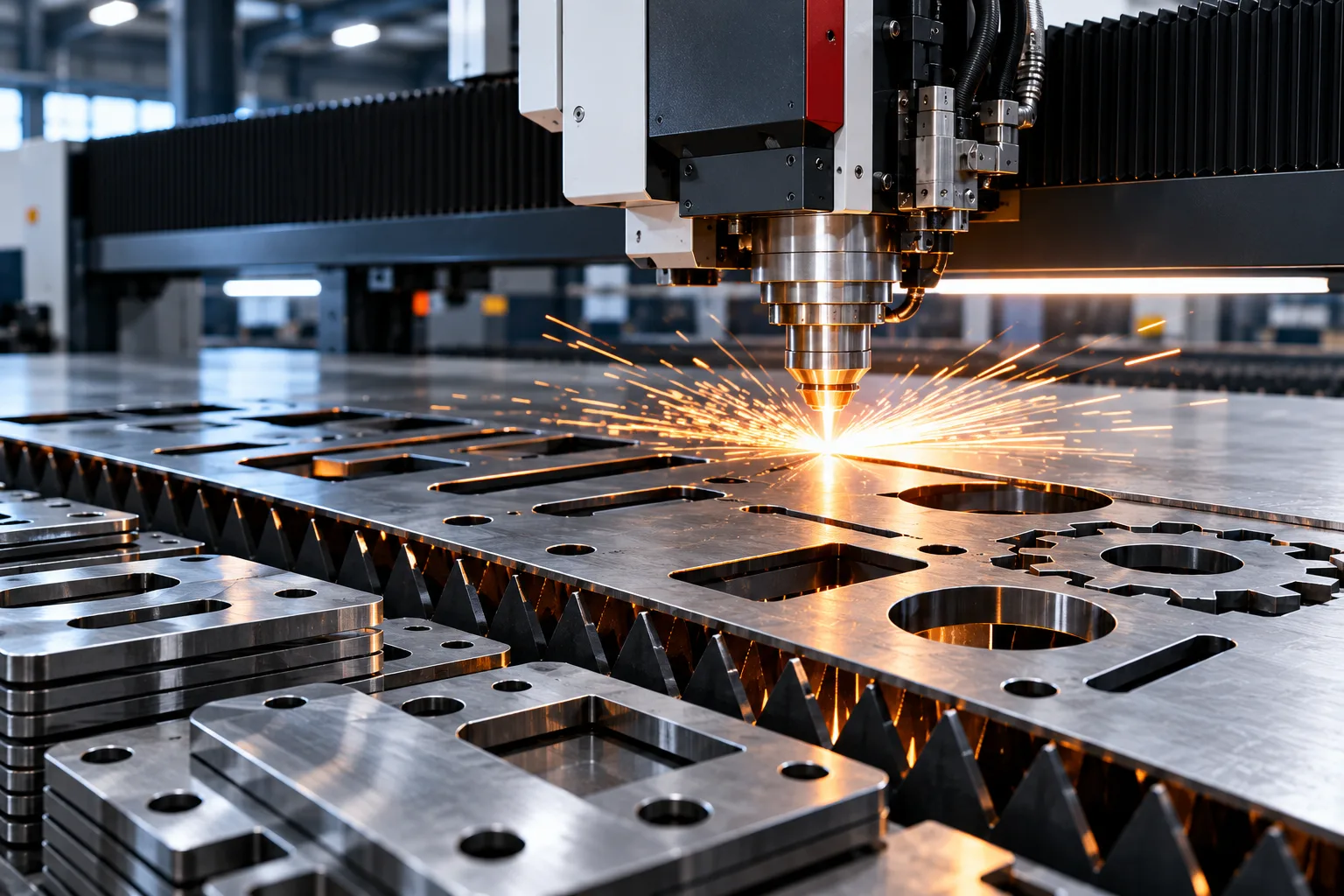
Laser, Plasma & Waterjet Cut Parts
Neutralizes internal rolling stress prior to thermal processing and relieves cut-edge thermal strain on complex geometries. For high-speed sheet metal laser cutting machines, it prevents internal stress release that causes parts to tip up and collide with cutting heads.
- Prevents expensive laser cutting head crashes
- Maintains uniform focal height and kerf consistency
- Enables reliable automated robotic part picking
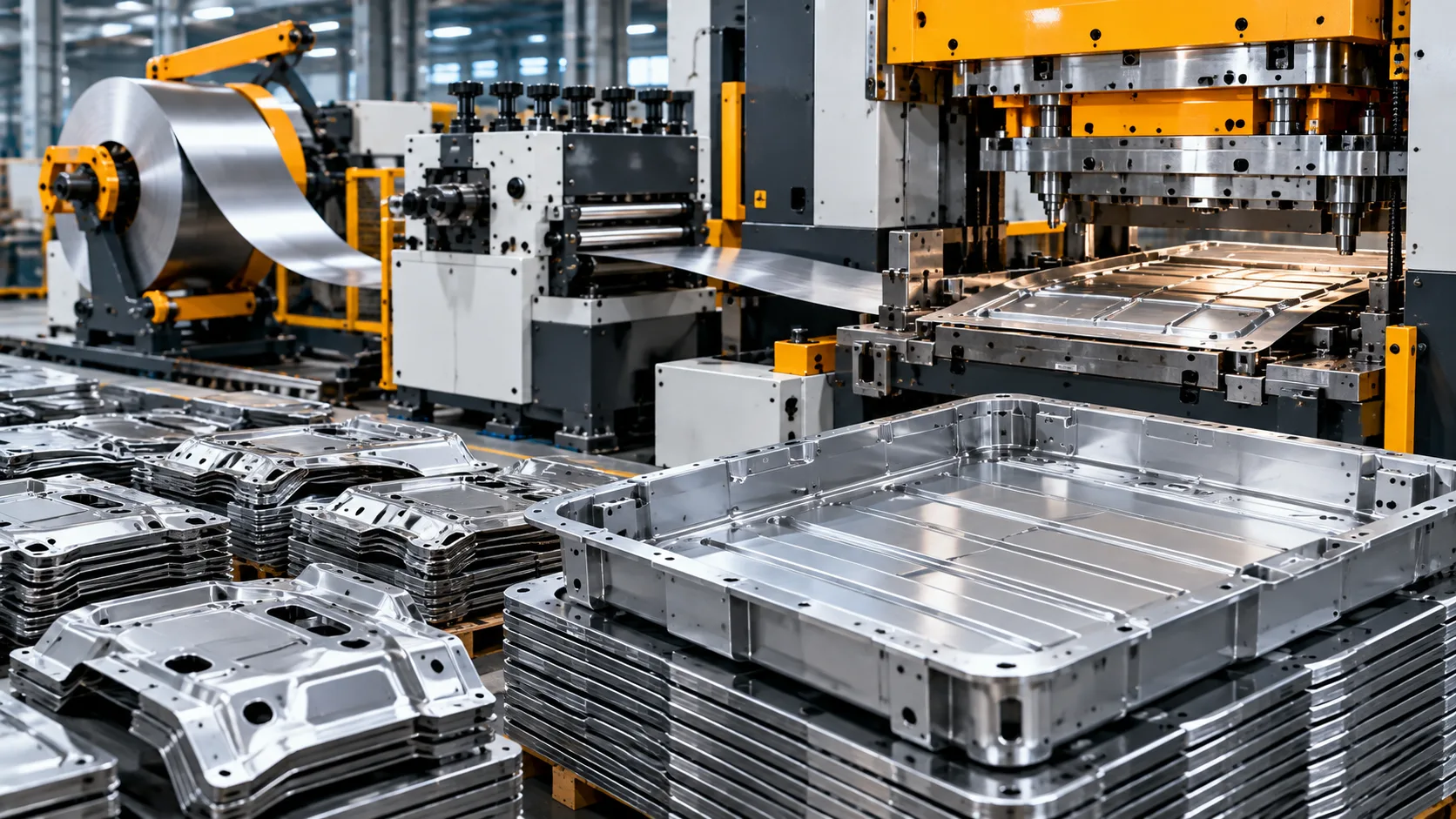
Automotive Stamping & EV Battery Trays
Eradicates elastic springback in Advanced High-Strength Steels (AHSS/UHSS) and structural aluminum alloys, delivering seamless integration with coil-fed laser cutting machines and precision repeatability in multi-station progressive stamping dies.
- Eliminates coil set, crossbow, and camber defects
- Protects progressive dies and extends tool wear life
- Ensures airtight sealing tolerances for EV battery packs
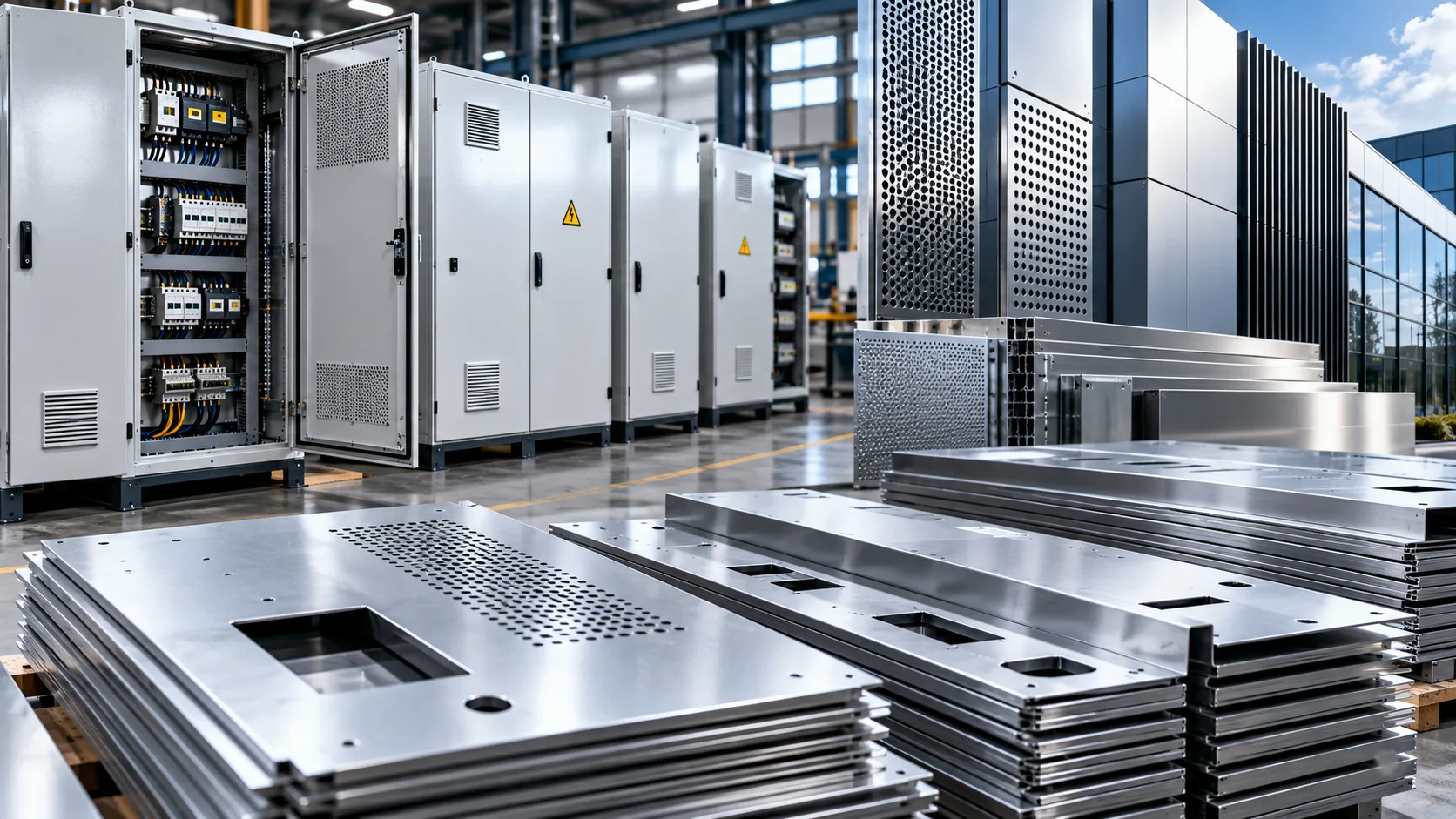
Electrical Cabinets & Architectural Skins
Eliminates center buckle, edge waves, and visible oil-canning across wide panels. Delivers exact 90-degree press brake bends and defect-free finishes for high-end powder-coated facades and enclosures.
- Removes visible cosmetic oil-canning and distortion
- Ensures precise corner seam alignment during assembly
- 6-High cassette structure protects mirror and brushed finishes
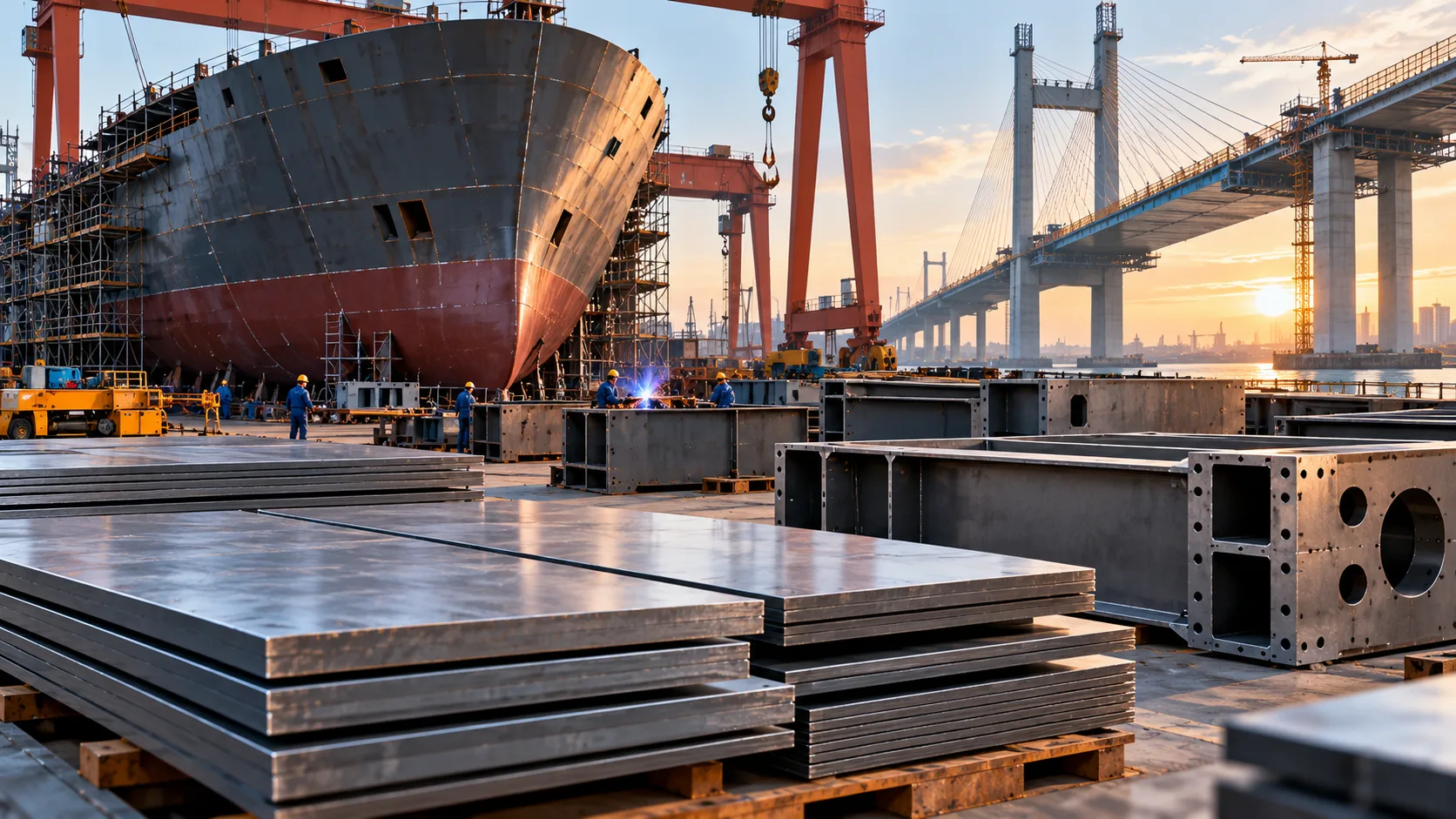
Heavy Machinery, Shipbuilding & Bridges
Corrects angular warping and flame-cutting thermal distortions in heavy structural steel plates up to 30 mm thickness, restoring precise baseline flatness required for automated structural welding.
- Levels high-strength structural plate grades up to S690/S960
- Replaces labor-intensive manual flame-straightening
- Ensures uniform joint fit-up in automated robotic welding
Comprehensive Processed Material Compatibility
Different industrial metals demonstrate distinct yield points, work-hardening behaviors, and surface sensitivity. Haden roller leveling machines provide precise, programmable plastic deformation across conventional structural steels, sensitive non-ferrous sheets, and ultra-high-yield alloys.
Carbon & High-Tensile Structural Steels
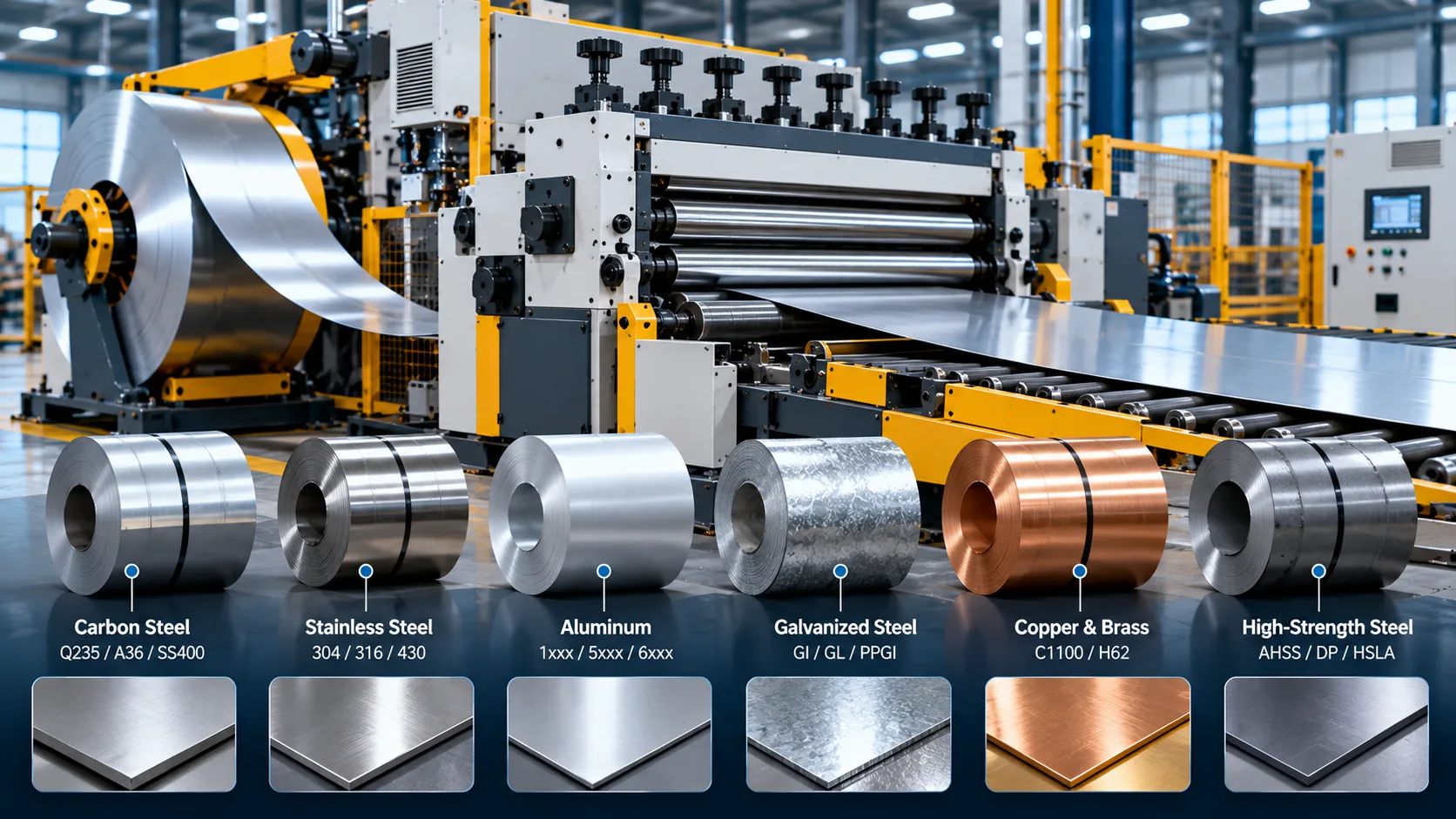
Hot-rolled, cold-rolled, pickled & oiled coils, Q235, SS400, A36, plus quenched and tempered grades including S690QL, Strenx, and Hardox wear plates.
Surface-Sensitive Stainless Steels
Austenitic and ferritic grades (AISI 304, 316L, 430) with 2B, brushed, No.4, or mirror polish finishes processed without roll marks using 6-High intermediate roll cassettes.
Lightweight Non-Ferrous Alloys
Aluminum sheets and coils (1000 through 7000 series), oxygen-free copper strip, brass alloys, and aerospace-grade titanium plate.
Downstream Fabrication Efficiency Gains
Roller leveling is far more than a cosmetic flattening operation—it is a critical quality enabler that directly lowers scrap rates, stabilizes automated processing, and eliminates secondary manual correction.
| Downstream Stage | Fabrication Bottleneck | Leveling Solution |
|---|---|---|
| CNC Laser Cutting | Release of internal stresses causes cut parts to tip upward, causing optical head collisions. | Over 95% reduction in cutting head crashes; facilitates lights-out automated operation. |
| Press Brake Bending | Angular variation and inconsistent flange dimensions resulting from irregular material springback. | Uniform bend angles and tight tolerances without frequent manual operator compensation. |
| Robotic Welding | Variable joint gaps and seam misalignment requiring time-consuming manual clamping and tacking. | Precise root-gap alignment; eliminates secondary flame straightening and weld rework. |
| Surface Finishing | Uneven powder coat distribution and visible optical distortion on reflective panel surfaces. | Flawless, mirror-flat reflection meeting stringent architectural and cosmetic standards. |
Evaluate Flatness Performance with Your Material
Share your sheet, plate, laser-cut blank, or coil sample requirements together with material grade, thickness, dimensions, incoming flatness, and target tolerance. Haden application engineers can review the application and recommend a suitable leveling configuration and trial approach for your material.
Built for Extreme Rigidity: Precision Engineering and Heavy-Duty Metallurgy
Haden manufactures industrial leveling machines engineered for continuous, high-load fabrication environments. Every structural frame, work roll assembly, and electro-hydraulic servo actuator undergoes rigorous manufacturing controls. Our equipment eliminates residual stresses while maintaining consistent, micron-level flatness across high-strength structural plates and surface-critical stock destined for sheet metal laser cutting machines.
Stress-Relieved Frame and Bearings
Solid welded box structures undergo full thermal annealing to permanently relieve internal stresses. Heavy-duty, self-aligning multi-row roller bearings absorb extreme hydraulic down-thrust forces without frame deflection.
- Finite Element Analysis (FEA) optimized structure
- Sealed self-lubricating bearing blocks
- Zero structural deflection under maximum load
Alloy Tool Steel Induction Rolls
Work rolls are forged from vacuum-degassed GCr15 and 50CrV4 alloy tool steel. Deep multi-stage induction hardening creates a resilient, wear-resistant outer shell while preserving a ductile, shock-absorbing core.
- Surface hardness rating: HRC 60 to 65
- Hard chrome micro-crack electroplating
- Mirror-ground finish down to Ra ≤ 0.2 µm
Hydraulic Defense and Crown Control
Fast-acting hydraulic relief valves provide millisecond-level overload protection during accidental double-sheet feeds. Motorized intermediate backup wedges deliver dynamic counter-bending to eliminate edge waves and center buckle.
- Millisecond-response overload pressure dump
- Multi-zone independent wedge adjustment
- Active camber and wave compensation
CNC Expert System and MES Link
An industrial touchscreen HMI features an integrated material database with thousands of yield strength profiles. It delivers automated roll gap calibration and factory connectivity for seamless integration with downstream laser cutting machines.
- ±0.01 mm servo roll gap repeatability
- OPC UA and Industrial Ethernet ready
- Automated recipe storage and parameter recall
Advanced Roll Hardening and Surface Treatment Architecture
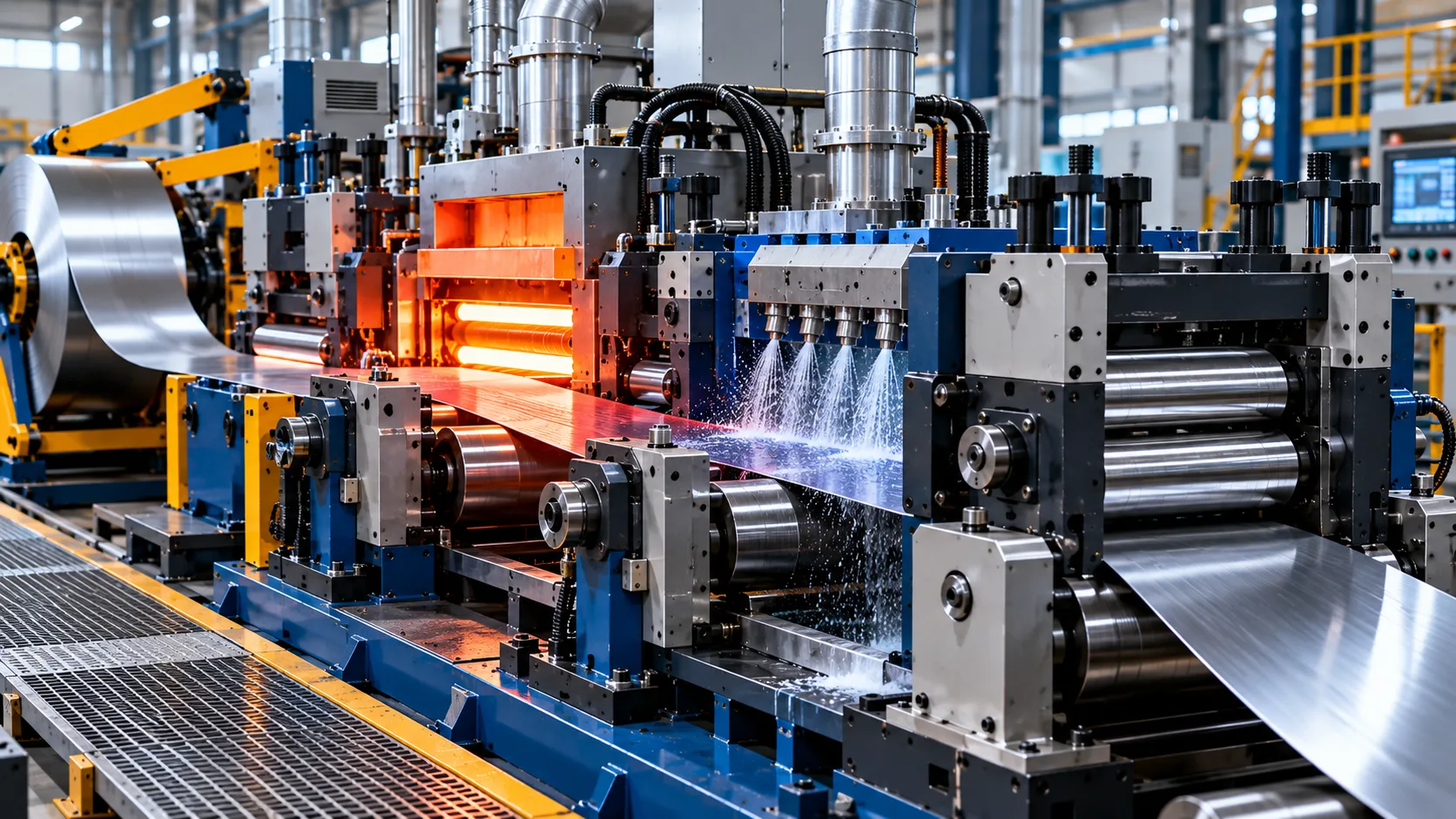
Work rolls serve as the vital contact interface during alternating elastoplastic bending. Haden uses a proprietary multi-stage induction hardening and sub-zero treatment protocol. This structural depth prevents micro-spalling, roller scarring, and core fatigue when flattening abrasive hot-rolled steel and high-tensile alloy plates.
Mechanical Build Standards Comparison Matrix
Engineering benchmarks across Haden precision parts levelers, heavy-duty structural plate straighteners, and continuous coil processing systems integrated with high-efficiency coil-fed laser cutting machines.
| Engineering Benchmark | Precision Parts Leveler | Heavy-Duty Plate Leveler | Continuous Coil Leveler |
|---|---|---|---|
| Frame Architecture | Stress-relieved solid steel monolith | Thermally annealed welded box structure | High-stiffness four-column portal frame |
| Roll Cassette Type | 6-High intermediate roll configuration | 4-High heavy backup roll support | 4-High or 6-High quick-change cassette |
| Roll Core Metallurgy | Vacuum-melted alloy tool steel GCr15 | Forged alloy structural steel 50CrV4 | Induction hardened tool steel 9Cr2Mo |
| Roll Gap Servo Precision | ±0.005 mm dual servo positioning | ±0.01 mm electro-hydraulic synchronization | ±0.01 mm motorized mechanical screw-down |
| Overload Defense Mechanism | Dual mechanical safety torque limiter | Millisecond fast-acting hydraulic valve | Continuous closed-loop pressure monitor |
| Flatness Compliance Standard | DIN EN 10029 Class S (≤ 0.1 mm/m) | DIN EN 10029 Class S (≤ 0.5 mm/m) | ASTM A568 / EN 10131 standard |
Haden Certified Quality and Manufacturing Rigor
All structural weldments undergo 100% ultrasonic non-destructive testing, multi-point laser interferometer calibration, and 72-hour continuous load testing prior to delivery. We guarantee exceptional repeatability and reliable field performance.
Frequently Asked Technical Questions on Industrial Leveling Machines
Selecting the appropriate multi-roll leveling system requires evaluating elastic-plastic deformation thresholds, roll cassette geometries, and residual stress neutralization mechanics. Explore our technical guide below for detailed engineering answers regarding sheet metal flatness standards, coil set removal methods, sensitive surface preservation, and production integration benchmarks.
How does multi-roll leveling differ from traditional hydraulic press flattening or three-roll bending?
Traditional hydraulic press flattening applies localized, static single-point loads. While this can temporarily force high spots down visually, it leaves severe, non-uniform internal residual stress gradients locked within the material matrix. When these parts undergo subsequent secondary operations like laser cutting, CNC punching, or robotic welding, the trapped stresses release unpredictably, leading to severe part distortion, angular twisting, and dimensional reject rates.
Three-roll plate bending machines induce a continuous single-radius curve across a broad cross-section, making them effective for rolling cylinders but physically incapable of eliminating complex internal shape defects such as center buckle, quarter buckle, or wavy edges.
In contrast, Haden multi-roll precision leveling machines subject the workpiece to a continuous series of alternating elastic-plastic reverse bends across 17 to 23 precision-ground rolls. Deep entry roll immersion achieves 70% to 80% plastic deformation to erase mechanical memory, while progressively decaying outlet roll depths balance internal fiber lengths, yielding durable, stress-relieved flatness across the entire cross-section.
What flatness tolerances can Haden leveling machines consistently achieve?
Depending on raw material yield strength, incoming shape defect severity, and thickness parameters, Haden precision levelers consistently surpass international standard benchmarks, including DIN EN 10029 Class S and ASTM A6:
- Thin & Precision Sheet (0.2 mm – 3.0 mm): Flatness deviation controlled within ±0.1 mm to ±0.3 mm per linear meter.
- Medium Structural Plate (3.0 mm – 12.0 mm): Flatness deviation controlled within ±0.3 mm to ±0.5 mm per linear meter.
- Heavy Plate & High-Tensile Plate (12.0 mm – 30.0 mm+): Flatness deviation maintained within ≤ 0.8 mm per meter, significantly exceeding standard mill delivery tolerances.
This level of geometric consistency prevents optical head collisions on precision sheet metal laser cutting machines, ensures seamless automated robotic handling, and eliminates angular variation during CNC press brake bending.
How does a 6-High roll cassette prevent surface marks on mirror stainless steel and aluminum?
In standard 4-High leveling machines, the slender work rolls make direct contact with the backup bearing rollers. Under heavy downward hydraulic loads, the concentrated Hertzian contact stresses can transmit subtle micro-deflections or shadow line impressions directly onto surface-sensitive sheet materials.
A 6-High roll cassette architecture introduces a full-length row of intermediate drive rolls between the slender work rolls and the segmented backup bearings. This structure provides two essential technical advantages:
- Uniform Force Distribution: Intermediate rolls distribute concentrated backup roller forces into a smooth, continuous linear support across the entire face of each work roll.
- Elimination of Surface Shadowing: By isolating work rolls from direct backup roll contact and axial thrust friction, mirror-finish stainless steel, brushed aluminum, automotive skin panels, and coated copper strips emerge without backup roll striping or surface marring.
Haden 6-High cassettes also incorporate induction-hardened, hard-chrome plated alloy work rolls (HRC 60–65) with high surface finishes to protect critical aesthetic materials.
Can roller leveling eliminate internal stresses induced by thermal laser or plasma cutting?
Yes. Thermal cutting processes performed by industrial laser cutting machines introduce localized heat input along the cut kerf. As molten edges cool rapidly, the perimeter shrinks against the unheated interior core, setting up severe tensile and compressive stress imbalances that result in part camber, bowing, and twist.
Haden precision parts levelers process these cut blanks through closely pitched, multi-roll cassettes. By subjecting every zone of the cut component to alternating plastic reverse bending, localized edge-shrinkage stress concentrations are equalized with the core material. The cut components return to uniform, flat profiles ready for beveling, robotic welding, or CNC machining without fixture binding.
Does operating an automated Haden leveler require a skilled metallurgy specialist?
No. Haden leveling systems feature an intuitive CNC Intelligent Expert Control System with an integrated material property database that simplifies setup.
The operator selects the material grade (e.g., Mild Steel Q235/A36, Stainless 304/316, Aluminum 5052/6061, or High-Yield Strenx 700), enters the measured sheet thickness and width, and initiates the cycle. The CNC system calculates the required plastic penetration curves, determines the target roll wedge angles, and positions high-precision servo-hydraulic actuators with 0.01 mm repeatability.
Custom job parameters can be stored in the recipe management system and integrated with plant SCADA or MES platforms via standard industrial Ethernet protocols.
What is the standard coil set and crossbow removal method for automated coil feeding lines?
Coil set (longitudinal curvature) and crossbow (transverse arching) result from the plastic-elastic deformation of strip stock wound around a tight coiler mandrel under tension.
To eliminate these defects simultaneously for continuous blanking lines and coil-fed laser cutting machines, Haden coil levelers utilize an asymmetrical entry roll immersion profile combined with motorized, independent back-up roll crown adjustment:
- Inlet Wedge Immersion: Deep roll engagement at the entry cassette plastically bends the strip in reverse of the original coiling direction, fully canceling longitudinal coil set memory.
- Dynamic Hydraulic Crown Adjustment: Individual backup bearing wedges apply selective localized counter-bending at the strip center or edges, correcting transverse crossbow, center buckle, or edge waves in real time across the moving web.
Flatness Standards Benchmark
DIN / ASTM ComplianceCompare standard mill delivery tolerances with precision roller-leveled output to evaluate prospective quality improvements across your fabrication processes:
| Standard / Class | Typical Tolerance | Process Quality |
|---|---|---|
| ASTM A6 / Mill Delivery | 6.0 – 12.0 mm / m | Standard Mill Plate |
| DIN EN 10029 (Class N) | 3.0 – 9.0 mm / m | Commercial Grade |
| DIN EN 10029 (Class S) | 1.5 – 3.0 mm / m | Structural Fabrication |
| Haden Precision Class | 0.1 – 0.5 mm / m | Laser & Automotive Grade |
Finite Element Stress Analysis: Ultra-rigid, fully annealed welded frames prevent machine deflection under high hydraulic reaction forces.
Empirical Sample Testing Protocol: Full CMM dimensional flatness inspection and stress-relief validation prior to equipment delivery.
Rapid Cassette Quick-Change: Hydraulic roll cassette exchange in under 15 minutes allows swift adaptation across varied sheet thicknesses.
Request a Sample Part Leveling Trial
Send us your distorted, stressed, or thermally cut test parts. Our applications engineering lab will level your workpieces, perform comprehensive CMM flatness verifications, and provide detailed machine sizing recommendations tailored to your exact production requirements.
Configure the Right Leveling System for Your Material
Share your material grade, thickness, width, incoming flatness condition, and production requirements. Haden application engineers can evaluate the suitable leveling capacity, roll configuration, machine structure, and integration approach for your application.
Application-Based Machine Sizing
Machine capacity and roll configuration evaluated around your material, thickness range, width, and target flatness.
Material & Flatness Evaluation
Review your incoming material condition and target flatness requirements before selecting the machine configuration.
Production Line Integration
Evaluate standalone leveling machines or integrated systems for coil processing, cutting, forming, and automated production.
Planning a continuous blanking line? Leveling systems can also be evaluated as part of an integrated coil-fed laser cutting system based on your production workflow.
Request Leveling Machine Proposal & Quotation
Provide your basic material and production requirements for an application-specific machine configuration review.
Application Review
Machine configuration evaluated around your material and production requirements.
Material Evaluation
Review thickness, width, strength, incoming condition, and target flatness.
Configuration Matching
Match leveling capacity, roller system, controls, and workflow to the application.
Production Integration
Evaluate standalone equipment or integration with continuous processing lines.