Sheet Metal Machinery Technical & Sourcing FAQ
Practical answers for machine selection, technical specifications, fabrication processes, automation, equipment configuration, procurement, and application engineering across modern sheet metal manufacturing.
Explore Sheet Metal Machinery FAQs & Engineering References
Explore practical guidance on machine selection, technical parameters, tooling, automation, delivery, commissioning, and support across Haden sheet metal fabrication systems.
Fiber Laser Cutting System Selection
How should laser power be selected?
Start with material type, maximum thickness, required edge quality, expected production speed, and assist-gas strategy. Higher laser power can increase processing capability, but machine selection should be based on the actual production mix rather than power rating alone.
What information is needed before machine sizing?
Provide material grades, minimum and maximum thickness, sheet dimensions, representative drawings, annual or monthly volume, and any loading, unloading, or storage automation requirements.
Sheet laser or sheet-and-tube system?
A dedicated sheet machine is generally appropriate when flat sheet processing dominates production. A combined sheet-and-tube configuration may be considered when both flat sheet and tube profiles form a meaningful part of the production mix.
When should automation be considered?
Automation becomes more relevant when production requires longer unattended operation, repetitive material handling, higher machine utilization, or integration with upstream and downstream processes.
Review Your Machine Configuration with Haden Engineering
Share your material, thickness, part dimensions, drawings, production volume, and process requirements for a more application-specific equipment discussion.
Laser Cutting Systems FAQ: Power Selection, Tolerances & Edge Quality
Review detailed engineering guidance for selecting industrial fiber laser cutting machines across flat sheet, rotary tube, structural profile, and coil-fed laser blanking systems from 3kW to 30kW. Compare material thickness limits, cutting speeds, assist gas operating economics, and ISO 9013 edge squareness tolerances to make informed manufacturing investments.
Haden Fiber Laser Build Standards
- ✓ Stress-Relieved Bed: Heavy-duty welded carbon steel frame annealed at 600°C with internal structural webbing to eliminate dynamic distortion.
- ✓ Aviation Gantry: Fifth-generation extruded aerospace aluminum beam designed for 2.0G acceleration and high dynamic rigidity.
- ✓ Linear Precision: ±0.03 mm/m positioning accuracy and ±0.02 mm repeatability backed by sealed optical linear scales.
- ✓ Intelligent Optics: Autofocus cutting heads with dual water-cooling loops, internal lens contamination monitoring, and anti-collision breakaway.

Need Sample Cuts for Your Specific Alloy & Geometry?
Submit your 2D/3D CAD files (DXF, DWG, STEP) to our applications engineering team for nesting yield calculations, assist gas cost-per-part modeling, and physical test cutting.
Sizing a fiber laser requires separating high-efficiency production thickness from maximum severance limits . While a 6kW source can sever 25 mm (1.00 in) carbon steel at reduced travel rates, continuous factory throughput demands sufficient reserve wattage to maintain clean dross-free edges, prevent thermal blooming, and minimize burr formation during high-speed piercing cycles.
| Laser Power | Carbon Steel (O2/N2) | Stainless Steel (N2) | Aluminum Alloy (N2/Air) | Target Production Application |
|---|---|---|---|---|
| 3kW – 4kW | Up to 20 mm (0.79 in) | Up to 10 mm (0.39 in) | Up to 8 mm (0.31 in) | Precision enclosures, electrical cabinets, 1–6 mm thin sheet |
| 6kW – 8kW | Up to 25 mm (0.98 in) | Up to 20 mm (0.79 in) | Up to 16 mm (0.63 in) | General job shops, high-speed sheet processing, mid-plate fabrications |
| 12kW – 15kW | Up to 40 mm (1.57 in) | Up to 35 mm (1.38 in) | Up to 30 mm (1.18 in) | High-volume heavy plate cutting using high-pressure air and nitrogen |
| 20kW – 30kW | Up to 60 mm (2.36 in) | Up to 50 mm (1.97 in) | Up to 50 mm (1.97 in) | Heavy structural steel, yellow goods, shipbuilding, and defense manufacturing |
Core Engineering Selection Factors:
- Highly Reflective Alloys: Pure copper, brass, and polished aluminum require optical back-reflection isolators to protect internal collimator lenses from reverse laser feedback.
- Thermal Lens Management: Ultra-high-power generators (12kW+) integrate automated variable zoom collimators to shift beam Rayleigh lengths dynamically between piercing and high-speed cutting.
- Cycle Time Economics: Upgrading from 3kW (6 m/min) to 12kW (32 m/min) on 3 mm stainless steel cuts unit processing time by over 80%, yielding a dramatically lower cost-per-part despite higher initial machinery investment.
Press Brakes & Panel Benders FAQ: CNC Forming Tonnage, Deflection Crowning, and Angle Precision
Find authoritative engineering guidance on electro-hydraulic synchronization, pure electric servo drives, active deflection crowning, and high-speed flexible panel bending. This guide delivers verified specifications and forming mechanics to help tooling engineers, production managers, and plant buyers integrate forming cells with advanced laser cutting machines for high-precision sheet metal fabrication.
Dual optical linear glass scales track Y1-Y2 positioning in closed loop.
Available across pure servo-electric, hybrid, and synchronized tandem systems.
Universal folding blade kinematic manipulation without manual punch and die setups.
Dynamic mechanical wave crowning paired with real-time laser angle sensors.
Choosing between an electro-hydraulic synchro press brake and a pure electric servo-driven press brake depends on your typical sheet thickness, cycle speed requirements, electricity footprint, and thermal consistency demands.
| Performance Metric | Electro-Hydraulic Synchro (CNC) | Pure Electric Servo-Driven |
|---|---|---|
| Energy Consumption | Continuous pump motor draw during idle; standard industrial power consumption | Draws power primarily during active ram movement, reducing idle energy demand |
| Approach & Return Speed | Controlled through the hydraulic proportional valve and CNC synchronization system | Direct servo drive supports rapid response and high dynamic acceleration |
| Thermal Drift & Stability | Hydraulic oil temperature may vary during extended operation and can require compensation | No hydraulic oil circuit, reducing viscosity-related thermal variation |
| Tonnage & Bed Length | Suitable for a broad range of medium and heavy-duty bending capacities | Commonly applied to precision and high-cycle sheet metal bending applications |
| Routine Maintenance | Hydraulic fluid, filters, seals, and valve systems require scheduled maintenance | Eliminates hydraulic-system maintenance but still requires inspection of mechanical drive components |
Application Consideration: Electro-hydraulic press brakes are widely used where higher force capacity and longer working lengths are required, while servo-electric machines are especially relevant to precision, high-cycle, thin-to-medium sheet applications where energy efficiency and fast response are important.
Under bending load, elastic deformation can occur in both the ram and lower bed. Without compensation, this may cause a variation in bend angle between the center and ends of a long workpiece.
CNC Mechanical Crowning
A CNC-controlled crowning system adjusts the lower tooling support profile to compensate for calculated machine deflection according to bending force, material, thickness, and working length.
Hydraulic Crowning
Hydraulic compensation elements integrated into the machine bed can provide controlled counter-deflection during the bending cycle, particularly for long parts and higher bending loads.
Closed-Loop Angle Measurement
Depending on machine configuration, an angle measurement system can monitor the developing bend angle and provide feedback to the CNC control. This helps compensate for variations in material thickness, tensile properties, and springback.
Conventional press brakes and automatic panel benders solve different production requirements. Machine selection should be based on part geometry, material thickness, bend sequence, production volume, and automation requirements.
-
✓
Panel Bending: Well suited to repeatable thin-sheet panel components such as cabinets, enclosures, doors, appliance panels, and HVAC parts.
-
✓
CNC Press Brake: Provides broad tooling flexibility for different material thicknesses, bend radii, profiles, part sizes, and forming requirements.
-
✓
Automation: Panel benders can reduce repeated manual sheet positioning, while press brakes can also be integrated with robotic handling for automated bending cells.
Offline programming allows bend sequences, tooling configurations, backgauge positions, and part movement to be evaluated before the job reaches the machine.
Use part geometry as the basis for evaluating bend lines, dimensions, and forming requirements.
Evaluate punch and die combinations, station layout, and tooling capacity before production.
Review part movement, tooling clearance, frame clearance, and backgauge movement before transferring the program.
The final workflow depends on the CNC controller and offline programming software configured with the specific press brake.
Compare hydraulic, hybrid, and servo-electric bending platforms.
Air Bending Tonnage Calculator
Preliminary force estimate for 90° free air bending. Enter sheet thickness, total bend length, V-die opening, and material type.
S = sheet thickness in mm
L = total bending length in meters
V = V-die opening in mm
Rm = material tensile strength in N/mm² (MPa)
*Preliminary engineering estimate for air bending only. Actual machine and tooling requirements depend on material tensile strength, bend radius, tooling geometry, bending method, part configuration, and machine/tooling load limits.
Need Exact Machine Sizing?
Send your material, thickness, bend length, part drawing, bend radius, and production requirements for application-based press brake and tooling evaluation.
Request Engineering ReviewStress-Relieved Welded Frame
Heavy monolithic steel plate weldments undergo complete thermal furnace annealing to relieve residual stresses, ensuring structural stability and zero bed deformation over decades of high-tonnage operation.
Synchronized Multi-Axis Backgauges
Heavy-duty 4-axis, 6-axis, or 8-axis (X, X-prime, R, Z1, Z2, Delta X) backgauge systems driven by AC servo motors for high-speed, repeatable positioning on complex tapered or stepped flanges.
CE & ISO Global Safety Standards
Equipped with certified dual-beam DSP or LazerSafe optical guard systems, Category 4 safety monitoring relays, and electrical interlocks meeting European EN 12622 and American ANSI B11.3 standards.
Shearing, Plate Rolling & Leveling Machinery FAQ
Find authoritative engineering answers on hydraulic shearing mechanics, 4-roll CNC plate bending, and multi-roller precision leveling lines. Haden heavy metalworking equipment incorporates stress-relieved steel frames, hardened 42CrMo alloy rolls, and high-response hydraulics to eliminate edge camber, residual stress, and out-of-round tolerances across demanding industrial fabrication workflows.
Haden Heavy Machinery Capability Benchmarks
Standard vs. Heavy Structural Specifications| Machinery Category | Primary Mechanism | Core Working Capacity | Dimensional & Flatness Tolerance | Key Engineering Advantage |
|---|---|---|---|---|
| Hydraulic Guillotine Shears | Vertical linear guide with programmable rake angle | Thickness: 0.157"–1.26" (4–32 mm) | Length: 8.2'–20' (2,500–6,000 mm) | Squareness ±0.05 mm/m; minimal twist deformation | CNC motorized blade clearance and stroke length management |
| 4-Roll CNC Plate Bending Rolls | Hydraulic planetary side roll drive with central pinch clamping | Thickness: 0.25"–4.75" (6–120 mm) | Width: 5'–13' (1,500–4,000 mm) | Roundness ±0.5 mm; unbent flat end ≤ 1.3 × thickness | Single-pass dual-edge pre-bending with direct automated plate squaring |
| Precision Roller Levelers | Multi-roll alternating plastic-elastic bend sequencing | Thickness: 0.020"–1.00" (0.5–25 mm) | Width: up to 86" (2,200 mm) | Flatness ≤ 0.1 mm/m²; complete coil memory and stress relief | Independent backup roll groups with dynamic hydraulic crowning control |
| Hydraulic Swing Beam Shears | Heavy-duty pivot arc action with nitrogen cylinder return | Thickness: 0.118"–0.625" (3–16 mm) | Length: 6.5'–13' (2,000–4,000 mm) | Edge straightness ±0.10 mm/m for general structural fabrication | High-speed production cycling with minimal moving wear components |
Plate Shearing & CNC Rolling Technology
Kinematics, blade clearance calibration, rake angle optimization, and 4-roll pre-bending mechanics.
The choice between guillotine and swing beam cutting systems depends on blade motion trajectory, rake angle adjustability, and cut-edge perpendicularity across varying material gauges:
- Hydraulic Guillotine Shears (HGS Series): The upper blade moves vertically within rigid linear guideways. Operators can dynamically adjust the rake angle between 0.5° and 2.5° directly from the CNC console. A lower rake angle reduces twisting, bowing, and camber on narrow strips of thin sheet metal, while an increased rake angle delivers the tonnage necessary to cut heavy plate up to 32 mm cleanly without overpressuring hydraulic circuits before routing to sheet metal laser cutting machines.
- Hydraulic Swing Beam Shears (HSS Series): The upper beam pivots along a fixed arc axis using heavy-duty trunnion bearings. Because the blade rake angle is fixed at a single angle, narrow off-cuts on thin sheets can experience slight torsional twist. However, the swing beam design eliminates vertical sliding gibs, providing extreme reliability and low maintenance in high-volume, single-thickness blanking operations.
- Precision Blade Clearance Management: Haden guillotine shears feature motorized four-edge rectangular blade clearance adjustment with high-resolution digital feedback (0.01 mm increments), delivering clean 90-degree cut faces across mild carbon steel, abrasion-resistant armor plate, and stainless alloys.
Engineering Clearance Rule: Set blade gap to 7%–9% of material thickness for carbon steel, and 11%–13% for high-yield stainless steel to eliminate secondary shear cracks and reduce tool edge wear.
Heavy Plate Roll Capacity Sizing Tip
Factor yield strength scaling before equipment selection
Machine nominal rolling capacities are rated on carbon steel with a yield point (σs) of 245 MPa (35,500 PSI). When rolling high-strength structural grades like ASTM A514, Hardox, or Q690 (σs ≥ 690 MPa), the maximum thickness capacity must be scaled down by a factor proportional to the yield ratio:
Residual Stress Relief & Plate Leveling
Neutralizing internal residual stresses, coil set, edge waves, and center buckle before precision processing.
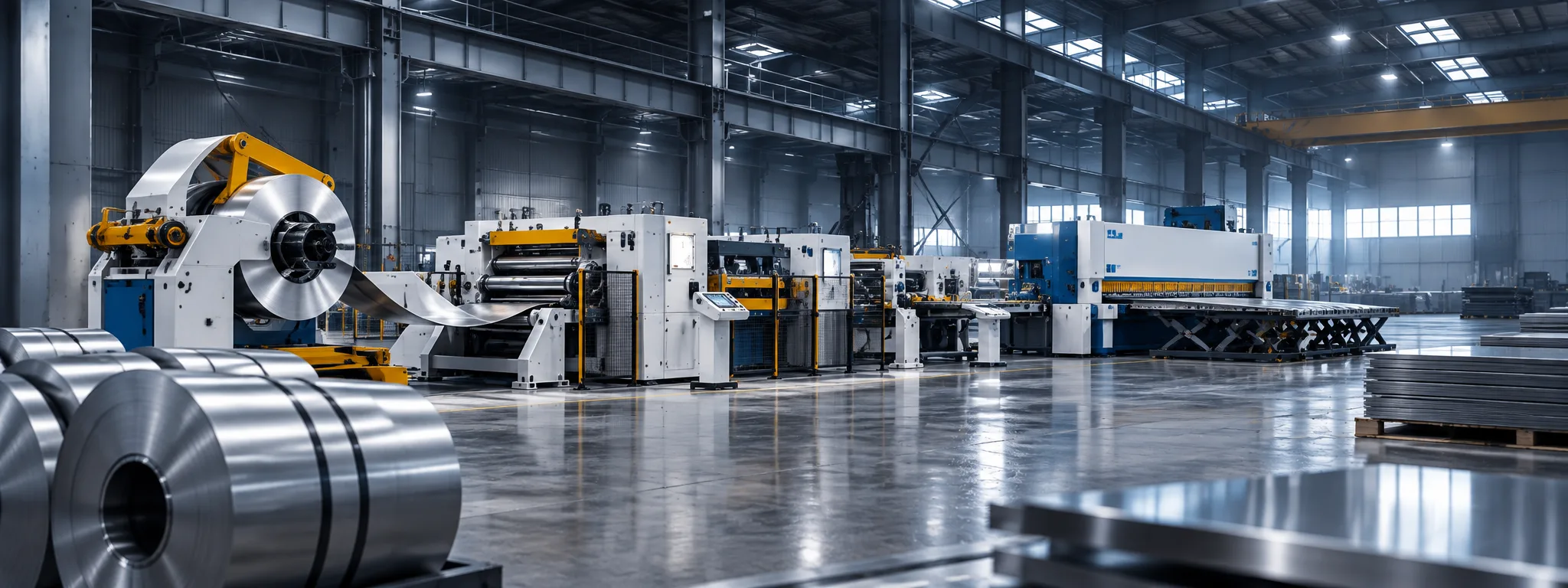
Stress-Relieved Annealed Machine Frames
Every Haden shearing, plate bending, and leveling machine frame undergoes high-temperature furnace annealing and complete shot blasting to neutralize internal weld stresses, ensuring zero frame deflection across decades of high-tonnage production.
Need Application-Specific Shearing or Plate Rolling Calculations?
Share your plate dimensions, material properties, target radius, and production requirements. Haden application engineers can evaluate bending force, roll configuration, deflection compensation, blade clearance, and machine capacity for your actual application.
Automated Sheet Metal Production Lines & Turnkey Systems
Explore practical engineering considerations for modular automation, robotic bending, material storage and handling, production-line integration, and high-mix sheet metal manufacturing.
Modular Automation Roadmap
Build automation around existing cutting, storage, bending, and material-flow processes.
MES & Data Integration
Plan machine, controller, production-data, and factory-system connectivity.
High-Mix Automation
Evaluate flexible tooling, robotic handling, changeover, and batch-production requirements.
The appropriate sequence depends on the existing equipment, production mix, material flow, floor space, and automation goals. A practical roadmap can be divided into four engineering stages:
Automated Cutting & Material Loading
Add sheet loading, unloading, pallet exchange, and material handling around laser cutting equipment to reduce repetitive manual intervention.
Material Storage & Retrieval
Integrate automated storage and retrieval around raw material and work-in-process requirements to improve material flow and reduce unnecessary handling.
Automated Bending
Robotic press brake cells or automated panel bending systems can be introduced where part geometry, production volume, and changeover requirements justify automated forming.
Integrated Material Flow
Sorting systems, conveyors, AGVs or AMRs can connect production stages where automated routing provides a measurable operational benefit.
Engineering Principle: Automation does not need to be implemented as a single large project. A modular architecture allows each production stage to be evaluated against actual throughput, labor, material-flow, and integration requirements.
Communication architecture should be defined according to the machine controller, robot controller, PLC, MES or ERP platform, and the production information that needs to move between systems.
Machine Layer
CNC systems, PLCs, robots, sensors, material handling, and safety controls form the equipment-level architecture.
Communication Layer
Available industrial communication interfaces are selected according to the controller platform and plant integration requirements.
Production Layer
Production orders, machine status, alarms, job progress, utilization, and other required data can then be mapped to the plant's MES or management system.
Important: MES and ERP integration should be confirmed at the project engineering stage because available protocols and data points depend on the selected CNC, PLC, robot, and software configuration.
High-mix automation is possible, but the business case depends less on batch size alone and more on whether multiple part families can share tooling, gripping, programming, and material-handling strategies.
Flexible Gripping
End-effectors should accommodate the relevant range of blank sizes, weights, surfaces, and geometries.
Tooling Strategy
Standardized tooling and automatic tool-change capability can reduce manual setup between compatible part families.
Part Recognition
Sensors or vision systems may be used where part location, orientation, or positioning varies during automated handling.
Offline Programming
Offline programming and simulation can reduce machine interruption while new parts and robotic sequences are prepared.
Feasibility Check: Before selecting a robotic cell, review representative part drawings, material thicknesses, blank dimensions, bend sequences, annual volumes, batch sizes, and expected changeover frequency.
Machinery Lead Times, Export Logistics & Trade Compliance FAQ
Cross-border procurement of industrial sheet metal machinery demands transparent production schedules, robust ocean export packaging, and rigorous commercial trade compliance. Haden aligns standardized lean assembly lines with global logistics engineering to ensure on-schedule delivery, secure ocean transit, and frictionless customs clearance worldwide.
Standardized Lead Times
7–10 days for ready stock; 25–35 days for standard build-to-order machinery configurations.
Heavy-Duty VCI Packing
Vacuum barrier foil, desiccants, heavy channel skids, and certified seaworthy bracing.
Global Trade Compliance
CE Machinery Directive declarations, ISO 9001 audits, and third-party inspection dossiers.
Turnkey Incoterms 2020
Flexible fulfillment across FOB, CIF, CFR, DAP, and comprehensive door-to-door DDP terms.

Export Crating & Maritime Transit Engineering
Heavy-tonnage CNC systems and high-precision laser cutting machines represent critical capital assets vulnerable to marine humidity, salt spray, and long-voyage kinetic shock. Haden utilizes reinforced box-channel skids, multi-layered Vapor Corrosion Inhibitor (VCI) films, calculated desiccant packs, and tensioned container lashing designed for transoceanic shipping routes across North America, Europe, Southeast Asia, and the Middle East.
Haden Quality Assurance & Release Protocol
Before final balance settlement and export dispatch, every machine undergoes thorough multi-point quality validation to ensure zero startup defects upon site arrival.
- Continuous Dynamic Testing: 72-hour full-cycle endurance run covering servo drives, CNC interpolations, and high-pressure hydraulic manifolds.
- Laser Interferometer Calibration: Renishaw multi-axis pitch error compensation, squareness auditing, and physical cut/bend test validation.
- 4K Video FAT & Calibration Dossier: Comprehensive test footage, serial-matched inspection certificates, and tool geometry charts provided before crate sealing.
Manufacturing Lead Time Matrix by Equipment Category
Manufacturing schedules reflect frame casting cycles, thermal stress-relief annealing, CNC controller customization, and automation staging requirements:
| Equipment Line | Standard Configuration | Custom / Heavy-Duty | Recommended Shipping Mode |
|---|---|---|---|
| Fiber Laser Cutting Systems (Sheet & Tube) | 20–25 Days | 35–45 Days | 40HQ High Cube / Flat Rack Container |
| CNC Electro-Hydraulic & Servo Press Brakes | 25–30 Days | 40–50 Days | 40HQ Container / Open Top (for Heavy Tonnage) |
| Plate Rolling & Hydraulic Shearing Machines | 20–28 Days | 35–45 Days | 20GP / 40HQ Standard Seaworthy Freight |
| Intelligent Flexible Panel Benders | 30–35 Days | 45–60 Days | 40HQ Dedicated Container with Anti-Shock Rigging |
| Automated Robotic Cells & Leveling Lines | 45–60 Days | 60–75 Days | Modular Multi-Container Dedicated Freight |
*Note: Fast-moving standard models (such as 3kW–12kW fiber lasers and 100T–200T CNC press brakes) are maintained in pre-machined staging stock for express 7- to 10-day export dispatch following FAT release.
International Commercial Trade Terms (Incoterms 2020)
Haden supports transparent shipping frameworks aligned with your procurement policy, freight forwarder contracts, and import customs capabilities:
Frequently Asked Questions: Shipping, Timelines & Commercial Terms
Review detailed engineering and trade answers regarding build cycles, maritime preservation techniques, regulatory certificates, milestone payments, and plant site preparation.
01
How does Haden distinguish between standard build schedules and custom machinery lead times?
Our production timelines leverage modular fabrication workflows, pre-machined bed inventories, and dedicated assembly bays to avoid international manufacturing delays:
- In-Stock Rapid Staging (7 to 10 Business Days): Standard sheet metal laser cutting machines (3kW to 12kW) and standard CNC electro-hydraulic press brakes (63T to 160T) are maintained in our pre-assembly inventory. Dispatch occurs immediately after 48-hour continuous testing, optical calibration, and export crate crating.
- Standard Build-to-Order (25 to 35 Calendar Days): Standard frames configured with tailored CNC controller packages (Delem, ESA, Cybelec), custom laser resonator powers, multi-axis backgauges, or specialized hydraulic tool clamping systems.
- Heavy-Duty & Turnkey Production Lines (45 to 60 Calendar Days): High-tonnage tandem press brakes (over 300T), automated tube laser cutting machines, 4-roll plate bending systems, uncoiling and leveling blanking lines, and robotic bending cells require custom finite element analysis (FEA), stress-relieved furnace annealing, and comprehensive PLC communication integration.
Every production schedule is bound by contractual milestone timelines, backed by weekly photo/video progress reporting directly from the shop floor.
02
What anti-corrosion and physical shock packaging protocols are used for ocean shipping?
Maritime transit exposes precision machine tools to severe temperature fluctuations, airborne salt mist, and mechanical vibration. Haden enforces a rigorous multi-barrier export packing standard:
Anti-Corrosion & Moisture Barrier
- Heavy-duty protective oil coatings on linear guideways, ground ball screws, and polished hydraulic piston rods.
- Multi-layered Vapor Corrosion Inhibitor (VCI) shrink film encapsulating the entire frame assembly.
- Hermetically sealed vacuum aluminum foil packaging combined with industrial-grade silica desiccant bags.
Mechanical Bracing & Container Lashing
- Reinforced channel steel skids welded and bolted to factory chassis anchoring points.
- High-tensile steel wire ropes, turnbuckles, and heavy-duty load binders secured to container corner posts and floor D-rings.
- Treated timber wheel chocks and high-density vibration dampers fitted to kinetic axes to prevent dynamic shifting in transit.
Sensitive laser sources, optical cutting heads, and CNC control consoles are crated separately in ISPM 15-compliant fumigated timber boxes with integrated tri-axial drop and tilt sensors.
03
What compliance certificates, safety directives, and commercial customs documents does Haden supply?
To eliminate customs clearance delays, Haden provides a complete, authenticated regulatory and commercial documentation package with every shipment:
- CE Declaration of Conformity: Fully certified against the European Machinery Directive 2006/42/EC, Low Voltage Directive 2014/35/EU, and EMC Directive 2014/30/EU, including verified safety interlock documentation.
- Factory Audit & Inspection Reports: ISO 9001:2015 factory certification, detailed pre-shipment Factory Acceptance Test (FAT) logs, electrical insulation test records, and optional SGS or TÜV Rheinland inspection dossiers.
- Commercial & Trade Documentation: Commercial Invoice, Detailed Packing List specifying net/gross weights and packaging volumes, Clean On-Board Bill of Lading, and preferential Certificates of Origin (CO, Form E, Form RCEP, EUR.1, or USMCA certificates where applicable).
- Engineering Blueprints: Foundation layout CAD drawings, foundation bolt pocket coordinates, electrical schematic diagrams, and pneumatic/hydraulic schematics sent prior to vessel departure to accelerate local site prep.
04
What are the standard international payment structures and transaction security terms?
Our payment milestones are engineered to align financial accountability with tangible manufacturing verification, protecting your capital investment at every phase:
- Telegraphic Transfer (T/T) Milestone Structure: Standard terms involve a 30% advance deposit upon countersigned contract to initiate steel plate cutting, casting, and component procurement; the remaining 70% balance is payable upon full machine assembly, successful 4K FAT video demonstration, and issuance of the official release-for-shipment certificate.
- Irrevocable Letter of Credit (L/C at Sight): Accepted through established global commercial banking institutions for large-scale turnkey sheet metal systems, tandem press brakes, and major industrial tenders.
- On-Site Witness & Pre-Shipment Inspection: Customers or authorized third-party inspection firms (SGS, Bureau Veritas, Intertek) are invited to witness live laser cutting and full-tonnage bending tests at our facility prior to balance release.
All international commercial transactions are executed through audited corporate banking channels accompanied by validated commercial contracts and pro forma invoices.
05
How does Haden support on-site container unloading, heavy rigging, and foundation readiness?
Smooth machinery commissioning depends on precise workshop preparation long before the container arrives at your loading dock. Haden provides complete technical site preparation support:
- Rigging & Offloading Blueprints: Comprehensive weight distribution diagrams, designated overhead crane lifting points, center-of-gravity schematics, and recommended forklift capacities provided in advance.
- Civil Foundation Drawings: Detailed CAD blueprints specifying reinforced concrete pad thickness (200mm to 400mm depending on machine tonnage), anti-vibration expansion joint boundaries, and anchor bolt positioning provided within 5 days of order confirmation.
- Site Utility Checklist: Explicit guidelines for 3-phase industrial power supply tolerances (380V/480V ±5%), recommended voltage stabilizers, auxiliary assist gas delivery lines (high-purity N2/O2 and dry shop air), and recommended hydraulic oil viscosities (ISO VG 46/68).
Our after-sales service desk coordinates with your receiving timeline to schedule certified on-site commissioning engineers or initiate guided remote installation sessions upon physical placement of the equipment.
Planning Machine Delivery, Shipping & Installation?
Share your machine configuration and destination details for application-specific shipping planning. Our team can review container loading, export packaging, delivery requirements, and foundation or installation documentation for your project.
Include the destination country or port and machine model for more accurate logistics planning.
Machinery Commissioning, Operator Training & Warranty FAQs
Deploying industrial CNC press brakes, high-performance laser cutting machines, and automated sheet metal lines requires absolute operational certainty from day one. Explore engineering guidance covering on-site foundation preparation, factory engineer dispatch, CNC control programming curricula, comprehensive multi-year warranty protections, and rapid global spare parts logistics.
Direct access to certified senior application engineers via real-time CNC telemetry and video link.
Priority air express dispatch for cutting heads, CNC modules, and hydraulic proportional valves.
Full-stroke laser cutting and multi-point load bend trial protocols verified and documented before crating.
Zero expiration on remote troubleshooting, controller parameter recovery, and tooling advice.
How does Haden handle on-site machine commissioning and plant foundation requirements?
Smooth machine startup begins well before delivery. We provide comprehensive plant readiness packages and dispatch qualified factory field engineers to verify mechanical alignment, optical calibration, and electrical stabilization.
Pre-Delivery Site Preparation Checklist
- ✓ Foundation Slab: Reinforced concrete pad (minimum 200–300 mm thickness, C25/30 grade) vibration-isolated for high-tonnage press brakes and high-speed sheet metal laser cutting machines.
- ✓ Electrical Power Stabilization: 3-Phase 380V/480V ±5% with dedicated industrial ground (≤ 4Ω resistance) and industrial voltage stabilizer recommendations.
- ✓ Pneumatics & Assist Gas: Clean, dry compressed air (ISO 8573-1 Class 1.4.1), industrial Nitrogen (99.999% purity for oxide-free cutting), and industrial liquid Oxygen tanks.
What structured training curriculum is provided for CNC operators and maintenance staff?
Equipment productivity relies on operator confidence. Haden delivers a three-tier educational curriculum combining classroom CAD/CAM software training with intensive hands-on machine operation and preventive maintenance execution.
Structured Operator Curriculum Modules
- ✓ CNC Control & Nesting: Delem/ESA/CypCut navigation, DXF/STEP file import, automatic micro-joint placement, and collision-free toolpath generation.
- ✓ Tooling Setup & Calibration: Precision segmented punch/die clamping, hydraulic crowning compensation, laser focal point optimization, and nozzle centering.
- ✓ Safety & Self-Diagnostics: Optical safety light curtain calibration, emergency override recovery, alarm log interpretation, and daily lubrication workflows.
What is the standard warranty coverage on machine frames and critical components?
We back our industrial manufacturing standards with comprehensive, transparent warranty protection. Key structural members, optical resonators, and motion systems are backed by extended tier-one manufacturer guarantees.
Component Protection Breakdown
- ✓ Machine Bed & Frame (5 Years): Heavy annealed stress-relieved steel gantry and side frames protected against structural deformation or weld fatigue.
- ✓ Laser Resonator & Optics (2–3 Years): IPG / Raycus / Maxphotonics fiber laser sources and cutting heads covered under complete OEM warranty terms.
- ✓ CNC, Servos & Hydraulics (2 Years): Delem/ESA controllers, Yaskawa/Schneider servo motors, and Rexroth/Hoerbiger proportional valves.
How fast can replacement parts, consumables, and custom tooling be dispatched?
Unscheduled downtime damages profitability. Haden maintains localized regional spare parts warehouses and stocks essential consumables for guaranteed same-day or 24-to-48-hour express international air courier dispatch.
Included Starter Kit & Ongoing Logistics
- ✓ Machine Startup Backup Kit: Every unit ships with spare protective quartz optical windows, single/double cutting nozzles, ceramic rings, and seal kits.
- ✓ Standardized Tooling Profiles: Ready inventory of standard European / Promecam style punches, multi-V dies, and custom shearing blades.
- ✓ Direct DHL/FedEx Express: Critical wear items dispatched within 24 hours of notification with end-to-end priority airway tracking.
Service Delivery Models & Commissioning Scope
Compare Haden onboarding frameworks designed for standalone machine deliveries up to multi-cell turnkey production lines.
| Service Dimension | Remote Guided Commissioning | Standard Field Engineer Dispatch | Turnkey Automated Line Integration |
|---|---|---|---|
| Recommended For | Standard plate shears, 3-roll plate rolls, compact fiber cutters | High-power fiber lasers (6kW–30kW), electro-hydraulic press brakes | Automated ASRS towers, robotic bending cells, coil-fed laser cutting machines, and blanking lines |
| Engineer Presence | Dedicated Senior Engineer via HD Video & Remote Telemetry | 1–2 Field Engineers On-Site at Client Facility | Multi-Discipline Engineering Team (Mechanical, Electrical, Software) |
| Duration On-Site | 3–5 Scheduled Remote Sessions | 4–7 Working Days | 10–20 Working Days (Phased Verification) |
| Calibration & Alignment | Interactive sensor review & factory-preset loading | Full laser interferometer & optical dial gauge verification | Full line synchronization, AGV alignment & robot kinematic tuning |
| Sample Part Validation | Client cuts test coupons and verifies via digital calipers | Engineer oversees high-precision test cut and bend trial runs | Full production batch run meeting strict Cpk & cycle-time metrics |
Direct Connection to Haden Application Engineers
We eliminate gatekeepers. When technical queries arise regarding laser assist gas pressure, crowning table calibration, or CNC alarm clearing, our global engineering desk connects you directly with a metallurgy and controls specialist.
Select Your Preferred Technical Support Protocol
Every Haden CNC machine equipped with modern industrial PC controls (Delem, ESA, CypCut) features integrated Ethernet ports for secure remote login. Our software engineers can directly inspect optical sensors, verify I/O status, and adjust deflection crowning coefficients in real time.
Need a Machine Configuration for Your Actual Parts?
Share your part drawings, material, thickness, dimensions, production volume, and process requirements. Haden application engineers can evaluate the appropriate machine configuration, tooling, capacity, and automation approach for your production.
Part Drawings
DXF, DWG, STEP, PDF or representative part drawings.
Material & Thickness
Material grade, thickness range and relevant properties.
Part Dimensions
Working length, width, diameter or maximum part envelope.
Production Requirements
Batch size, annual volume, cycle expectations and automation.
Tell Us About Your Application
Provide the basic project information below for an application-based machine review.