
Sheet Metal Machinery for HVAC Manufacturing
Haden provides cutting, bending, V-grooving, leveling, coil processing, panel forming, and automated production solutions for HVAC ductwork, air-handling unit enclosures, ventilation components, and related sheet metal manufacturing applications.
Solving the Core Metalworking Bottlenecks in Modern HVAC Production
Commercial ventilation and air distribution systems must satisfy increasingly stringent building energy efficiency codes, aggressive indoor air quality standards, and rigorous airtightness classifications. Meeting global benchmarks such as SMACNA HVAC Air Duct Leakage Class 3 and Eurovent Air Tightness Class D demands that ductwork, fire dampers, and air handling unit (AHU) casings maintain exact dimensional tolerances without compromising surface zinc integrity.
However, conventional sheet metal facilities face persistent HVAC fabrication challenges when processing light-gauge galvanized and prepainted sheet from 0.5 mm to 3.0 mm. Legacy mechanical shear lines, manual press brake tooling setups, and inconsistent roll forming introduce thin sheet bending deformation, severe oil-canning, high nesting scrap rates, and flange air leakage that escalate operating costs and compromise ductwork production efficiency.
Thin Sheet Bending Deformation and Zinc Layer Abrasion
Root Cause: High-speed mechanical punching and standard sliding-friction press brake dies scrape protective zinc coatings from galvanized steel sheet. Thin gauges (0.5 mm–1.2 mm) suffer visible wave distortion and oil-canning under uneven mechanical clamping pressure.
Operational Impact: Exposed core steel causes premature rust in humid airflow conditions, while uncompensated material springback leads to angular variations up to ±1.5°, creating leaky joint connections in duct assemblies.
Universal rolling-contact bending tooling and synchronized servo clamping eliminate relative surface friction, ensuring scratch-free galvanized sheet fabrication with repeatable angular accuracy.
Fitting Nesting Inefficiency and High Offcut Scrap
Root Cause: Cutting transitional duct fittings, offset reducers, and multi-segment elbows from standard pre-cut sheet formats leaves large skeleton offcuts. Static mechanical shears lack the flexibility for dynamic nesting on variable geometries.
Operational Impact: Raw sheet utilization often stays below 82%, forcing HVAC contractors to absorb volatile steel surcharges while devoting excessive labor to manual shearing and secondary edge deburring.
Continuous coil-fed laser cutting machines execute tight dynamic nesting with common-line cutting, pushing coil material utilization above 92% with smooth, dross-free edges.
AHU Custom Panel Setups and Skilled Operator Dependency
Root Cause: Double-skin cleanroom AHU casings, acoustic baffles, and structural louver frames involve frequent dimensional changes. Standard press brakes require lengthy manual die changes and multi-axis sheet handling for every custom batch.
Operational Impact: Tooling setup downtime consumes up to 45% of available shift hours. Factory output becomes vulnerable to shortages of senior press brake operators, resulting in order backlogs.
Intelligent CNC panel benders use universal segmented tooling that automatically adjusts to casing dimensions, completing 4-sided folding and box hemming without manual tool changeovers.
Comparative Engineering Matrix: Legacy Methods vs. Haden Automated Technology
Evaluating critical failure points across standard HVAC fabrication processes demonstrates why conventional equipment struggles to meet modern airtightness standards and cost targets.
| Processing Stage | Conventional Fabrication Defect | Haden Engineered Solution | Quality & Output Gain |
|---|---|---|---|
| Coil Blanking & Sizing | Mechanical shears produce cut-edge burrs, residual coil curvature, and high skeleton scrap on non-standard lengths. | Continuous fiber laser blanking directly from precision levelers with dynamic common-line nesting algorithms. | +15% Material Yield; Eliminates Secondary Deburring |
| AHU Panel Corner Forming | Large outer bend radii create visible corner gaps, loose thermal insulation joints, and thermal bridging. | Pre-bend high-speed CNC V-grooving to achieve sharp outer corner profiles with tight bend radii (R < 0.5 mm). | Airtight Corner Mating; Eliminates Thermal Bridging |
| Rectangular Duct Flanging | Manual press brakes cause longitudinal angle variation, flange waviness, and corner air leakage under test pressure. | Automated panel benders with real-time deflection compensation and synchronized closed-loop angle control. | Meets SMACNA Class 3 & Eurovent Class D Standards |
| Fire Damper & Louver Blades | Frequent staged tool swaps, angular inconsistency across multi-bend profiles, and operator setup scrap. | Electro-hydraulic servo press brakes with extended throat depths and programmable multi-axis backgauges. | < 2-Minute Job Changeover; ±0.01 mm Repeatability |
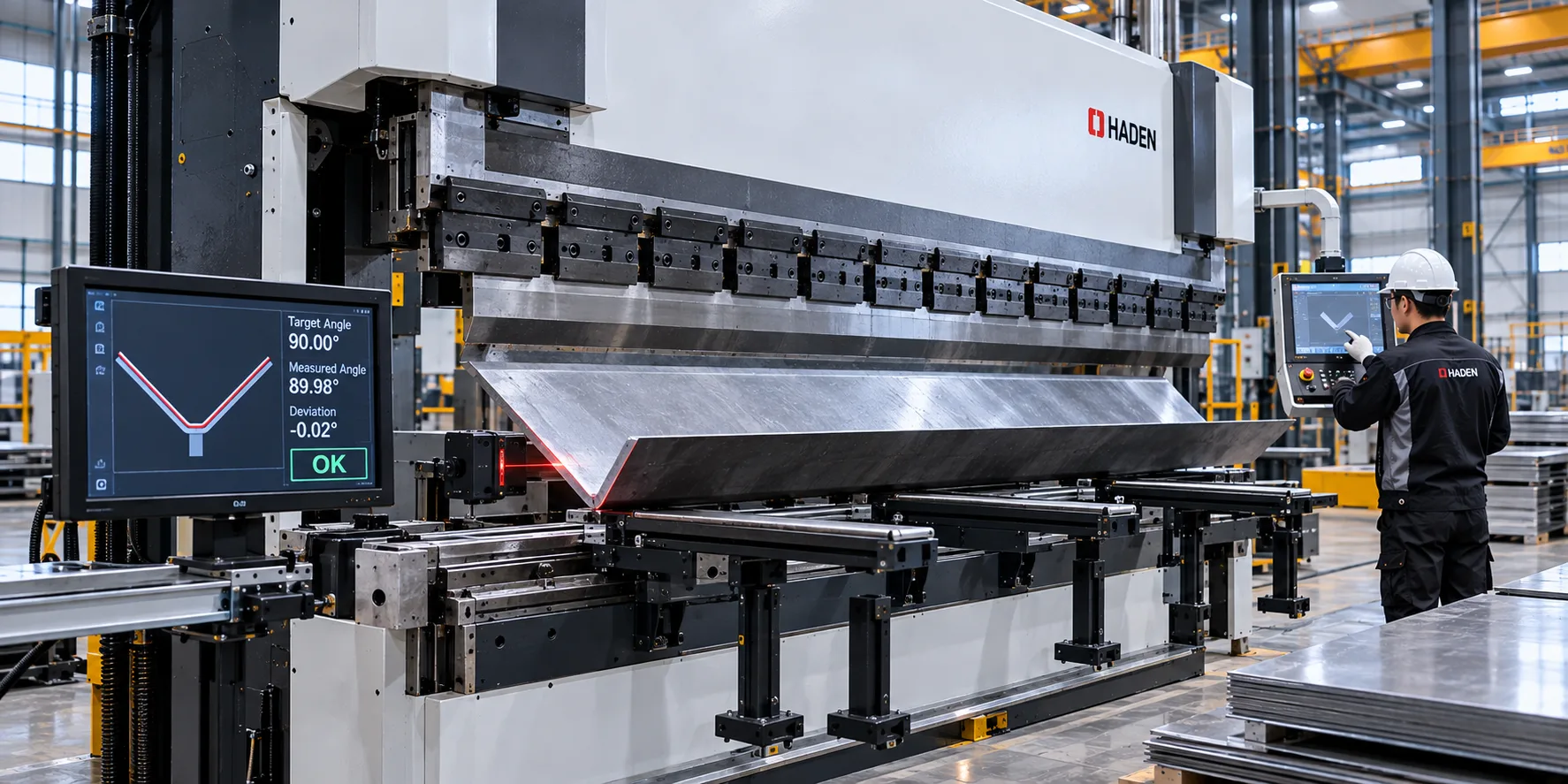
Eliminating Micro-Tolerances That Undermine Ductwork Production Efficiency
Air duct leakage typically stems from accumulated manufacturing variations during blanking, grooving, and edge forming. When flange angles drift by even a fraction of a degree along a 2.5-meter duct section, field installers must apply extra mastic sealants and mechanical fasteners to force joints closed, substantially inflating jobsite assembly costs.
Maintains structural joint tightness under positive static pressures up to 2,500 Pa without relying on excessive sealing compounds.
Replaces batch flat-sheet shearing with synchronous coil-fed sheet metal laser cutting machines, lowering floor footprint and work-in-progress inventory.
Haden products and machinery are built to eliminate these fabrication limits. By pairing rigid machine frames with intelligent CNC algorithms, our equipment empowers HVAC and AHU manufacturers to transition from manual, scrap-heavy workflows to high-yield, automated production lines.
Dedicated Processing Solutions for Key HVAC Components
Modern commercial, industrial, and cleanroom ventilation demands stringent airtightness ratings, uncompromising structural rigidity, and clean, corrosion-resistant surface finishes. Haden engineers tailored production workflows mapped directly to the geometric and mechanical profiles of high-performance HVAC assemblies. From coil-fed rectangular air duct fabrication and automated air handling unit (AHU) double-skin panel forming to high-precision damper and architectural louver processing, our equipment configurations maximize sheet yield, eliminate manual bottlenecks, and maintain strict compliance with SMACNA, Eurovent, and UL555 manufacturing standards.
TDC/TDF Rectangular Ductwork & Complex Transition Fittings
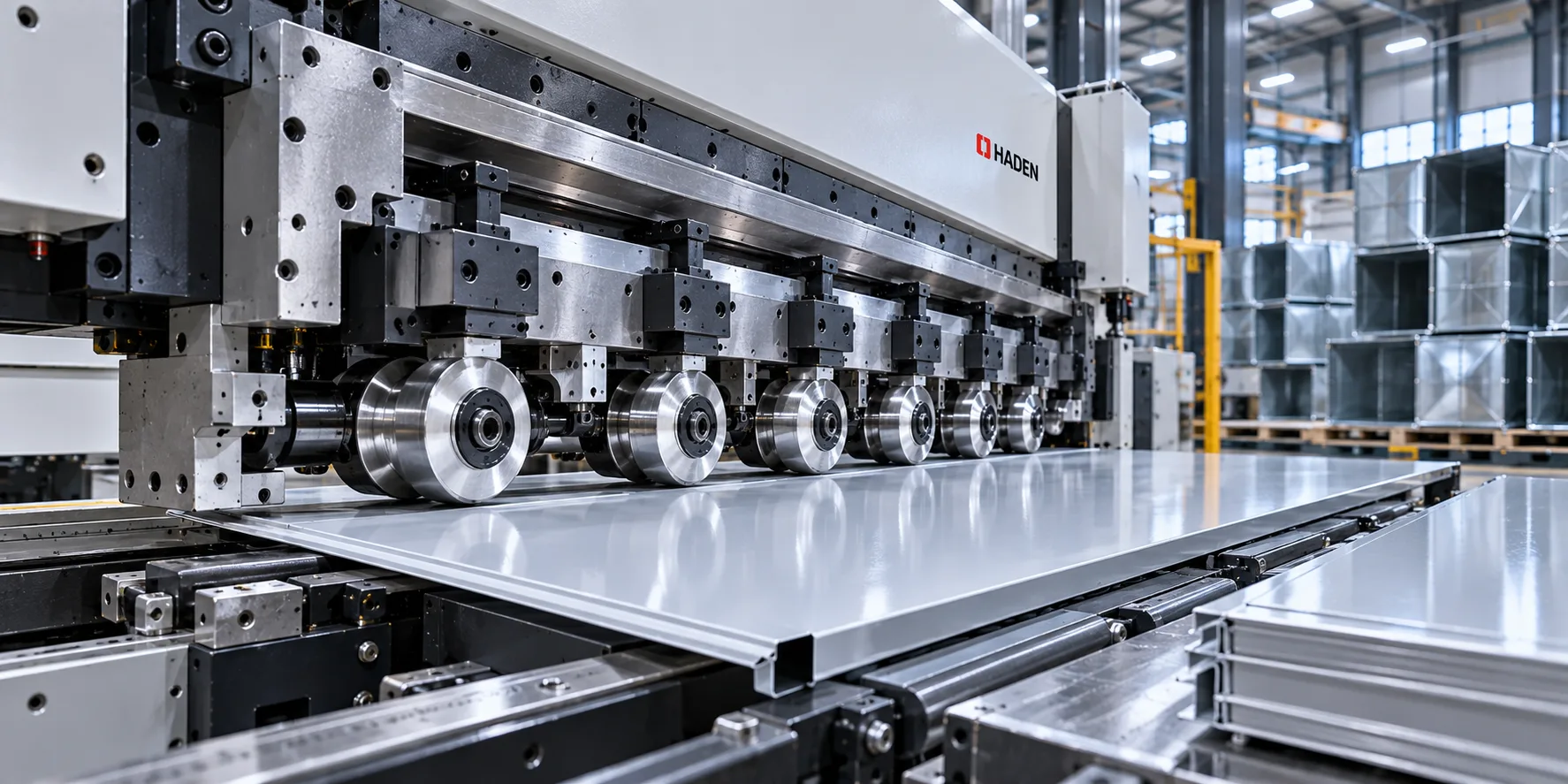
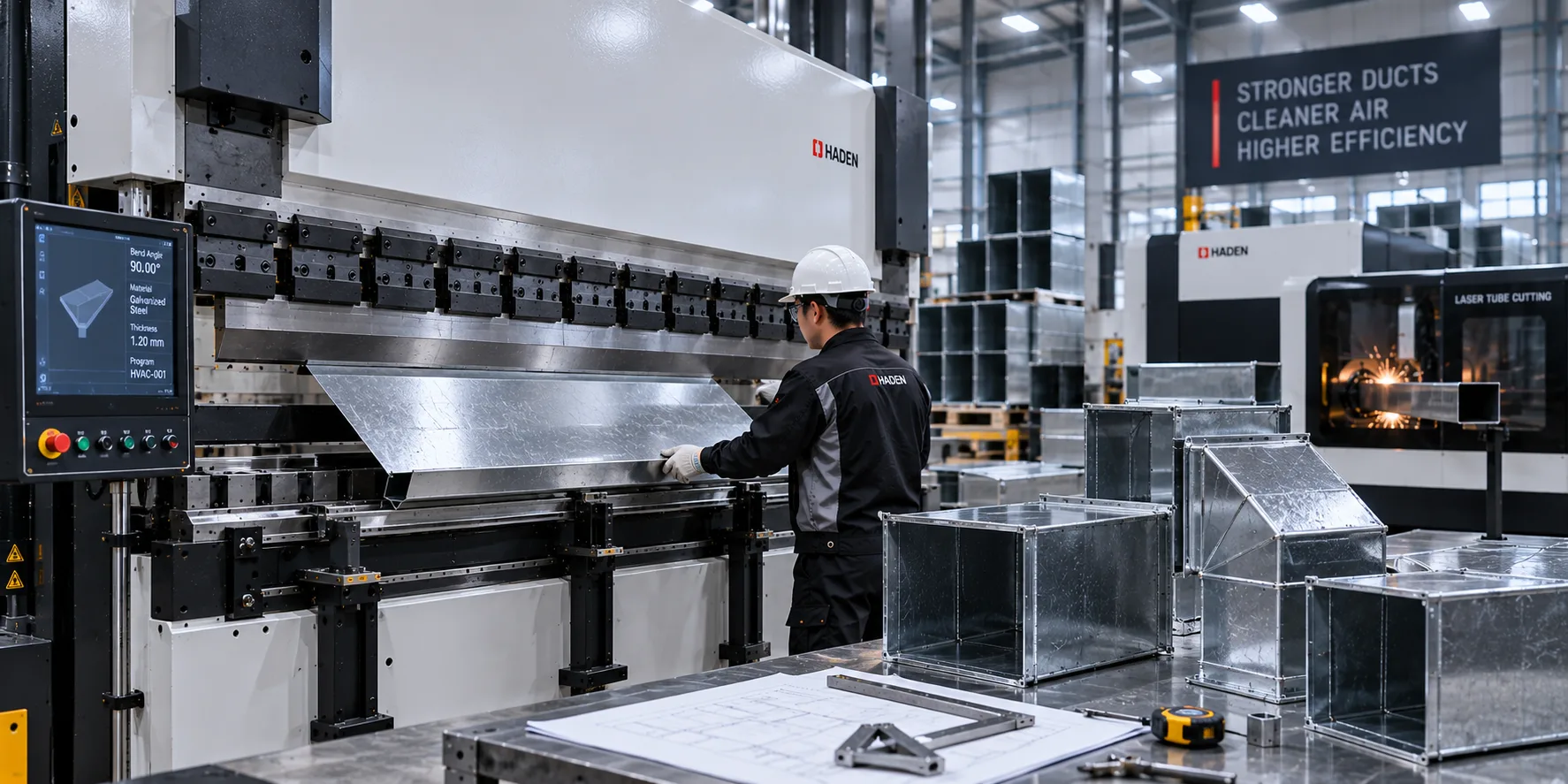
High-volume air duct manufacturing demands continuous, high-speed blanking and dependable seam alignment to eliminate joint air leakage under high static pressures. Traditional sheared blanks frequently introduce diagonal runout, resulting in edge misalignments during Pittsburgh lock or snap-lock roll forming. Haden synchronizes continuous coil-fed laser-cutting machines with precision auto-folding lines, enabling operators to produce custom straight ducts, segmented elbows, transitions, and offset reducers directly from 0.5 mm to 1.5 mm galvanized coils with minimal scrap.
Optimized Production Sequence
Automated decoiling, leveling, and fiber laser cutting with dynamic nesting for TDF/TDC corners, reaching 92%+ material utilization.
Smooth forming of Pittsburgh locks, snap-lock profiles, and integrated flanges without flaking or scratching the protective zinc coating.
Automated 4-side wrapper folding maintaining consistent 90-degree squareness within ±0.2 mm across the entire duct section.
Continuous roller-press lock closing producing airtight longitudinal and transverse seals fully compliant with SMACNA Class 3.

Engineered for High-Pressure HVAC Systems
Eliminate secondary manual sealing and labor-intensive mastic repairs. Haden automated duct manufacturing solutions guarantee repeatable seam geometry, keeping duct wall deflection below 0.5% under working static pressures up to 2,500 Pa.
HVAC Component Manufacturing Capability Matrix
Compare recommended machine configurations, processing capabilities, and material thickness thresholds across common industrial ventilation parts.
| HVAC Component | Primary Materials | Thickness Range | Primary Machine Setup | Critical Quality Standard | Cycle Advantage |
|---|---|---|---|---|---|
| TDF/TDC Rectangular Ducts | Galvanized Steel Coil (G60/G90) | 0.5 – 1.5 mm | Coil-Fed Laser + Auto-Duct Line | SMACNA Leakage Class 3 | +35% material yield |
| Spiral Duct Fittings & Elbows | Galvanized, SS304, Aluminum | 0.5 – 1.2 mm | Coil-Fed Fiber Laser Blanker | Eurovent High-Airtight | < 0.1 mm cutting seam |
| AHU Modular Double-Skin Casings | Pre-Painted, Galvanized, SS304 | 0.8 – 2.0 mm | CNC V-Groover + Panel Bender | Eurovent Class D / TB1 | 18 s automated folding |
| Acoustic Silencer Splitter Baffles | Perforated Galvanized Sheet | 0.6 – 1.2 mm | High-Speed Panel Bender | Zero hole distortion | Burr-free forming |
| Fire & Smoke Control Dampers | Heavy Galvanized, Mild Steel | 1.2 – 3.0 mm | Tube Laser + Servo Press Brake | UL555 / EN 1366 Compliance | 100% pin alignment |
| Architectural Louvers & Screens | Architectural Aluminum, Steel | 1.5 – 3.0 mm | CNC Press Brake (Dynamic Crowning) | AMCA 500-L Certified | ± 0.25° angular consistency |
Engineered Machinery Powering High-Output HVAC Factories
Haden builds rugged, precision-engineered metalworking machinery with normalized solid steel frames and high-response servo drives across our HVAC manufacturing products, built for continuous 24/7 output.
 Coil Blanking
Coil-Fed Laser Cutting Machines
Coil Fed Laser Cutting HVAC
- •Material: 0.5–2.0 mm Galvanized Sheet & Stainless
- •Feed System: Integrated Decoiling, Leveling & Feeding
- •Automation: Continuous Dynamic Nesting Software
High-yield nesting and burr-free blanking for rectangular duct segments, spiral fittings, offset transitions, and custom take-offs utilizing high-efficiency laser cutting machines.
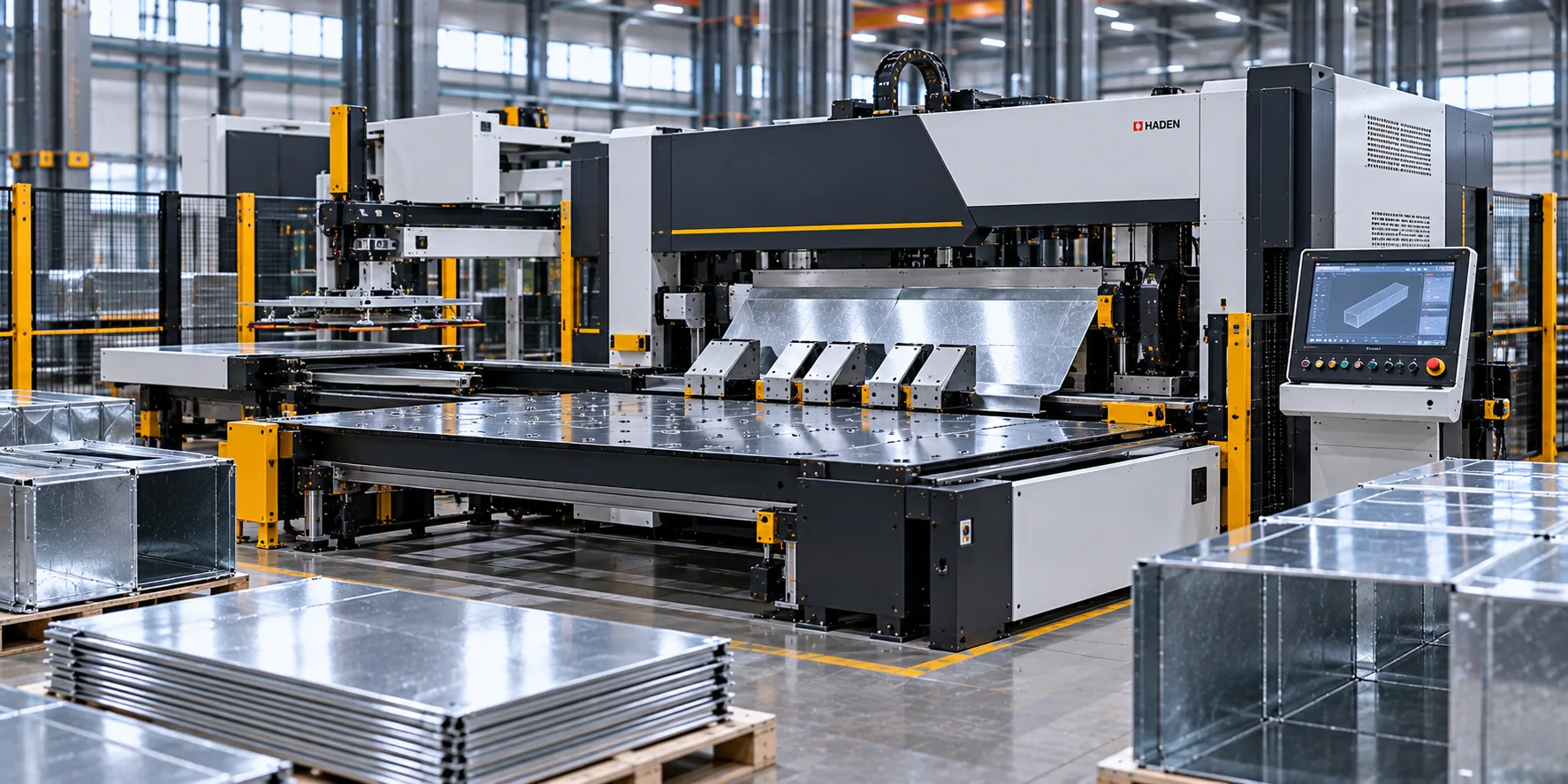 Intelligent Bending
Automatic Panel Benders
Panel Bender for HVAC
- •Tooling: Universal Universal Segmented Tool System
- •Forming: Changeover-Free 4-Sided Pan & Box Bending
- •Function: Hemming, Positive/Negative & Radius Bends
Rapid, scratch-free production of air handling unit double-skin casing panels, acoustic louvers, access doors, and modular chiller shells.
 Precision Bending
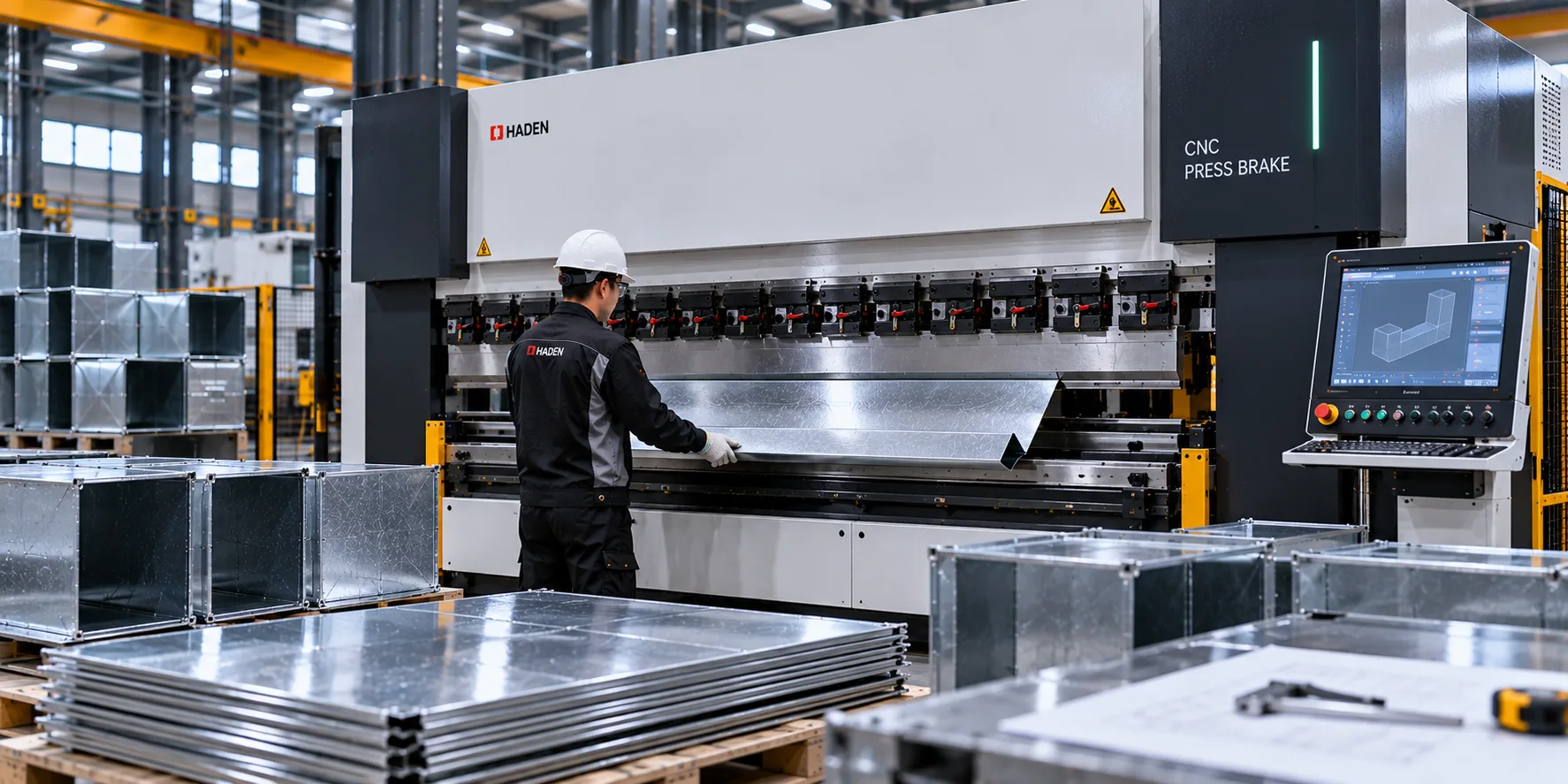
CNC Press Brakes
CNC Press Brake Ductwork
- •Drive: Electro-Hydraulic & Full Electric Servo
- •Geometry: Extended Throat Depth & Open Daylight
- •Accuracy: CNC Dynamic Mechanical Crowning Table
Precision folding of heavy-gauge fire damper sleeves, structural mounting brackets, reinforcement stiffeners, and custom ventilation flanges.
 Precision Grooving
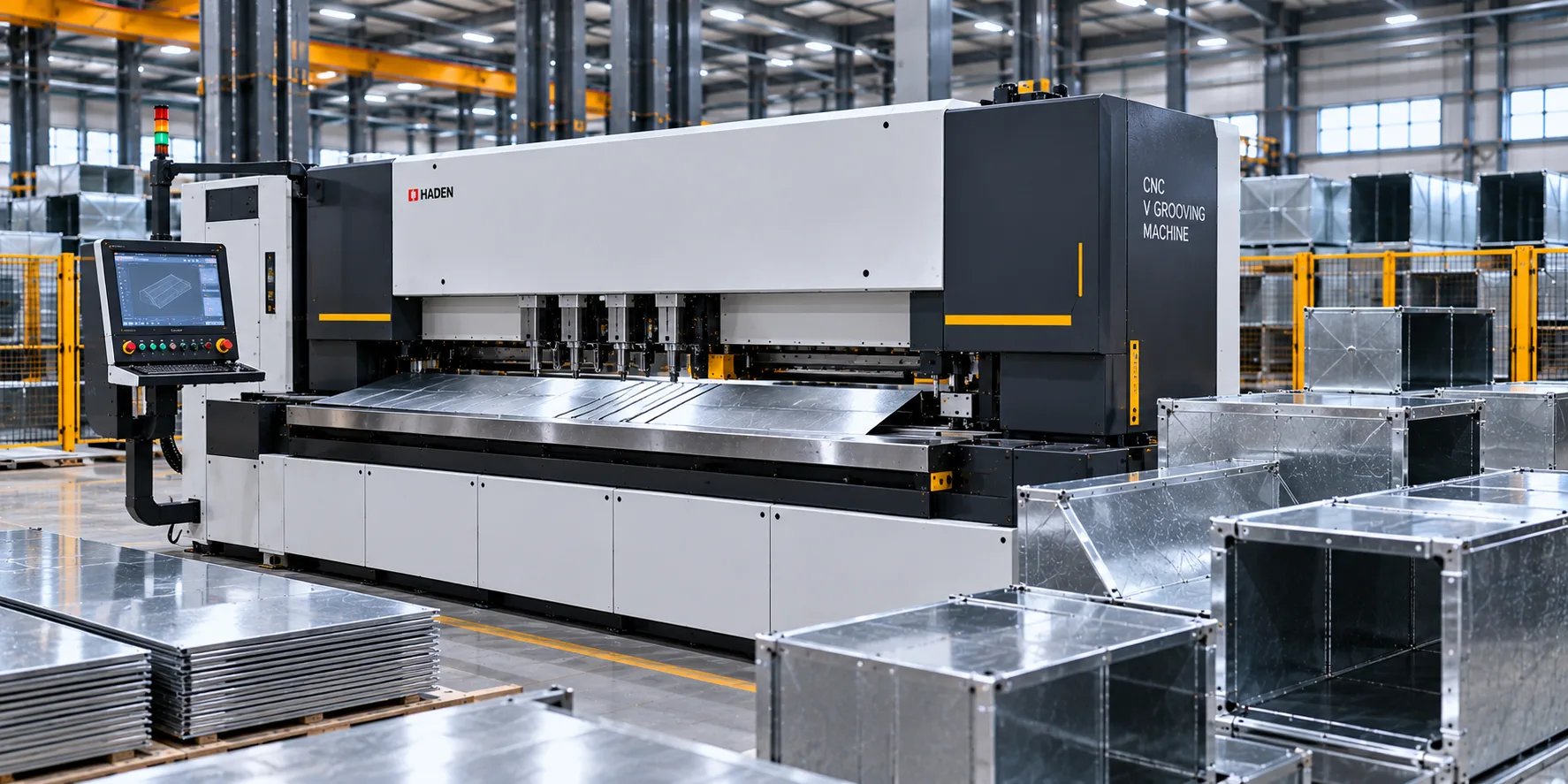
CNC V Grooving Machines
HVAC V Grooving Machine
- •Orientation: High-Speed Horizontal & Vertical Bed Formats
- •Forming: Near-Zero Outer Radius Sharp Edge Folding
- •Control: Micro-Depth Multi-Axis CNC Indexing
V-cut pre-grooving for airtight, razor-sharp perimeter edges on premium hygienic AHU enclosures, cleanroom panels, and decorative ducting.
Need Custom Tooling or an Integrated HVAC Production Line?
Share your ductwork, AHU enclosure, or ventilation component requirements. Haden engineers can evaluate suitable cutting, bending, forming, tooling, material handling, and automation configurations around your parts, production targets, and available factory space.
End-to-End Automated Workflow: From Raw Coil to Finished Ductwork
Transforming raw galvanized master coils into airtight, code-compliant HVAC ductwork requires continuous process synchronization. Haden integrates precision decoiling, coil-fed fiber laser cutting, V-grooving, robotic panel bending, and seam closing into a synchronized digital manufacturing line. This flexible duct manufacturing setup eliminates manual staging delays, safeguards surface zinc coatings, and delivers dependable compliance with SMACNA and Eurovent leakage standards.
Decoiling, Leveling & Stress Relief
Neutralizes residual coil set, edge wave, and internal stresses in galvanized steel coils up to 3.0 mm gauge.
Core Applied Machine
Precision Multi-Roll Leveling Cell
Engineering Gain: Feeds perfectly flat sheet blanks to eliminate laser focus shifts and prevent cutting head collisions.
Dynamic Nesting & Laser Blanking
Cuts straight duct sections, complex offsets, transitional elbows, and branch takeoffs continuously on the fly via high-speed laser cutting machines.
Core Applied Machine
Coil-Fed Fiber Laser Cutting System
Engineering Gain: Common-line dynamic nesting elevates sheet utilization above 92%, drastically cutting offcut waste.
V-Groove Pre-Treatment
Carves micro-depth V-grooves along designated bend lines for premium air handling unit (AHU) double-wall casings.
Core Applied Machine
High-Speed CNC V-Grooving Machine
Engineering Gain: Lowers bending tonnage requirements and achieves tight outside corner radii (R < 0.5 mm) without coating fracture.
Adaptive Panel Bending & Folding
Performs autonomous bidirectional folding, hemmed flange formation, and real-time sheet springback compensation.
Core Applied Machine
Servo-Electric Automatic Panel Bender
Engineering Gain: Universal tooling completes complex four-sided casing bends in under 18 seconds without manual die setup.
Lock Seaming & Airtight Assembly
Closes longitudinal Pittsburgh or snap locks and presses integral TDF/TDC flange corners for structural integrity.
Core Applied Machine
Automated Duct Seamer & Flanging Cell
Engineering Gain: Forms consistent, tight seams that reliably meet SMACNA Class 3 and Eurovent Class D airtightness requirements.
Digital Factory Convergence for High-Throughput Ductwork Fabrication
The Haden automated HVAC sheet metal process unifies raw master coil decoiling, cutting, grooving, and forming into a single continuous digital pipeline. By replacing disconnected manual shearing stations and stand-alone press brakes with integrated sheet metal laser cutting machines and automated forming cells, mechanical fabricators significantly increase daily tonnage throughput while stabilizing component quality.
Each automated workstation links directly with plant-wide MES and ERP platforms via standard industrial protocols. From importing parametric DXF, DWG, and CAM-Duct fitting files to executing multi-gauge dynamic nesting and real-time material thickness compensation, our coil-to-finished-part fabrication setup protects galvanized zinc coatings, reduces work-in-progress inventory, and eliminates costly shop floor rework.
Zinc Layer Protection: Polymer-cushioned tool contacts and non-sliding bending kinematics safeguard galvanized anti-corrosion barriers.
Reduced Labor Reliance: Automated parts handling and changeover-free universal tooling reduce per-shift labor demand by up to 50%.
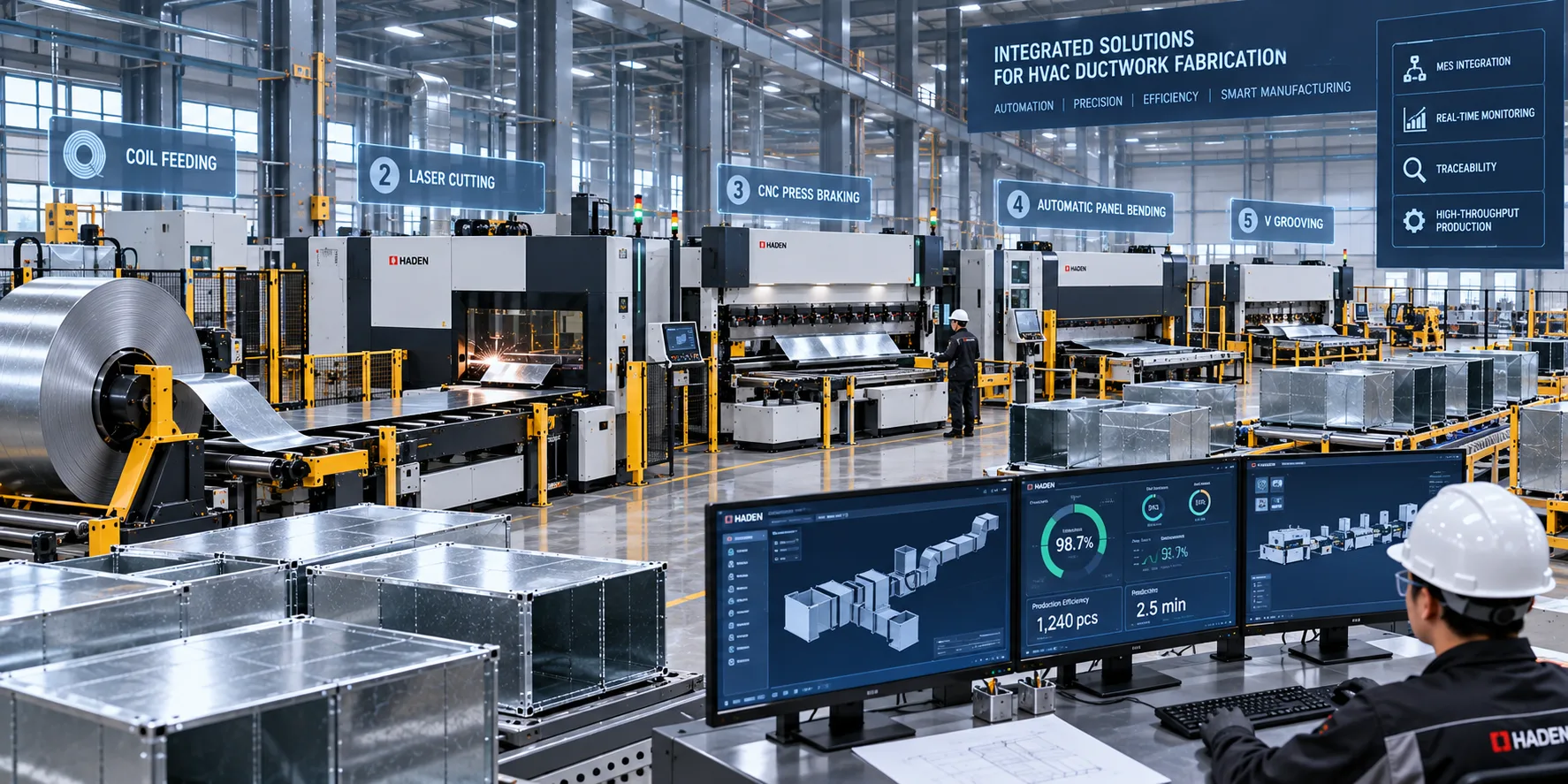
HVAC Line Engineering Comparison: Traditional Methods vs. Haden Automated Production
Performance Benchmark| Production Parameter | Conventional Manual Fabrication | Haden Automated Production Line |
|---|---|---|
| Material Infeed Method | Pre-cut standard flat sheets with high secondary scrap margins | Continuous direct master coil feed with integrated multi-roll leveling |
| Sheet Metal Utilization | 75% – 82% (Significant remnant loss on elbows, transitions, and offsets) | 92% (Dynamic common-line nesting across continuous coil stock) |
| AHU Panel Cycle Time | 70 – 120 seconds per part (Manual part manipulation and multi-tool changeovers) | < 18 seconds per part (Universal tooling on automated panel bender) |
| Surface Finish & Zinc Coating | Prone to tool drag abrasion, galling, and localized zinc flaking | Non-sliding rolling contacts maintain intact galvanized corrosion barriers |
| Duct Airtightness Class | SMACNA Class 1 / Class 2 (Variable seam closure and manual corner sealing) | Consistently achieves SMACNA Class 3 / Eurovent Class D airtight ratings |
Improve Productivity Across Your HVAC Sheet Metal Production Line
From coil-fed laser cutting and automated nesting to CNC bending and integrated material handling, Haden helps HVAC manufacturers evaluate opportunities to improve material utilization, shorten production cycles, maintain consistent forming quality, and reduce repetitive manual handling. Actual results depend on part geometry, material specifications, equipment configuration, and production volume.
Material Utilization
Evaluate coil-fed cutting and nesting strategies to reduce offcuts, improve blank layout, and make more effective use of sheet metal across ductwork and enclosure components.
Production Cycle Time
Assess automated panel bending and CNC forming configurations to streamline repeated bending operations, reduce manual repositioning, and improve production flow for HVAC panels.
Forming Consistency
Use controlled cutting, grooving, and bending processes to support repeatable panel dimensions and joint geometry. Final duct airtightness depends on assembly, sealing, and application-specific testing.
Production Automation
Explore automated feeding, part transfer, and forming-cell integration to reduce repetitive handling and coordinate operations across cutting, bending, and downstream production.
Engineering Precision: Airtight Duct Forming & Sheet Metal Surface Protection
HVAC energy-efficiency directives mandate stringent thresholds for ductwork leakage rates and structural corrosion resistance. Haden combines dynamic mechanical crowning, closed-loop servo angle monitoring, and mark-free folding kinematics across our specialized products to deliver sheet metal components that consistently satisfy SMACNA Class 3 and Eurovent Class D airtightness criteria while preserving protective galvanized coatings.
Precision Flange Forming for Zero-Leakage Duct Connections
In commercial ventilation systems, minute angular deviations across long transverse duct flanges (TDF/TDC) create corner joint gaps, inducing persistent static pressure drops and elevated fan energy consumption. Haden electro-hydraulic CNC press brakes eliminate cross-bed deflection using multi-axis dynamic mechanical crowning synchronized with real-time laser angle tracking across sheet lengths up to 4,000 mm.
The closed-loop CNC system actively counters variations in sheet thickness and material yield strength across blanks processed by high-precision sheet metal laser cutting machines. By ensuring a uniform 90-degree fold along the entire flange profile, duct sections mate with near-zero tolerance, minimizing mastic sealant consumption and preventing seam blowouts during high-pressure testing.
- ✓ SMACNA & Eurovent Compliance: Restricts envelope leakage to conform with SMACNA Class 3 and Eurovent Class D high-pressure ventilation standards.
- ✓ Dynamic Mechanical Crowning: Multi-wedge servo compensation maintains ±0.25° angle uniformity across 0.5 mm to 3.0 mm galvanized sheet runs.
- ✓ Consistent Flange Profiles: Uniform bend profiles ensure rapid corner-insert installation, flawless drive-cleat fitment, and automated seaming consistency.
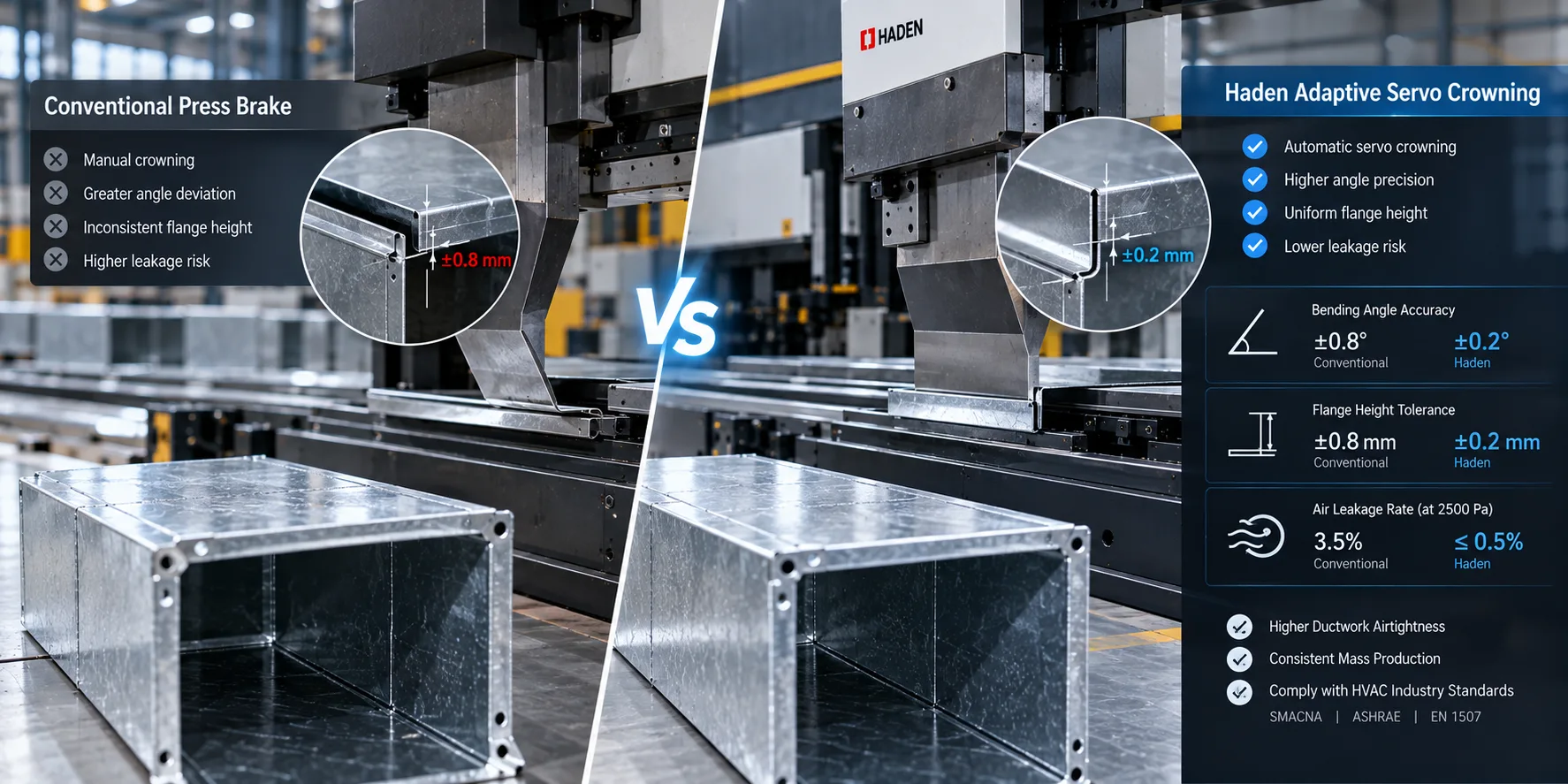
Flange Accuracy & Leakage Standards Comparison
Quantifiable performance metrics comparing conventional press brake operations against Haden adaptive servo crowning systems.
| Parameter | Standard Press Brake | Haden Servo System |
|---|---|---|
| Angle Tolerance (3m Length) | ±1.5° to ±2.0° | ±0.25° |
| Flange Corner Gap | 1.5 – 3.0 mm | < 0.3 mm |
| Airtightness Classification | Eurovent Class B | Eurovent Class D |
| Post-Bending Rework Rate | 8% – 12% | < 0.5% |

Galvanized Layer Protection Technology
Kinematic and tooling design parameters protecting pre-coated and galvanized surfaces during high-volume forming.
Folding blades roll along the bend radius without sliding across the surface, eliminating tool marks on pre-painted and galvanized sheet.
Specialized micro-polished, wear-resistant tool coatings eliminate zinc pickup and reduce die maintenance intervals.
Controlled bend radius distribution prevents micro-fracturing of the outer zinc coating during sharp 90° hem and channel folds.
Scratch-Free Panel Bending & Zinc Layer Protection
Air handling unit (AHU) double-wall insulated panels and acoustic louvers rely on heavy galvanized coatings (G90/Z275) or pre-painted architectural finishes for atmospheric corrosion defense. After precision profile cutouts are completed on high-speed laser cutting machines, conventional press brakes often force sheet metal across fixed V-die shoulders under heavy tonnage, generating friction drag that shears the outer zinc layer and exposes raw carbon steel to moisture and premature oxidation.
Haden intelligent panel benders utilize universal folding kinematics where servo-controlled bending blades rotate smoothly over the sheet face. Because the tooling rolls tangentially instead of scraping, the protective zinc passivation remains 100% intact across positive, negative, and hemmed folds without requiring secondary protective film.
- ✓ Mark-Free Kinematics: Eliminates surface scuffing, die scarring, and micro-flaking along external radius corners.
- ✓ Preserved Corrosion Resistance: Retains 1,000+ hour ASTM B117 salt spray resistance ratings on all formed structural edges.
- ✓ Hygienic Cleanroom Ready: Delivers mirror-smooth, crevice-free surfaces required for hospital-grade and pharmaceutical AHU enclosures.
Heavy monolithic side frames undergo full thermal annealing and stress-relieving, eliminating frame deflection under continuous multi-shift production.
Integrated dual-circuit thermal regulation stabilizes hydraulic oil viscosity and servo temperatures, ensuring consistent precision in varying climates.
Every Haden machine undergoes multi-point laser interferometer alignment and full-load dynamic testing before factory sign-off.
Frequently Asked Questions on HVAC Sheet Metal Machinery
Selecting the right sheet metal fabrication line directly dictates compliance with SMACNA Class A and Eurovent airtightness standards, preserves anti-corrosion galvanized coatings, and eliminates production bottlenecks. Explore detailed technical answers below to help your engineering and plant management teams configure the optimal equipment matrix across our specialized HVAC duct products range.
How does coil-fed laser cutting outperform traditional plasma or mechanical shearing for ductwork?
Conventional HVAC duct shops depend on mechanical guillotine shears for straight duct bodies and CNC plasma tables for elbow transitions, dampers, and custom take-offs. While plasma cutting processes heavy plate reliably, it introduces significant thermal and geometric limitations on light-gauge (0.5 mm to 1.5 mm) galvanized steel sheet metal. Continuous coil-fed fiber laser-cutting-machines resolve these fabrication challenges across four pivotal production areas:
1. Zinc Coating Preservation & Zero Heat Scorch
Fiber laser cutting utilizes an ultra-fine beam profile (spot diameter < 0.08 mm) combined with high-pressure nitrogen assist gas. The process suppresses thermal diffusion, preserving the protective zinc layer right up to the cut edge without burning or discoloration, which prevents premature rust along duct seams.
2. Dross-Free Edges for Instant Lock Seaming
Plasma cutting leaves dross and molten slag along the lower cut kerf that demands secondary angle-grinder clean-up. Coil-fed laser cutters produce clean, perpendicular, burr-free edges that pass immediately into Pittsburgh lock formers or Snap-Lock rolls without causing tooling jams or edge blowouts.
3. Simultaneous Notching, Piercing & Marking
A high-speed laser cutting head executes bolt holes, damper axle apertures, corner flanging cutouts, and part-identification etching in a single pass. This eliminates secondary hydraulic corner-notching stations, magnetic drills, and manual layout marking.
4. Continuous Strip Nesting Yields
Standard pre-sheared blanks (such as 4x8 ft or 5x10 ft sheets) generate severe edge and skeleton waste when cutting curved duct fittings. Continuous coil-fed lasers nest parts across infinite coil lengths, driving sheet material utilization up to 92–95% and lowering annual raw material expenditure by 12% to 15%.
Haden integrates precision decoiling, precision hydraulic roll leveling, and high-speed conveyorized blanking into advanced sheet-metal-laser-cutting-machines, enabling high-output ductwork manufacturers to convert master coils into fully processed flat blanks with minimal operator intervention.
Can automatic panel benders process varying gauges of galvanized and stainless steel without manual tooling changeovers?
Yes, absolutely. The primary engineering advantage of an automatic panel bender in air handling unit (AHU) casing, double-wall acoustic panel, and access door production lies in its universal segmented bending tool architecture. Unlike conventional press brakes that demand physical punch-and-die swaps when switching between 0.6 mm galvanized outer skins and 1.5 mm stainless steel hygienic liners, automated panel benders use servo-driven universal blades controlled entirely by software:
- ✓Servo-Controlled Blade Trajectory: Upper and lower folding blades move in precisely interpolated elliptical paths. Flange angles, internal bend radii, and hemming closures are defined digitally inside the CNC program rather than governed by physical V-die openings.
- ✓Adaptive Springback Compensation: Galvanized carbon steel and 304/316 stainless steel possess distinct tensile strengths and springback rates. Integrated sensor modules measure real-time deflection forces on the first stroke and calculate angular over-bending dynamically, holding ±0.5° accuracy across mixed batches.
- ✓Surface-Protection Rolling Forming: Conventional press brake tooling causes sliding friction that scratches galvanized spangle and scuffs pre-painted coil stock. Panel bender folding blades roll progressively across the bend line, ensuring pristine surfaces free of cosmetic gouges or anti-corrosion layer degradation.
Haden panel benders also incorporate automatic blank-holder segment positioning. Internal actuators reconfigure tool widths in seconds to clear upright side flanges, making them the optimal solution for high-mix, custom-dimension HVAC unit casing production.
How should an HVAC plant choose between a CNC press brake and an automatic panel bender for AHU cabinet panels?
Both CNC press brakes and automatic panel benders serve essential functions in modern HVAC facilities. The ideal machine selection centers on panel geometries, daily output requirements, plate gauge, and available labor. Use the technical comparison framework below to determine the best fit for your manufacturing workflow:
| Evaluation Parameter | Automatic Panel Bender | CNC Hydraulic / Servo Press Brake |
|---|---|---|
| Target HVAC Workpieces | AHU double-skin panels, acoustic wall cassettes, roof hoods, square casing covers | Structural corner posts, heavy base channels, deep U-profiles, multi-fold structural struts |
| Cycle Time per Component | < 18–35 seconds (full 4-side perimeter folding & hemming) | 90–180 seconds (requires continuous manual sheet lifting & rotation) |
| Material Thickness Window | 0.5 mm to 2.5 mm (ideal for sheet metal skins and cassettes) | 0.8 mm up to 6.0 mm+ (ideal for structural framework and support brackets) |
| Tooling Setup Downtime | Zero mechanical tool changes; instant digital CAD/CAM recall | 10–30 minutes for manual segmented punch and V-die changeover |
| Labor Dependency | Single operator feed or lights-out robotic loading integration | Demands experienced brake technicians; large sheets require dual operators |
Application Recommendation: Operations fabricating more than 150 panel skins per shift realize rapid capital payback by deploying an automatic panel bender for exterior and interior covers, paired with a heavy-duty CNC press brake dedicated to AHU structural corner posts, base stringers, and thick damper components.
What extraction systems and maintenance configurations prevent zinc dust buildup during high-volume cutting and bending?
Processing galvanized sheet metal generates airborne zinc oxide micro-particulates and oily residue. Without specialized mitigation, conductive zinc dust can settle on laser optics, foul linear guide ways, and accelerate mechanical bearing wear. Heavy-duty fabrication cells rely on three vital protective engineering systems:
Partitioned Dynamic Downdraft Extraction
On coil-fed laser cutters, pneumatic suction baffles open strictly beneath the active cutting head position. Delivering 4,500 to 6,500 m³/h vacuum airflow directly below the focal point captures 99.4% of vaporized zinc particulate, venting it into spark-arresting pulse-jet filtration units before it can settle across machine guideways.
Pressurized Bellows & Multi-Lip Wiper Enclosures
Linear guides, precision ground ball screws, and rack-and-pinion drives run inside fully sealed enclosures supplied with continuous positive air pressure. This creates an outward airflow barrier that prevents microscopic zinc dust ingress, while scraper wipers remove accumulated lubricant paste.
Automated Pulse Lubrication & Flange Purging
CNC controllers execute metered lubrication cycles tied directly to operational motion distance. Positive grease flow flushes out minute metallic debris through purge channels, maintaining smooth mechanical movement and protecting machine reliability over continuous 24/7 operating cycles.
Haden equips every automated HVAC cell with standard maintenance diagnostics that alert operators when filter delta-pressure thresholds are exceeded, ensuring consistent shop-floor air quality and zero unplanned machine downtime.
Planning an HVAC Sheet Metal Machinery Upgrade?
Share your HVAC components, material specifications, production requirements, and factory layout. Haden engineers can help you evaluate suitable cutting, bending, forming, and automation configurations for your manufacturing project.
Plan Your Next HVAC Sheet Metal Production Line with Haden
Whether you are expanding ductwork production, upgrading AHU enclosure fabrication, or integrating automated cutting and bending equipment, Haden can help you evaluate machinery configurations based on your components, material specifications, production targets, and available factory space.
Application Review
Evaluate part geometry, sheet material, thickness range, and forming requirements.
Machine Configuration
Explore suitable cutting, bending, grooving, and coil-processing equipment.
Line Integration
Discuss material handling, production flow, and automation requirements.
Prefer to discuss your requirements directly? Email Haden | WhatsApp
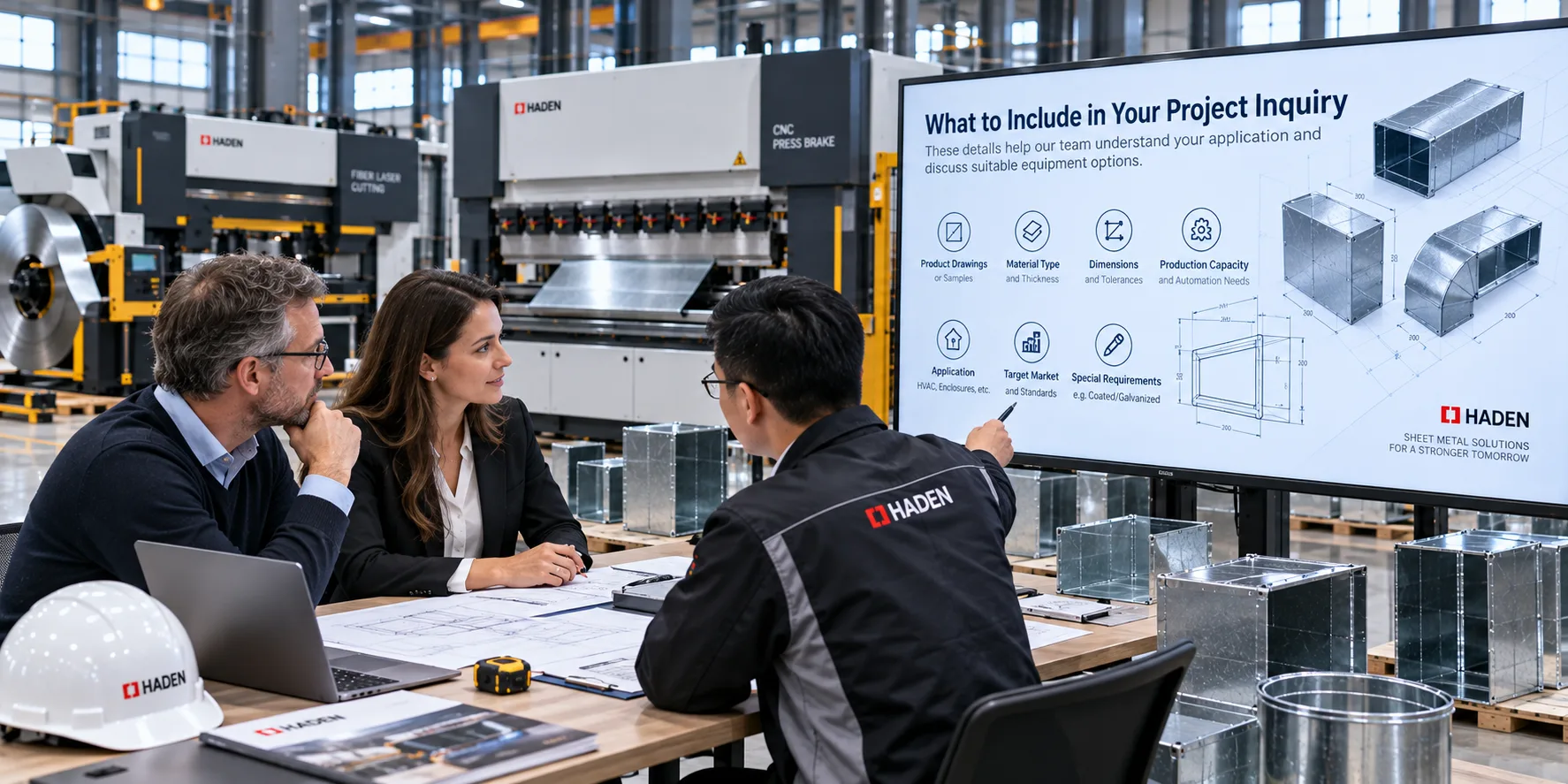
What to Include in Your Project Inquiry
These details help our team understand your application and discuss suitable equipment options.
Ductwork, AHU panels, fire dampers, or ventilation components.
Sheet material, thickness range, blank size, and part drawings.
Target output, equipment preferences, and automation needs.
Available floor space and existing production equipment.
You can send drawings, CAD files, and additional specifications to info@hadenmachinery.com for further discussion.